The Haunting Song of Inca Whistling Vessels

Ancient Inca “whistling vessels” (huaco silbadores in Spanish) could mimic animal calls—powered by nothing more than air and water. As water moves between connected chambers, it forces air through hidden whistles, releasing haunting, lifelike sounds.

These remarkable ceramics, found across several pre-Columbian cultures including the Inca, Chimu, and Moche, date back more than 2,000 years. Often uncovered in tombs and ceremonial sites, they likely played a role in rituals to honor nature, communicate with spirits, or accompany sacred ceremonies—though their exact purpose remains a mystery.

Rediscovering Flutex: Simple Glass, Complex Illusions

I’ve been toying with the idea of revisiting an old, low-key material for my art: Flutex.

If you haven’t heard of it, Flutex is a patterned industrial glass from the 1930s and ’40s, mostly used to give a bit of privacy in bathrooms and office partitions.

In the ’70s, Op artist Sydney Cash started playing with this glass and found that its ribbed surface works like a lenticular screen—showing different images depending on how you look at it. The effect? Hypnotic, shifting artworks that change as you move around them.

It’s just simple glass, but it tricks perception in a really cool way.

I’m seriously considering giving it a try myself—there’s something about that mix of humble material and complex visual play that feels worth exploring again.

The Art of Discovery Between a Question Mark and an Exclamation Point

Science — like art — doesn’t really speak in the indicative. It doesn’t say this is, it asks what if? It begins in the conditional, in the open-ended curiosity of what could be, and unfolds in the imperative, the bold call to look, try, observe.

Discovery doesn’t start with answers — it starts with a question. And when it arrives, it rarely comes wrapped in neat descriptions. It comes as a gesture, a provocation, a set of instructions that invite us to experience something for ourselves.

Think about it: no one learns to cook from a description of flavor. They follow a recipe — a list of directives. A musician doesn’t explain the music in his head; he writes a score. And when we follow it, sound becomes experience. The composer’s vision is reborn in the hands of another.

In my own work, I do much the same — though my instrument is perception, and my notes are lines, colors, forms. Each visual illusion, each image, is a kind of instructional code. Not a description of what’s there, but an opening. If you engage with it, something clicks — not because I told you what to see, but because the form guided your eyes to see it for yourself.

G. Spencer Brown wrote that the act of drawing a distinction is the first creative move — a way of bringing something into being. In that spirit, I don’t aim to define the world. I aim to make space for new ways of seeing it.

So perhaps the real language of both science and art isn’t declarative at all.

It’s performative. It doesn’t tell you what reality is — it dares you to experience it.
And in that challenge, something unexpected happens:
You discover not just what the world could be — but what you might be within it.

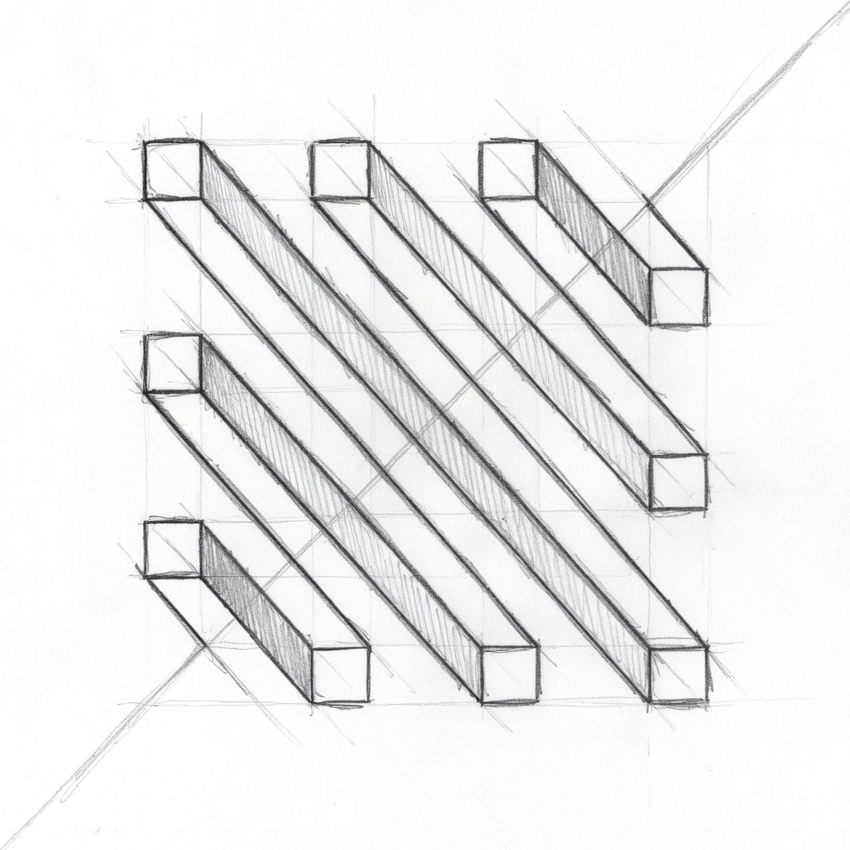
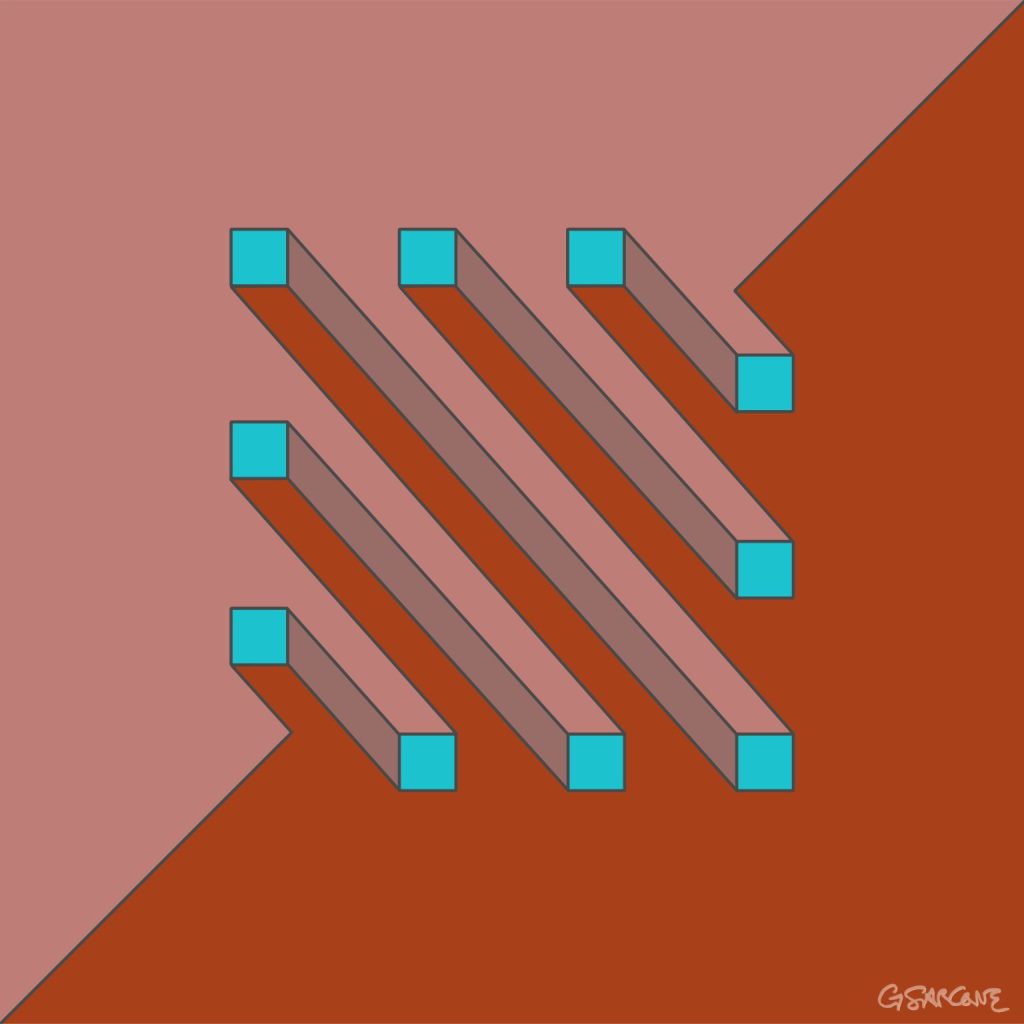
Title: Follow the Light
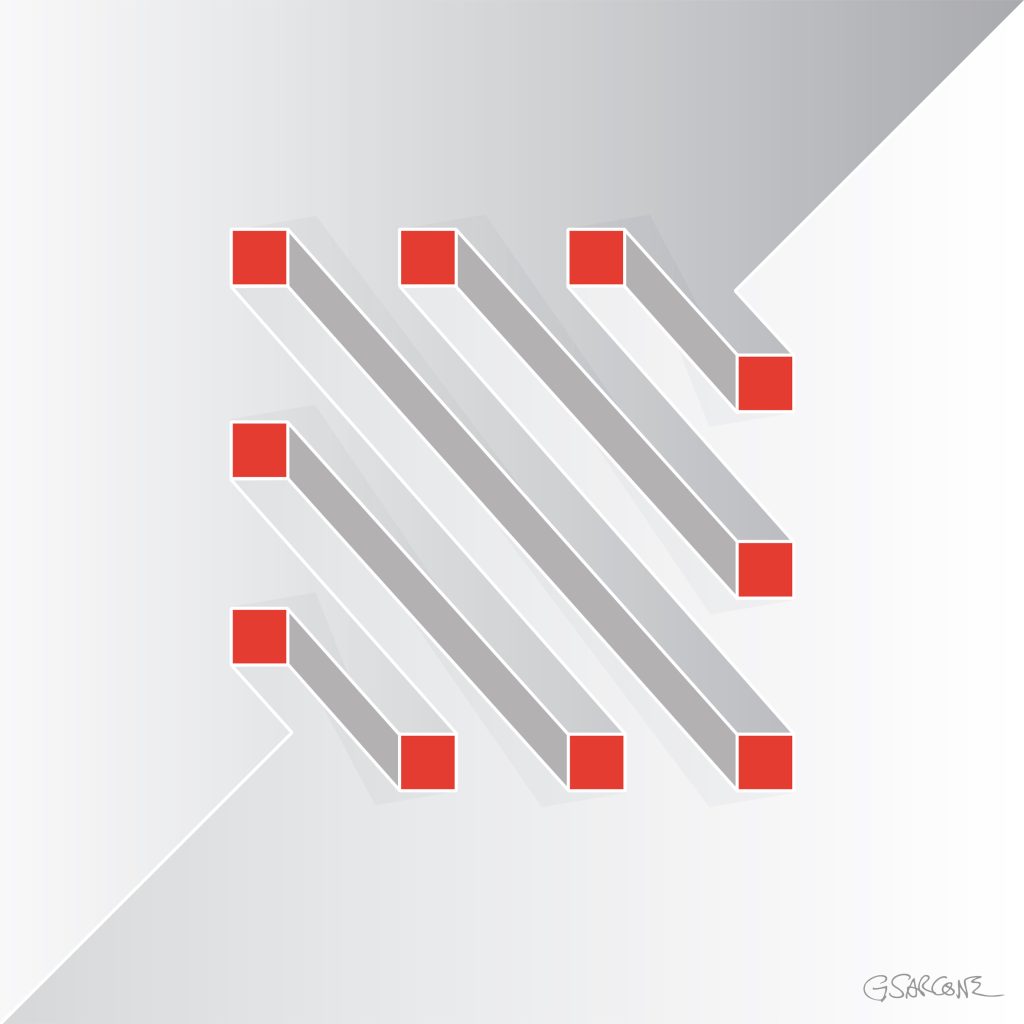
“Follow the Light” – A visual imperative that pulls the eye into the unknown. This piece doesn’t describe — it directs. It doesn’t tell you what to see — it invites you to find out. Available as a fine art print.

Silent Messengers from the Past

The Etruscans, a non-Latin people who settled in central Italy long before the rise of Rome, integrated so thoroughly into Roman society that much of their culture became embedded in the very foundations of Roman civilization. Among the many features that set Etruscan society apart was the relatively high status of women, who enjoyed greater visibility and social agency than their Greek and early Roman counterparts—a fact evident in both public life and funerary art.

Although their language—unrelated to Indo-European tongues and still only partially deciphered—eventually disappeared, it left a subtle yet lasting imprint on Latin, especially in religious, architectural, and political vocabulary. Etymologists trace several Latin terms, and later English derivatives, to Etruscan roots or influences, though some remain debated.

For example, Februarius (February) derives from Februa, a Roman purification festival likely influenced by an earlier Etruscan rite of cleansing. The name Aprilis (April) is less certain but may reflect pre-Latin seasonal traditions or deities with Etruscan ties. The Latin word satelles, meaning “attendant” or “bodyguard” and later giving rise to the English satellite, is sometimes linked to Etruscan social roles, though its origin is not definitively established.

Architectural terms such as atrium—the central hall of a Roman house—and templum, referring to a sacred space defined by augurs, clearly reflect Etruscan religious and spatial concepts adopted by the Romans. The theatrical term persona, originally meaning “mask” and later “character,” has a debated origin; while some suggest Etruscan roots, it may equally derive from Latin elements related to sound and speech. Similarly, the word antenna, referring to a ship’s yardarm, is occasionally attributed to Etruscan nautical vocabulary, though this remains speculative.

Despite the eventual loss of their language, the Etruscans’ cultural legacy endures—not only in Latin vocabulary but also in the ceremonial, artistic, and institutional foundations of Rome, and by extension, Western civilization.

Etruscan feminine statue
Statuette of an Etruscan noblewoman holding a soul-bird, a symbol of the journey to the afterlife. Found in the necropolis of Vulci, one of Etruria’s major burial sites, and dating to the late 6th or early 5th century BCE. Her braided hairstyle and close-fitting cap reflect elite Etruscan fashion. Though influenced by Archaic Greek sculpture, the figure embodies the distinctly Etruscan reverence for ritual, death, and the feminine.

· Further reading: List of English words of Etruscan origin.

The Wisdom of the Worn Path

Urban planners lay out beautiful, winding walkways with elegant curves, perfect symmetry, and just the right amount of gravel. And yet — within weeks — a dirt trail appears straight across the lawn, stubbornly cutting through flowerbeds, ignoring benches, signs, and sometimes, logic.
That trail? It’s called a “desire line.”
Or, more poetically, the path of people who have better things to do.
Desire lines are the world’s most honest feedback forms — no words, no complaints, just footprints. They’re not designed by committees. They’re carved by experience, laziness, impatience, and occasionally, sheer brilliance. A true grassroots movement (quite literally), paved not by asphalt, but by intent.
What makes them fascinating isn’t merely their function as shortcuts — they reflect what we actually value: efficiency, clarity, simplicity. They show how the world rewrites itself without asking permission. Nature may abhor a vacuum, but humans clearly loathe unnecessary detours.
There’s a quiet lesson here:
Sometimes, the straight line is more than just the fastest route — it’s a subtle form of resistance.
So go on — question the path laid out for you. You just might leave a better one behind.

· Further reading

Relative Size Illusions

Here are two relative size illusions I described back in 1997 and 2013.

The first, called Sarcone’s Crosses, challenges classic illusions like the Ebbinghaus illusion (Titchener Circles, 1898) and the Obonai square illusion (1954). It features a cross (the test shape) surrounded by squares of different sizes.

As shown in Fig. 1.a, 1.b, and 1.c, the three blue crosses are all the same size — yet the one on the left (Fig. 1.a) appears larger. Surprisingly, the illusion still works even when smaller squares completely cover the cross (Fig. 1.c).

So, the size of surrounding shapes doesn’t always dictate how we perceive the central one.

In the second illusion (Fig. 2.a and 2.b), due to assimilation, the red diagonal inside the larger ellipse seems longer — but the blue line is actually the longest.

Perception loves to play tricks on us.

sarcone's relative sizze illusions

You can explore more of my illusions and visual inventions on my official site: giannisarcone.com

The Race Westward — When the Jobless, the Indebted, and the Persecuted Became “Pioneers”

Behind the founding myth of the Westward Expansion lies a far less romantic truth: it was often a desperate migration of society’s outcasts. Unemployed men with no future, families crushed under debt, the persecuted looking for refuge — all were rebranded as “pioneers,” dressing up a harsh reality of flight rather than conquest.

Whenever production outpaces consumption, surplus follows. To offload the excess, people are encouraged to buy on credit — in other words, to go into debt. But that debt, inevitably, becomes unmanageable. Then come the bankruptcies, which, paradoxically, help the system reset: debts are recycled*, pulverized, erased, assets devalued, and a fresh cycle of borrowing and spending begins.

This is the hidden engine of our modern economy: a cycle of overproduction, credit dependency, and collapse. It’s a loop built not on balance, but on instability — propped up by the illusion of prosperity. And it’s this very loop that has always propelled the push Westward, toward lands supposedly rich, fertile, and full of promise. Toward an Eldorado — but one too often built on the backs of those who arrive too late or with too little.

Today, this “race to the West” is no longer just geographic. It’s symbolic. The West, or the so-called ‘Occidental’ world — from the Latin occidere, “where the sun sets” — still carries a double meaning: a place of wealth and power, but also the fading echo of a colonial order. The poor of the Global South, driven by poverty or war, still flock toward this West they resent — and yet still associate with survival, even hope. They flee what they reject… heading straight toward what they distrust.

But now, the direction is reversing. It’s no longer the poor who are fleeing, but the rich who are leaving. A mobile, fluid elite sets up home wherever money flows more freely: the United Arab Emirates, Kuwait, Singapore, Hong Kong… ultraliberal enclaves with light taxes, minimal state presence, and few social or environmental constraints.

This new exodus isn’t a gold rush — it’s an escape from reality. The ultra-wealthy are no longer interested in reshaping the world. They want out. They build bubbles — sanitized havens, detached from chaos — while the rest of the world scrambles for stability within a system that offers little more than illusion.


* Debt recycling is the latest fashion in our parasitic economy. Enter a new breed of vampires: the NPL investors. Operating globally, they scoop up bundles of “written-off” or hopelessly delinquent debt for a pittance — cents on the dollar. Think of them as the scrap merchants of finance: scavengers who profit from financial ruin. Through “legal” (often skirting the edge of the lawful), data-driven, or aggressive collection methods, they manage to squeeze a few drops of value from the wreckage. Their business model? “We buy trash for nothing, shake it hard, and once in a while, a few coins fall out.

Illusive Pietà

Uncovering the subtle visual tricks Michelangelo wove into his masterpiece.

We’re not very good at judging the true size and positioning of objects just by looking. Take Michelangelo’s Pietà—it hides some subtle, conceptual “illusions”:

  • If they were standing, the Virgin Mary would actually be much taller than Christ, which may be surprising.
  • Her knees are slightly off-center, forming a kind of base or pedestal that supports Christ’s body.
  • And while logically the Virgin should look older, her face is almost childlike, creating a striking contrast with the mature, somber face of her son.

Michelangelo himself explained this choice:
“The mother had to be young—young enough to appear forever a virgin. Meanwhile, her son, who took on our human nature, must, in the stripping away of death, be a man like any other.”

Art is full of illusions designed to meet the visual expectations of viewers—and sometimes to correct what might seem off or unnatural to the eye. Because reality, at times, doesn’t always feel quite real or right to those who look at it.

And one last curious detail: Pietà is the only work Michelangelo ever signed. Stung by whispers that another sculptor had made it, he returned one night and boldly carved his name across Mary’s sash— “MICHAELA[N]GELVS BONAROTVS FLORENT[INVS] FACIEBAT” (Michelangelo Buonarroti, the Florentine, made this). A rare flash of pride from an artist who usually let his work speak for itself.)

Pietà by Michelangelo

The First Hero’s Quest for Immortality

The Epic of Gilgamesh is the oldest known long-form poem in history—predating the Bible, The Iliad, and even the Mahābhārata. Often hailed as the first great work of world literature, this ancient Babylonian epic tells the story of a mighty hero, king of Uruk, who embarks on a quest for immortality. Its timeless themes—love, friendship, grief, the fear of death—still speak to us with surprising clarity.

Originally transmitted orally, the poem was later inscribed in cuneiform on clay tablets. The version we know today was written in Akkadian, the lingua franca of the Babylonian Empire, over four thousand years ago. For centuries, the text was lost to history—until its rediscovery in fragmented form during the nineteenth century sparked renewed interest.

The tale begins with Gilgamesh, a powerful yet restless king, and Enkidu, a wild man created by the gods to challenge him. After a dramatic contest of strength, the two become inseparable companions. They journey to the sacred Cedar Forest, where they slay its divine guardian, Humbaba. When Gilgamesh rejects the goddess Ishtar, she unleashes the Bull of Heaven. The two heroes kill the beast—an act that angers the gods, who punish them by taking Enkidu’s life.

Stricken by grief, Gilgamesh sets out on a perilous journey in search of eternal life. He ultimately meets Utnapishtim, a flood survivor granted immortality by the gods. From him, Gilgamesh learns a harsh truth: death is man’s destiny; immortality belongs only to the divine.

More than a heroic saga, The Epic of Gilgamesh established the prototype for later epic heroes—from Heracles to Odysseus—and continues to inspire writers and artists today. Its enduring influence stretches across millennia and cultures.

In Forests, Robert Pogue Harrison draws on The Epic of Gilgamesh to explore the symbolic power of forests in the Western imagination. Gilgamesh’s felling of the sacred cedars and slaying of Humbaba reflects humanity’s first mythic confrontation with nature—marking the forest not as sanctuary, but as territory to be mastered. For Harrison, this moment signals the dawn of civilization’s long, uneasy relationship with the wild.

To truly grasp the spirit of the ancient world, I encourage you to read The Aeneid by Virgil, Homer’s Iliad and Odyssey, as well as the timeless Mahābhārata and The Epic of Gilgamesh. These foundational texts continue to illuminate the hopes, fears, and questions that have shaped human thought across the ages.

Gilgamesh