Sarcone: The Willow

My surname Sarcone, attested as early as circa 1150, may reflect a phytotoponym derived from the Latin salix, salĭcis, “willow,” with the collective or augmentative suffix -ōne. A possible evolution is salicōne → salicone → sar(i)cone, through the phonetic changes that shaped the name over time.
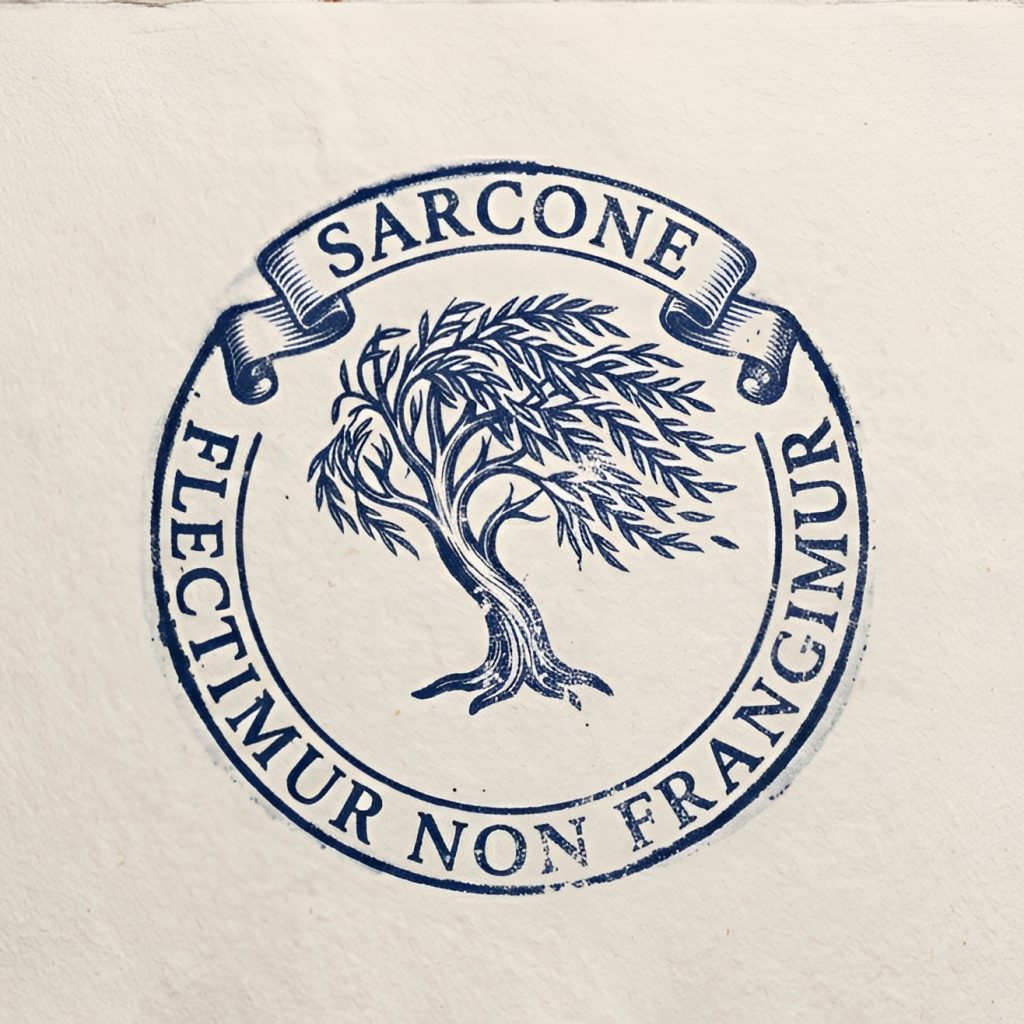
I like to think that my name is connected to nature, and especially to this magnificent tree: the willow. The willow has always fascinated me for its resilience, flexibility, and capacity for renewal. It bends without breaking, withstands the wind, and grows back vigorously after being cut. Its strength comes from its flexibility.

That symbolism speaks to me. Life constantly changes, and resisting every change is not necessarily a sign of strength. Sometimes you have to bend, adapt, and keep going without losing your roots.

The willow is also traditionally associated with the cycles of the Moon, imagination, dreams, intuition, and flexibility of mind. I find these associations particularly fitting, since much of my work concerns perception, imagination, and the strange ways in which the mind constructs what we call reality.

My name also has an ancient Indo-European root. Salix is related to the Indo-European root *səlik, with cognates such as Greek helíkē and related forms in Celtic and Germanic languages.

I like the idea that a surname can carry such a long memory. A few letters inherited from the past can still evoke a tree, its roots, its branches, its movement in the wind—and, in some small way, the person who carries its name.

Sarcone: the willow. Rooted, flexible, resilient, and always capable of growing again.

Silent Messengers from the Past

The Etruscans, a non-Latin people who settled in central Italy long before the rise of Rome, integrated so thoroughly into Roman society that much of their culture became embedded in the very foundations of Roman civilization. Among the many features that set Etruscan society apart was the relatively high status of women, who enjoyed greater visibility and social agency than their Greek and early Roman counterparts—a fact evident in both public life and funerary art.

Although their language—unrelated to Indo-European tongues and still only partially deciphered—eventually disappeared, it left a subtle yet lasting imprint on Latin, especially in religious, architectural, and political vocabulary. Etymologists trace several Latin terms, and later English derivatives, to Etruscan roots or influences, though some remain debated.

For example, Februarius (February) derives from Februa, a Roman purification festival likely influenced by an earlier Etruscan rite of cleansing. The name Aprilis (April) is less certain but may reflect pre-Latin seasonal traditions or deities with Etruscan ties. The Latin word satelles, meaning “attendant” or “bodyguard” and later giving rise to the English satellite, is sometimes linked to Etruscan social roles, though its origin is not definitively established.

Architectural terms such as atrium—the central hall of a Roman house—and templum, referring to a sacred space defined by augurs, clearly reflect Etruscan religious and spatial concepts adopted by the Romans. The theatrical term persona, originally meaning “mask” and later “character,” has a debated origin; while some suggest Etruscan roots, it may equally derive from Latin elements related to sound and speech. Similarly, the word antenna, referring to a ship’s yardarm, is occasionally attributed to Etruscan nautical vocabulary, though this remains speculative.

Despite the eventual loss of their language, the Etruscans’ cultural legacy endures—not only in Latin vocabulary but also in the ceremonial, artistic, and institutional foundations of Rome, and by extension, Western civilization.

Etruscan feminine statue
Statuette of an Etruscan noblewoman holding a soul-bird, a symbol of the journey to the afterlife. Found in the necropolis of Vulci, one of Etruria’s major burial sites, and dating to the late 6th or early 5th century BCE. Her braided hairstyle and close-fitting cap reflect elite Etruscan fashion. Though influenced by Archaic Greek sculpture, the figure embodies the distinctly Etruscan reverence for ritual, death, and the feminine.

· Further reading: List of English words of Etruscan origin.