Convex / Concave, it all depends on your point of view!
Although the plates are the same, in the second picture, the indents of the egg plate look more like convex domes rather than concave indents.


Convex / Concave, it all depends on your point of view!
Although the plates are the same, in the second picture, the indents of the egg plate look more like convex domes rather than concave indents.
This is one of my earliest color optical illusions. There is no yellow or green in the diamond shapes, just vertical black lines! (If you don’t believe it, use a eyedropper tool to check it.) This intriguing visual effect is mainly due to “simultaneous color contrast induction“.

This is one of my oldest illusions I created in the 90s. In the picture you may see ghostlike dark radial beams. This illusion is a variant of the Herman’s scintillating grid illusion. I designed this illusion just by turning 45 degrees the Herman grid and then by applying a polar transformation.

Our visual system can interpret colors and shades in surprising ways. This 3×3 Tic-Tac-Toe grid, for example, showcases how easily our perception of brightness can be fooled.
Do you notice anything unusual in the grid below?

The looping animation below brings the illusion to life, revealing the trick in action. That large green square behind the grid isn’t actually uniform—it’s made up of alternating dark and light green squares. Our visual system works like a “comparative computer”. In fact, we never see colors in isolation, as the appearance of any color is affected by the colors surrounding it. So, under certain conditions, colors that are identical may appear different, while colors that are different may look the same. In our visual system there is a mechanism that enhances the contrast of the outline of an object relative to its background: it is called “lateral inhibition”.
Show / Hide the Trick
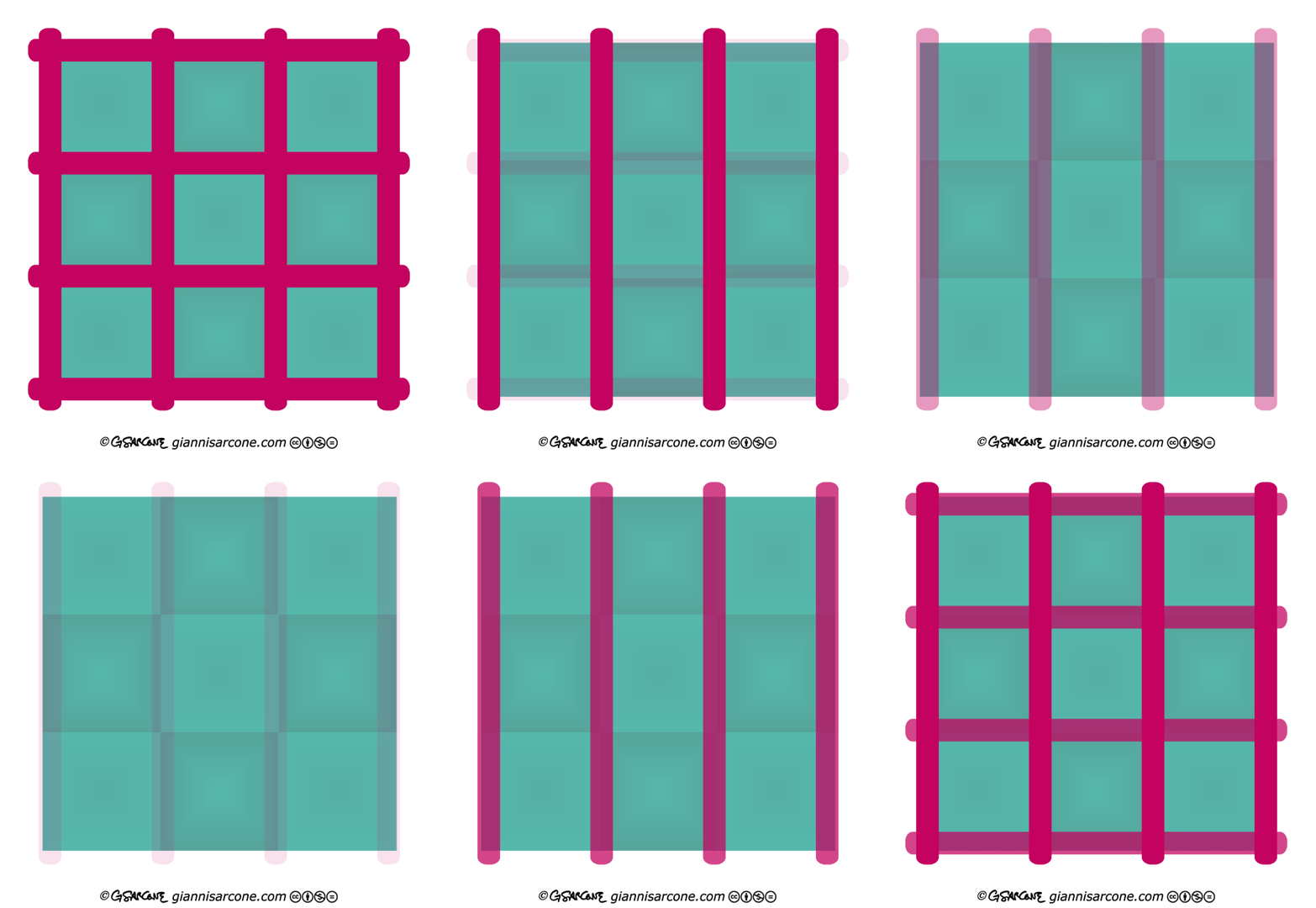
Thus, even small differences in brightness between adjacent zones, or objects, are deliberately increased by our visual system and the brain to better distinguish them. But something strange happens when the brightness boundaries of the color zones are concealed: the cues the brain needs to trigger the lateral inhibition no longer exist and consequently we become blind to variations in color brightness, as shown in the animated gif.
Recognitions
My optical illusion “Magic Tic-Tac-Toe” has been chosen to be among the top 10 finalists for the “2019 Best Illusion of the Year Contest”
I am working on a new two-dimensional variant of the Müller-Lyer illusion… You may be surprised to know that the Müller-Lyer illusion isn’t only linear: it involves plane geometry too! In fig. A shown below, the ends of the blue and red collinear segments, arranged in a radial fashion around a central point, delimit two perfectly concentric circles. However, for most observers, they seem instead to define a large ovoid that circumscribes another one, slightly eccentric (Fig. B). This comes from the fact that the red segments seem to stretch towards the lower part of the figure, while the blue segments seem to stretch towards the upper part of the same. As you can see, in this variant comes also into play the “neon color spreading” effect. In fact, a bluish inner oval-like shape appears within the black arrow heads (Fig. A), though the background is uniformly white.
