The blue and yellow arrows in this video seem to move up and down in a rhythmic dance—yet their motion is strictly horizontal and uniform. This illusion is a variation of the “Stepping Feet Motion” effect, first demonstrated by Stuart Anstis in 2003.
In the original phenomenon, two objects glide side by side at a constant speed across a striped background, but appear to alternately speed up and slow down, creating a stepping or oscillatory effect. The visual system misreads contrast differences as changes in motion, producing a false sense of vertical or staggered movement.
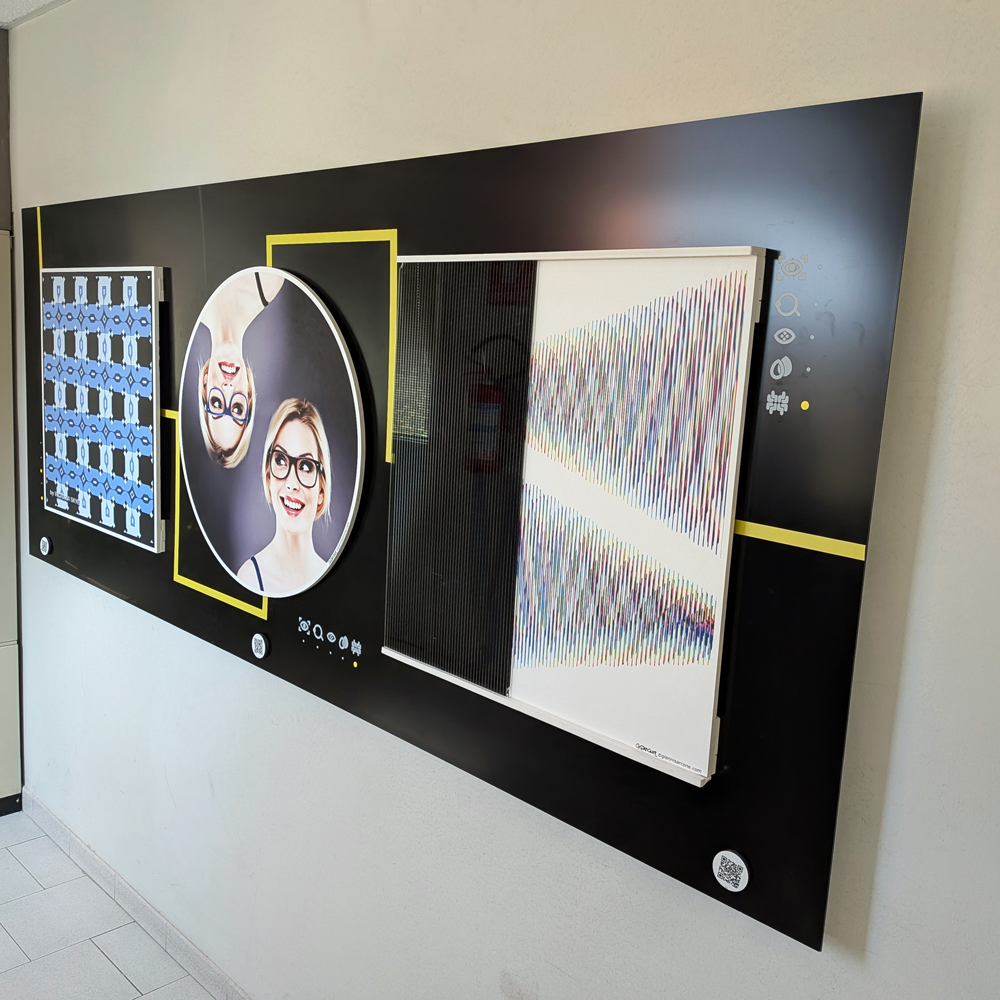
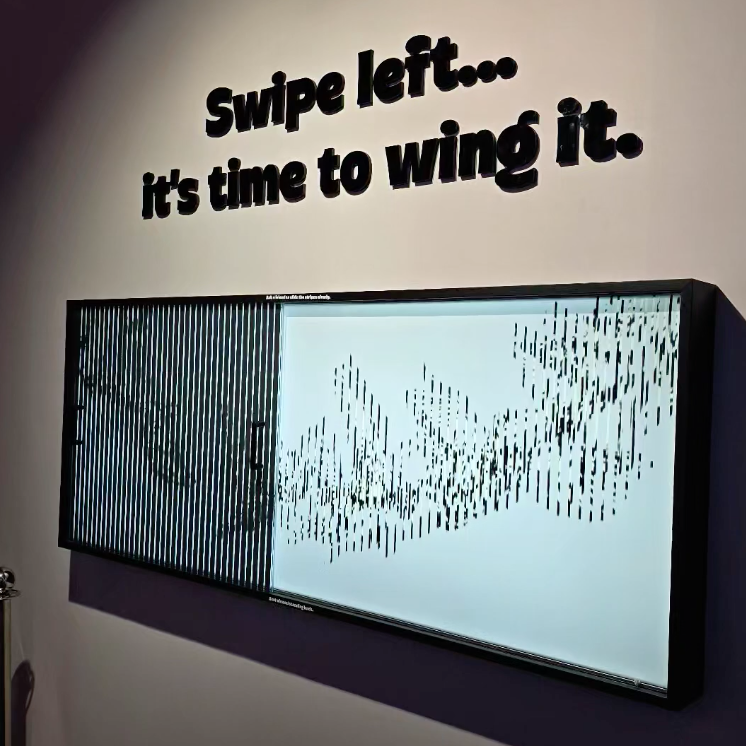
Here are two Kinegram installations I made, designed to educate, engage, and spark curiosity in visitors of all ages. These works make motion appear from static forms, offering an experience that is both playful and thought-provoking.
Kinegrams reveal movement through a sliding transparent panel printed with vertical black lines. As the panel moves over the underlying image, hidden sequences appear, animating the drawings like frames of a film. Each interaction lets the viewer explore how motion can emerge from stillness.
The concept of movement from static forms has long interested scientists and philosophers. Movement is a dimension unfolding in space and time—without time, there is no motion. Kinegrams make this idea tangible through touch and visual perception.
These exhibits are simple to set up but produce surprising results. I made the first panel for UNIFI, the University of Florence, and the second for the Mind Games Art Alive Museum in Sydney. Both projects engage and surprise visitors, combining education with visual impact.
“Twisting Cords,” Kinegram exhibit for UNIFI, Florence As the transparent panel etched with black lines glides across the design, colorful cords seem to twist, winding and unwinding in a mesmerizing, living rhythm.
“Flying Birds – Migration,” Kinegram exhibit for Mind Games, Sydney As the transparent panel etched with black lines glides across the static design in the background, the flock of birds rises and takes wing, transforming a still pattern into living, rhythmic motion.
A simple study in visual perception—an exploration of how a plain hexagon can evolve into the illusion of a cube. Through precise geometry and controlled form blending, static lines awaken into rhythm and volume, giving rise to a subtle sense of depth and movement.
Constructing the Illusion
Fig. A — The Base Shape Start with a regular hexagon. Divide it into three equal diamond shapes (rhombuses)—these represent the three visible faces of the cube. Each diamond has four equal sides: two acute angles (60°) and two obtuse angles (120°). Together, they form the geometric foundation of the cube.
Fig. B — Building Volume with Shape Blends In Illustrator, or any other vector software, use the Blend Tool to create a shape blend inside each diamond. Start with a small central circle and blend it toward the outer edge of the diamond. Adjust the number of blend steps to control how smooth or tight the transition appears. This process builds the cube’s apparent volume and visual tension. You’ll notice that the distance from corner to corner in the nested, diamond-like shapes is slightly greater than from side to side, creating subtle gaps that lead the eye to perceive an X across the surface.
Fig. C — Perspective and Transformation Distort slightly the hexagon to set the three diamonds in perspective. This step transforms the flat figure into a die-like cube, giving it spatial depth and presence.
Enhancing the Optical Effect Next, add horizontal background lines and some color, as shown in the two examples in the image. You can also adjust the illusion by making the visible faces of the die appear slightly concave, as in the figure on the right. This effect is created by shifting the concentric, nested diamond shapes slightly off-center—the position of the central ellipse determines whether the die appears concave or convex.
Below is the finished stage of the work. Curiously, the cube appears to hover, slide, and even emit a faint blue glow—though it remains entirely black and motionless. Ananke’s Die is a study I began in 2010, a continuing exploration of how repetitive lines and geometric precision can trick the mind into sensing motion and color where none exist.
You can get Ananke’s Die as a fine art print or canvas, available in different sizes and finishes. 👉 Buy it here
Why Ananke’s Die
I titled this work Ananke’s Die after Ananke, the Greek goddess of necessity and fate. The cube, a symbol of structure, represents order and control. Yet the three visible faces that seem to define its volume are an illusion—shifting and unstable. Under the viewer’s gaze, the shape changes, its meaning shifts, yet the form remains. This illusory die shows the balance between order, perception, and destiny, reminding us that what we think we control often exists within the unpredictable interplay of vision and inevitability.
This image also triggers multiple associations in a loop: hexagon, cube, die, chance, illusion, order, fate, contradiction. These connections show how perception mixes stability and randomness, revealing that what we see is shaped as much by the mind as by reality.
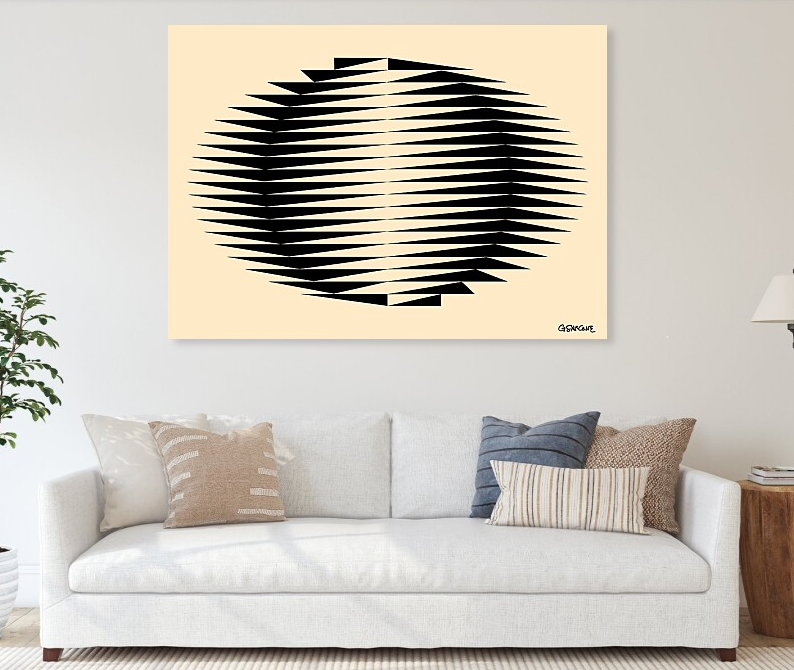
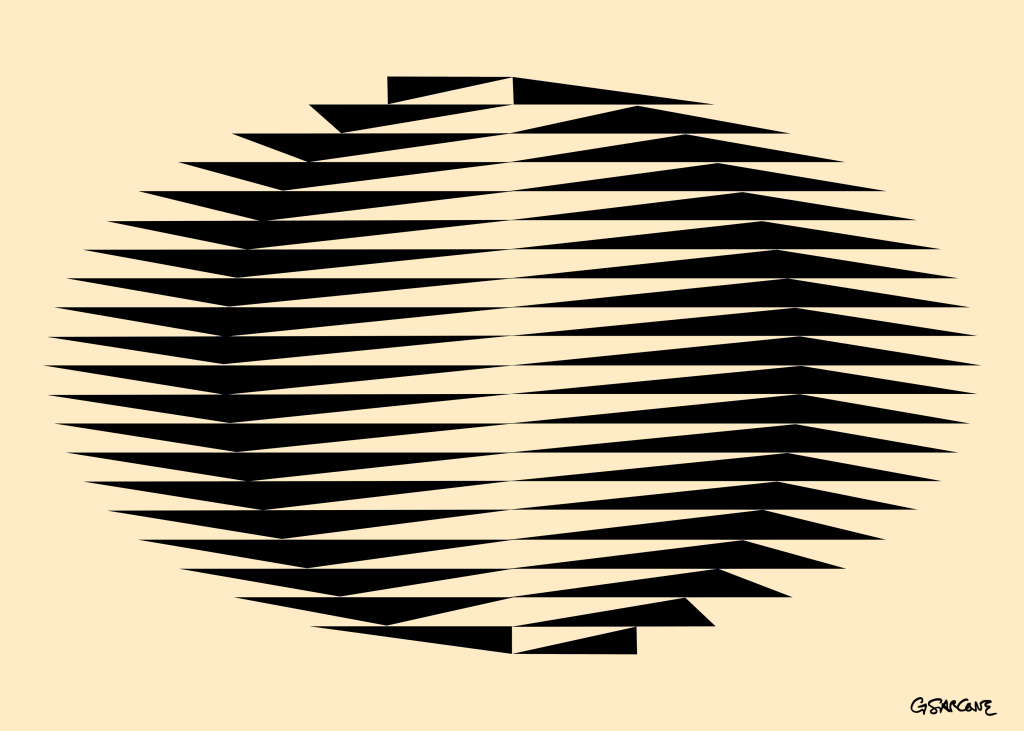
A memory from Japan, where I lived briefly in the 1980s. This piece recalls earthy colors, organic shapes, and fragments of that time. A circle emerges from a flowing field of triangles—like ripples of moonlight dancing on the sea near Kamakura.
Immersing in my Op Art is entering a space where opposing forces meet, interlock, and balance with precision and intensity. Each piece is a silent dialogue of form, line, color, perception, and mathematical structure, anchored in the language of symbols. Beneath the surface, it engages archetypes and ancient rites that still resonate in the collective unconscious.
I’ve been toying with the idea of revisiting an old, low-key material for my art: Flutex.
If you haven’t heard of it, Flutex is a patterned industrial glass from the 1930s and ’40s, mostly used to give a bit of privacy in bathrooms and office partitions.
In the ’70s, Op artist Sydney Cash started playing with this glass and found that its ribbed surface works like a lenticular screen—showing different images depending on how you look at it. The effect? Hypnotic, shifting artworks that change as you move around them.
It’s just simple glass, but it tricks perception in a really cool way.
I’m seriously considering giving it a try myself—there’s something about that mix of humble material and complex visual play that feels worth exploring again.
Although I’ve been working in the field of Op Art since the mid-1980s, it’s important to recognize that the movement itself has a deeper history. It began to take shape in the 1960s, led by pioneering figures such as Victor Vasarely and Bridget Riley.
However, the artists who truly captivate me—the ones who expanded the language of perception—are often the outsiders. One such figure is Julio Le Parc (b. September 23, 1928), an Argentine-born artist whose practice bridges Op Art and kinetic art. Le Parc studied at the School of Fine Arts in Argentina and went on to co-found the Groupe de Recherche d’Art Visuel (GRAV). His work, honored with numerous awards, holds a prominent place in Latin American modernism.
Le Parc’s recurring themes—color, light, and movement—have always resonated with me. During the ’60s and ’70s, he explored light not just as a visual element but as a living, dynamic material. Yet by the late ’70s, his presence in the art world had faded; his output became sporadic, and for decades his work slipped quietly out of the international spotlight.
Fortunately, recent years have witnessed a renewed appreciation of his explorations in light and movement, bringing his contributions once again to the attention of a wider public.
I’m pleased to announce that my work Apparition will be featured in the 6th volume of Taschen’s Library of Esoterica, set to release in early 2025.
This portrait, created by combining photographs of 50 different human faces, presents a ghostly image that endlessly shifts its features as you look at it. The effect is driven by the neural adaptation phenomenon, similar to Troxler fading, along with the brain’s face-recognition circuits, which complete the image.
You can explore this piece and more with prints available from my online gallery.
For a deeper dive, visit Spirit Worldshere to explore art, rituals, and myths from hidden realms.
Mystic Flying Bat is a mixed-media artwork I created back in 2010. It was the starting point for a series of pieces in a similar style, some of which I screen-printed using different color palettes. With this work, I wanted to invite viewers to think about an intriguing question: What is movement?
What makes this kinoptic artwork special is the way it creates the illusion of motion. As you look at it, the black bat seems to flutter, expand, or shift. But here’s the fascinating part—if you stare at it long enough and then close your eyes, a white bat will appear in your mind!
Kinoptic designs, like this one, play with our perception, making still images feel alive. It’s all about the clever use of contrasting colors and the precise arrangement of shapes.
Take a moment to focus on the circular pattern. How many spirals do you see? The surprising answer is none. There are no spirals here—just alternating black and yellow discs, slightly off-center and layered to create a striking illusion of swirling depth and motion.
I began crafting pieces like this in the early ’90s, drawing inspiration from Duchamp’s Rotoreliefs. I was captivated by how simple rotation could deceive the eye, inviting the viewer into a world of optical illusions. It’s a unique experience—seeing motion and depth in something entirely flat, both puzzling and mesmerizing.
This op art pattern comes to life across various mediums and transforms into artistic expressions on different objects. In my online gallery, you’ll find art prints and everyday items featuring this work, all available for purchase.
Let your gaze wander across the image below. Do the shapes in the first and third rows seem to subtly shift leftward, while the second and fourth rows appear to glide rightward?
Why do these static images appear to move? This perceptual phenomenon, known as “anomalous motion” or “peripheral drift illusion”, results from the interplay of color contrast, luminance, and eye movements. It occurs due to a sawtooth luminance grating in the visual periphery, where a sequence of contrasting colors transitions from light to dark. The speed of the perceived motion is influenced by the frequency of microsaccadic eye movements.
In the 1990s, I began creating many of these fascinating images, experimenting with patterns and contrasts to bring this mesmerizing effect to life.
Fine art prints and merchandise of these mesmerizing pieces are available in my online gallery—a perfect addition to any space!
Explore My World of Art, Books, and Creative Concepts