“Infinity”, A Kaleidoscope of Squares

With this work, I aim to push geometry to its limits, transcending the confines of color. My goal is to showcase the creative potential of simple concentric squares as a medium for experimentation and the discovery of new op art patterns. By delving into this exploration, I strive to unveil captivating illusions of color and mesmerizing motion.


Draw a large and a small square with thick lines and center them (Fig. A). Next, blend the inner and outer squares in six steps to create a set of concentric squares. Reproduce the set to form a larger square pattern, as shown in Fig. B.

My Dossier on Visual Illusions: A Special Feature in Focus Magazine

For over 10 years, I’ve had the pleasure of collaborating with Focus, an Italian monthly popular science magazine published in Milan.

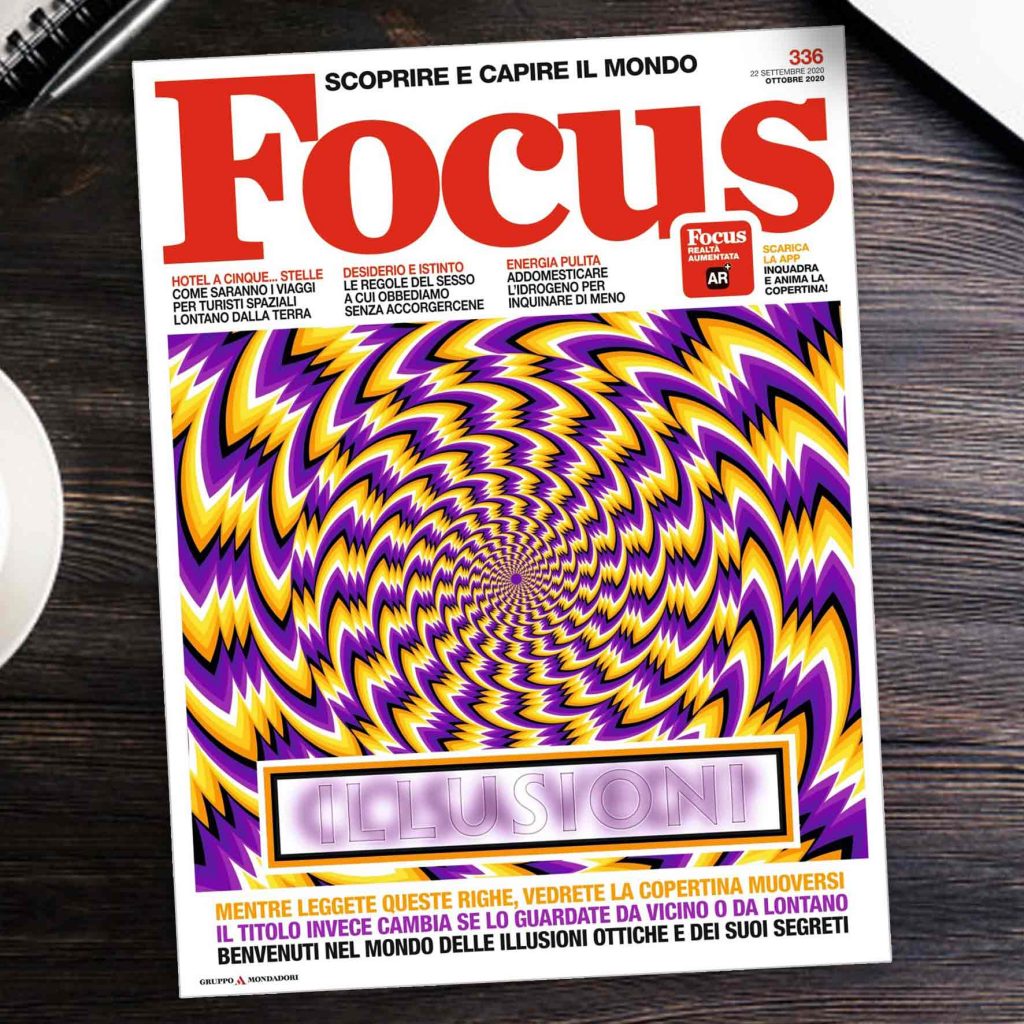
In October 2020, Focus released issue #336, which featured my article and optical illusions. This special edition included a 10-page dossier on visual perception, showcasing over 13 original illusions I created, complete with explanations.

The cover of this issue also featured a unique effect I designed for Focus. As you read the main title, the cover image moves, and, intriguingly, the title changes depending on your perspective—read closely, and it says ILLUSIONI; look from a distance, and it transforms into COSA VEDI?

Focus Mag cover

Continue Reading

Is seeing believing? This book will prove the contrary

I really enjoy communicate the mysteries behind the science of perception in a simple and clear manner with the use of instructive images.

We live in a “reallusive” world… Illusions are not totally unreal, because we feel them as they were real. Reality is also a kind of ‘illusion’. The outside world is mediated through our sense organs: vision, hearing, taste, touch and smell. All what we perceive and feel are just REPRESENTATIONS of reality, not the reality itself.

Children have a different way of looking at the world. So, writing and illustrating optical illusion books for kids is not an easy task, because they are less fooled by visual illusions than adults. This is due to the fact that brain’s capacity to consider the CONTEXT of visual scenes, and not just focus on SINGLE PARTS of scenes, develops very slowly.

My new work “Optical Illusions” will make you question: “is seeing believing?”… The brain is an amazing thing, but it doesn’t always get things right when it comes to sight. My book is here to explain why, with astounding images, baffling puzzles, and simple reveals.

Continue Reading

KINECHROMATICS: A new three-framed animation

Kinechromatics (patent pending) is a method of my invention for animating static images through retinal persistence and controlled interactions between additive and subtractive color systems. It produces apparent motion by sequential color filtering across layered chromatic structures, rather than relying on conventional frame-by-frame animation.

Kinechromatics static image

The static image above is made of 3 layers having each a different subtractive primary color (magenta, yellow, or cyan) blended in ‘multiply mode’…

What happens if we alternately overlay this image with transparent colored acetate sheets, each carrying an additive primary color (red, green, and blue)?

Kinechromatics red

Kinechromatics: red filter
When viewed through a red acetate sheet, the magenta and yellow components are largely absorbed, while the cyan layer remains visible, appearing black.

Kinechromatics green

Kinechromatics: green filter
Through a green acetate sheet, the cyan and yellow components are suppressed, revealing the magenta layer in black.

Kinechromatics blue

Kinechromatics: blue filter
Through a blue acetate sheet, the magenta and cyan components are reduced, allowing the yellow layer to emerge but appear black due to its lack of transmission in the blue range.

The animated GIF below produces a continuous motion effect using only four elements: a static base image and three full-color layers blended in multiply mode.

Kinechromatics animation

Colored light can also replace acetate filters, creating a seamless optical animation. Stroboscopic illumination in primary colors has the added effect of merging perceptually into white light, making the transitions visually smooth. This approach can be particularly effective in museum or gallery installations, offering a direct demonstration of how color interaction is processed by human vision. The setup consists of a static image containing the Kinechromatics pattern, illuminated sequentially by red, green, and blue projection, as shown in the animation below.

For inquiries about exhibition or collaboration, feel free to contact me.

projector

A second example, a simple animated dancing skeleton, demonstrates the same principle:

dancing skeleton


See also:

Kinegrams

Breathing Hexagon

This is one of my earliest self-moving op art works (2003). Have a look at the static image above, don’t you have the feeling that the sets of lenticular shapes seem to expand?

This piece is accessible in various formats, including prints, posters, and t-shirts, through my art gallery shop.

Continue Reading