Two monks stood outside a temple, watching its flag wave in the wind. “The flag moves,” said one. “No, the wind moves,” said the other.A third monk smiled: “Neither moves. Your mind moves.”
Back in the early 2000s, I ran a few public art workshops exploring a deceptively simple idea: a printed image does not have to move to appear animated.
The trick is a kinegram—a static image transformed into a precise pattern of lines. Place a special acetate screen over it, and the hidden movement suddenly appears.
No electronics. No screen. No animation software. Just a carefully calculated pattern and a bit of moiré.
In these workshops, we experimented with: • concentric circles • simple radial patterns • geometric textures
The resulting kinegrams produce seamless, looping animations from completely static printed images. If you’re interested in exploring the technique or collaborating, feel free to contact me.
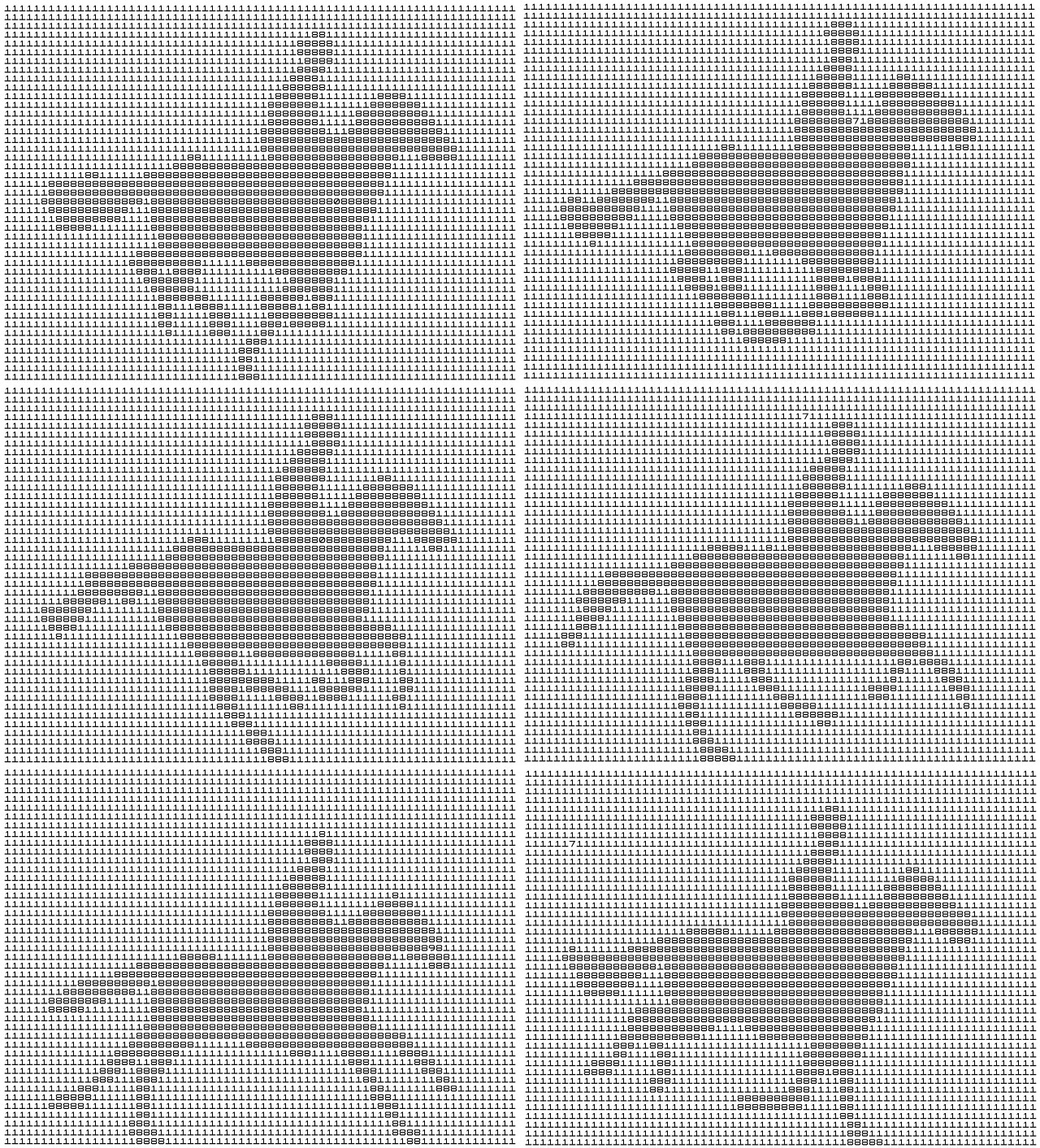
Every frame in this GIF is a 3,100-digit prime number:
Together, they recreate the world’s first motion picture: Eadweard Muybridge’s iconic 1878 “Galloping Horse.”
How it works: Each frame is converted into a grid of 1s and 8s, then slightly tweaked until the math clicks and a prime number is born. Fast primality tests spot the candidates, and rigorous checks confirm them.
The result? An animated piece of history, built entirely out of pure mathematics.
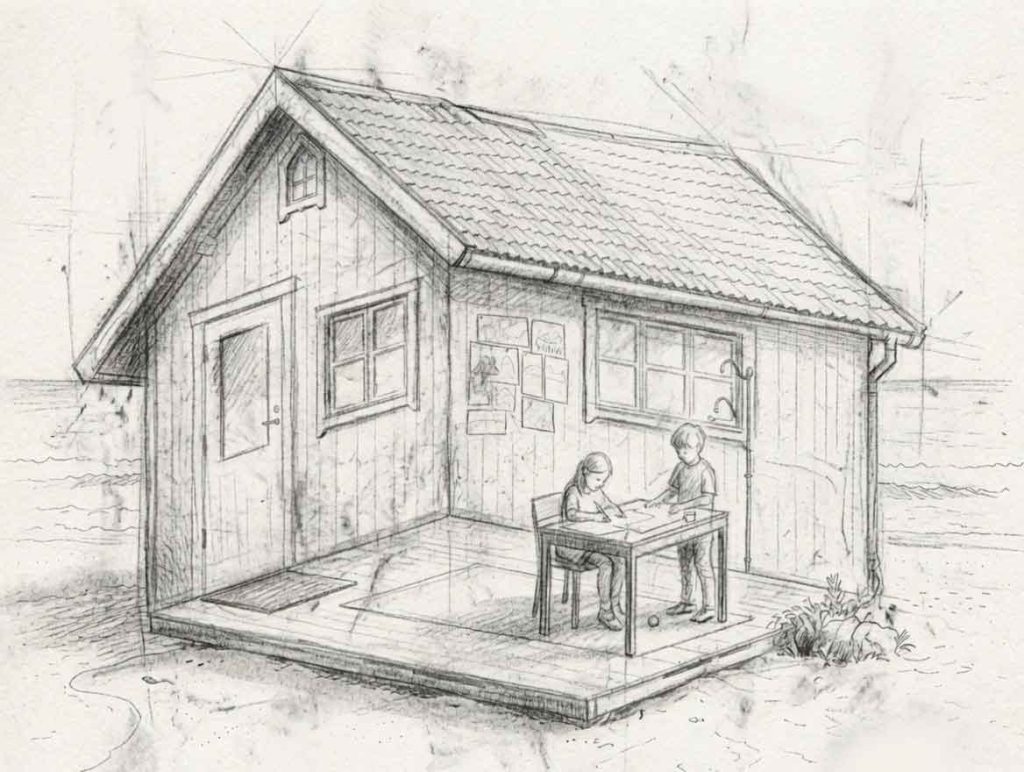
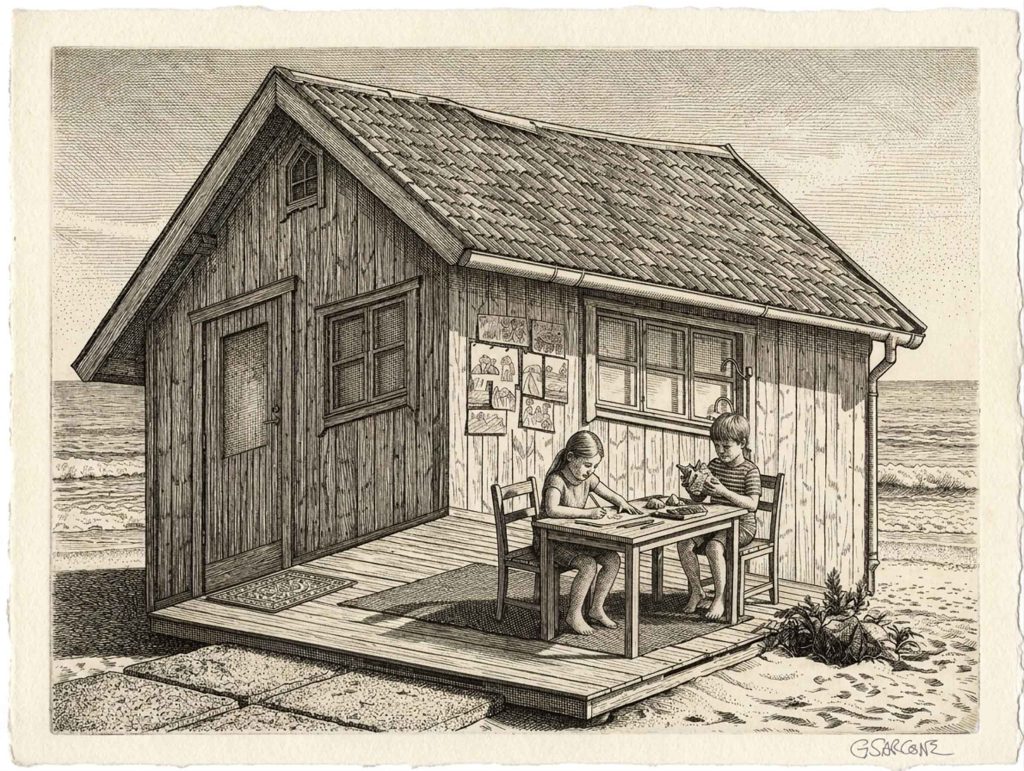
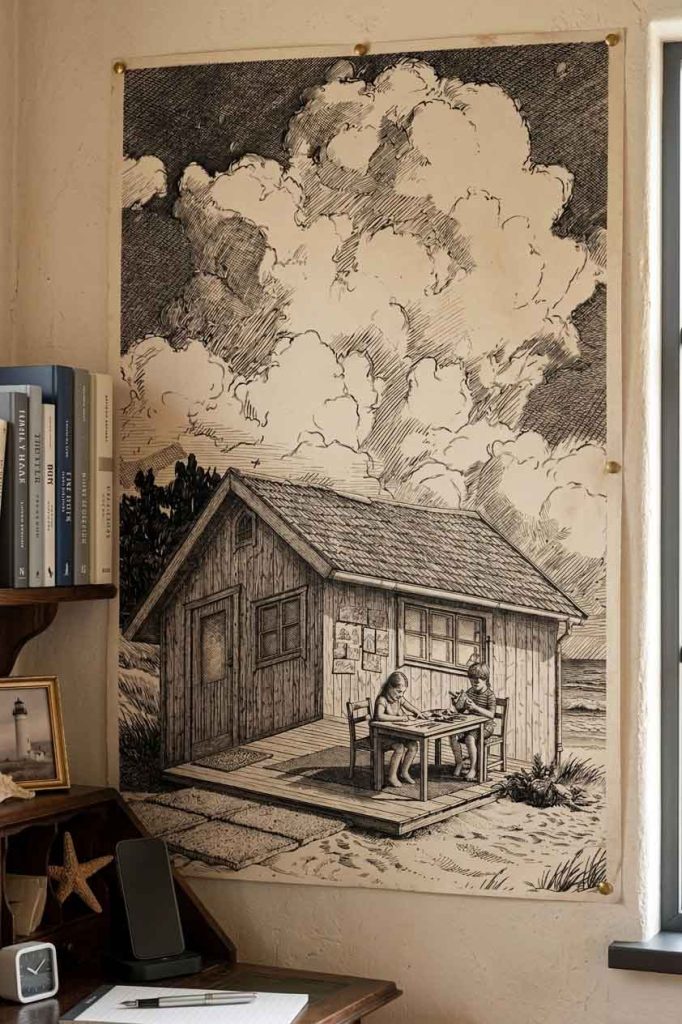
With summer just around the corner, I find myself drifting back to the shores of time, to this delightfully impossible little structure perched on the beach.
A drawing concept created for a children’s coloring book on optical illusions. Over the years, I’ve explored this theme through many curious and playful variations.
Are the kids engaging in creative activities inside the cabin or outside it?
The roof insists we’re looking at the exterior, while the floor pulls us firmly indoors. Both readings feel correct, yet they cancel each other out. So, there’s no clean resolution here—just a quiet visual paradox.
Curious to see more of my optical illusion book concepts, impossible worlds, and mind-bending creations? Take a stroll through my author page.
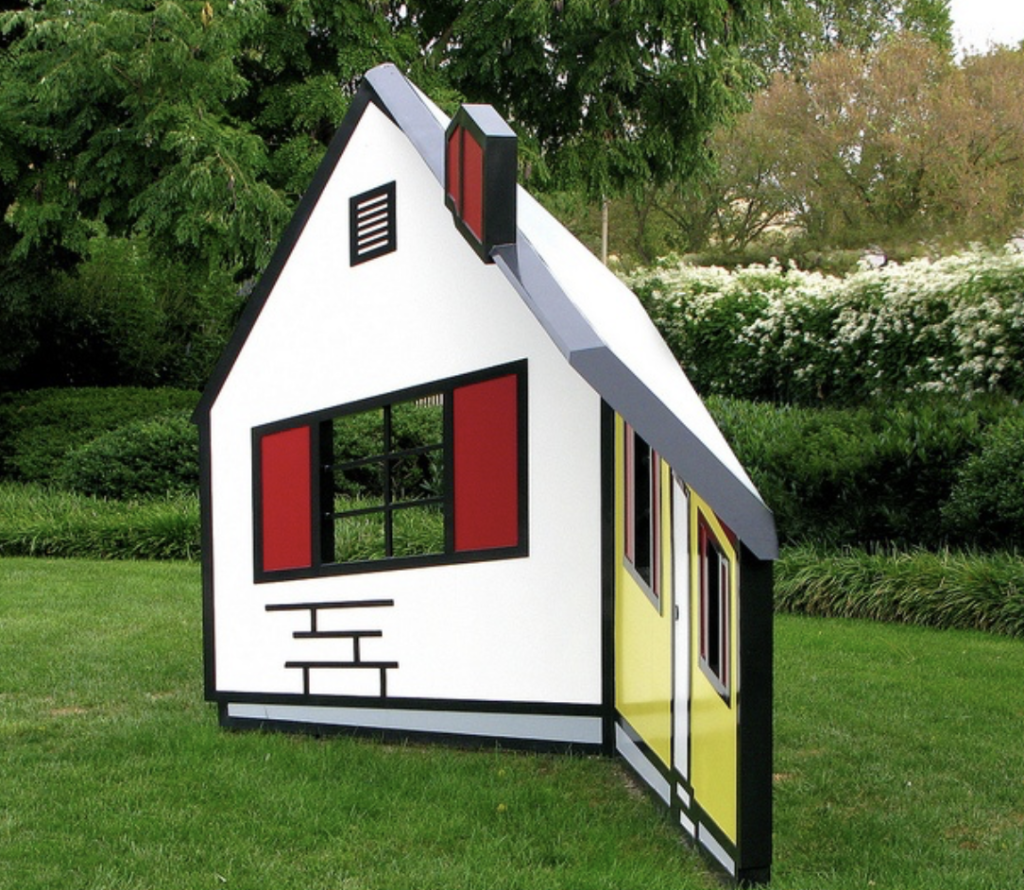
The idea itself is far from new and has inspired countless artists, architects, and photographers. It even exists in three dimensions. A notable example is Roy Lichtenstein‘s House I (1996), an ingenious sculpture that appears to be a solid house but is actually a concave construction made of angled steel planes. As viewers move around it, the structure seems to rotate and reshape itself, turning perception into part of the artwork.
“The Master of Numbers” is an Op Art photomosaic portrait of the renowned physicist, created from a collection of photographs of numbers. Each detail contributes to a visual exploration of mathematics, perception, and pattern. The project took me two years to complete, photographing numbers in the most unusual places and objects, and bringing them together into a single portrait.
And a little secret: tucked inside the mosaic is a tiny portrait of me and my wife—a fun, hidden signature and a personal touch.
Limited edition posters and prints are available through my online gallery.
First, observe the alignment of the red circles as they move in a straight vertical path, up and down. Then keep your gaze on one of the three Xs in the middle. What do you notice?
The red circles seem to drift away from their true physical trajectories, as if they were following the curves of the static lines. This perceptual shift is known as the “Mainz-Linez Illusion“.
When you keep your gaze on the central X, the moving dots shift into peripheral vision, where spatial resolution is limited and detail is reduced. The visual system compensates by interpolating missing information based on contextual cues and prior experience. As a result, the dots become perceptually “bound” to the nearby curved lines, as if threaded on them, and their straight vertical motion is misread as oscillating.
The Mainz-Linez phenomenon reflects a broader principle: peripheral vision is largely constructive. Under certain conditions, this predictive filling-in can also distort motion judgments in real-world tasks—such as driving—where events in the periphery may be misperceived.
My minimalist tribute to M. C. Escher: an animated “impossible waterfall,” drawn frame by frame. It’s not exactly my usual artistic language, but I had great fun creating it, and I hope you’ll enjoy watching it as much as I enjoyed making it.
As you can see, the isometric structure links impossible angles to create a continuous water channel that appears to flow upward in a loop, falling from a high point yet seemingly returning to the top.
The “impossible waterfall,” reimagined in a lavish Rococo style, rendered as a surreal illustration for a book project.
We usually perceive lines and shapes as forming a figure, while the paper and surrounding white space recede into the background. Yet, under certain conditions, what we assume to be background can itself acquire form and meaning. In the illustrations shown here, a clear geometric figure emerges—even though no lines actually define it. These visual phenomena are known as illusory figures.
What kind of 3-dimensional shape do you see?
Illusory figures depend, in part, on the presence of regular gaps within a visual arrangement. When such gaps occur, the visual system instinctively tries to resolve them into coherent forms. These gaps can be created by simple elements, such as circles. When solid black circles and partially “chipped” ones are arranged carefully, they produce striking illusory shapes.
The most familiar example is the Kanizsa triangle. Here, an illusory contour is perceived when black disks with wedge-shaped sections removed are aligned so that their edges define a triangular form in the negative space. Remarkably, this illusory region appears brighter than the surrounding page, even though its physical luminance is identical.
Kanizsa triangle
Etherial Cross
A pattern of black dots forms a ghostly ‘X’ shape through negative space. The arrangement of dots creates a subtle sense of motion and depth. The piece combines the Ouchi effect—where contrast between figure and background generates apparent movement—with the Kanizsa illusion, where the mind completes shapes that aren’t actually drawn.
Fine art prints of this Op Art piece are available for purchase through my official gallery.
The effect becomes even more dramatic when the illusion is animated. Rotate the cross, for example, and the X-shaped form—with no explicit outline—appears to emerge from a rigid grid of black dots. The shape is defined solely by subtle local distortions: small asymmetric intrusions along the contours of the X disrupt the regularity of the dots, making the form pop into perception despite having no actual boundaries.
Etherial Circle
Using the same technique, we can replace the X with a large O. Now the regular arrangement of black circles is disrupted by a ghostly central shape that seems to lift off the background, almost floating. As above, this Op Art piece combines the Ouchi effect—where the contrast between figure and background creates apparent motion—with the Kanizsa effect, where the mind completes shapes that aren’t actually drawn.
Fine art prints of this Op Art piece are available for purchase through my official gallery.
It is also interesting to add a rotational motion to this Op Art piece. I experimented with different solutions, and this one is the simplest yet striking nonetheless.
To conclude this journey into the world of contour illusions, still using black disks as our starting point, here are a few further experiments. They explore negative superpositions, translucent effects, and the emergence of more complex forms—showing how simple elements can give rise to unexpected visual structures.
Fine art prints of this Op Art piece are available for purchase through my official gallery.
Mystic Flying Bat is a mixed-media artwork I created back in 2010. It was the starting point for a series of pieces in a similar style, some of which I screen-printed using different color palettes. With this work, I wanted to invite viewers to think about an intriguing question: What is movement?
What makes this kinoptic artwork special is the way it creates the illusion of motion. As you look at it, the black bat seems to flutter, expand, or shift. But here’s the fascinating part—if you stare at it long enough and then close your eyes, a white bat will appear in your mind!
Kinoptic designs, like this one, play with our perception, making still images feel alive. It’s all about the clever use of contrasting colors and the precise arrangement of shapes.
Take a moment to focus on the circular pattern. How many spirals do you see? The surprising answer is none. There are no spirals here—just alternating black and yellow discs, slightly off-center and layered to create a striking illusion of swirling depth and motion.
I began crafting pieces like this in the early ’90s, drawing inspiration from Duchamp’s Rotoreliefs. I was captivated by how simple rotation could deceive the eye, inviting the viewer into a world of optical illusions. It’s a unique experience—seeing motion and depth in something entirely flat, both puzzling and mesmerizing.
This op art pattern comes to life across various mediums and transforms into artistic expressions on different objects. In my online gallery, you’ll find art prints and everyday items featuring this work, all available for purchase.
Explore My World of Art, Books, and Creative Concepts