Paradossal… Mente!

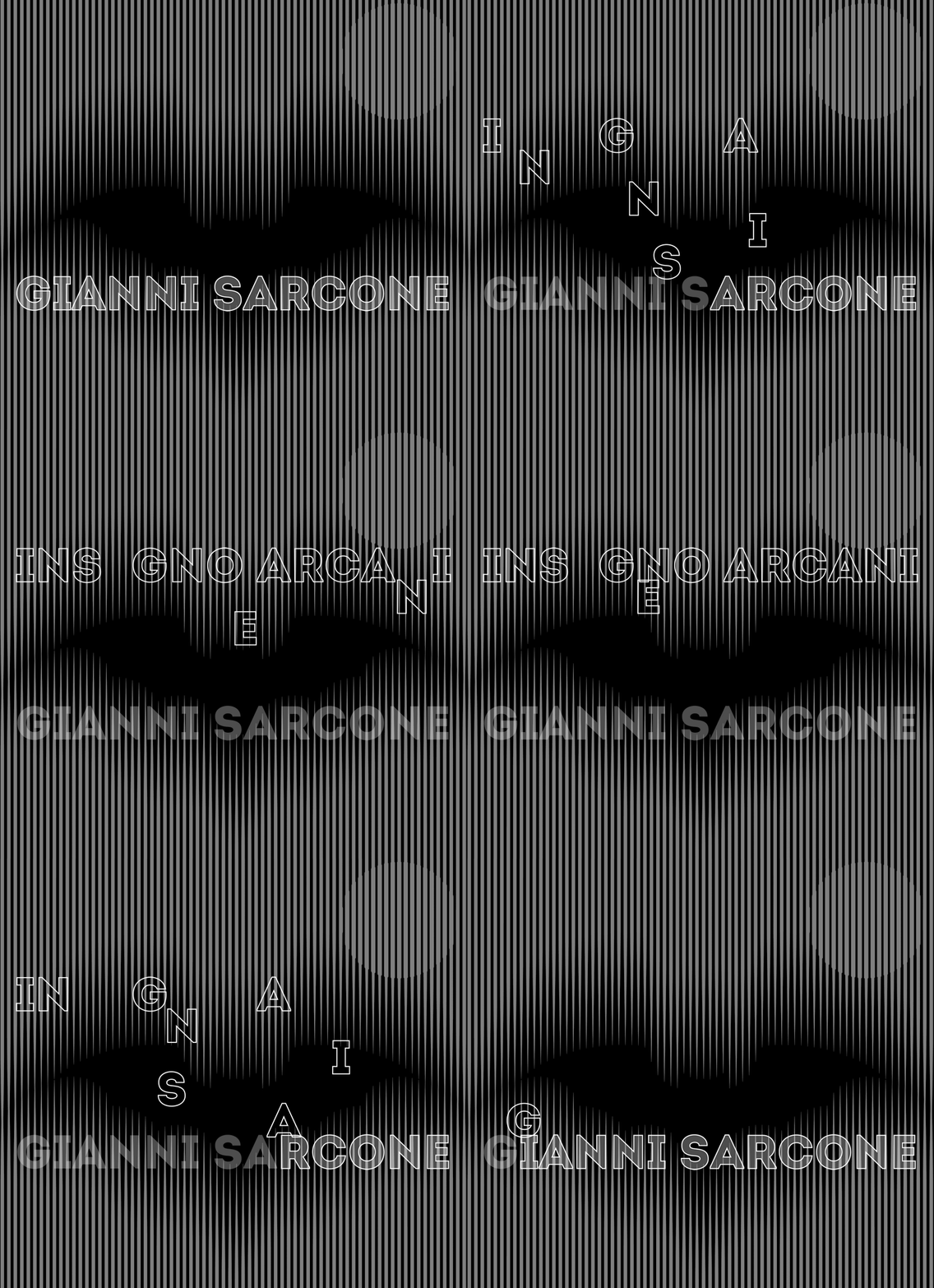
Sabato 21 dicembre ti aspettiamo alla Mostra delle Illusioni di Genova per “Paradossal…mente“, il laboratorio interattivo sulla percezione visiva che ho ideato e che guiderò personalmente. Non mancare!


I partecipanti saranno attivamente coinvolti in esperienze che mettono alla prova le percezioni: scopriranno illusioni ottiche inedite, creeranno giochi percettivi sconcertanti e indagheranno vari paradossi e misteri della mente e del sistema visivo. Ogni esperienza invita a riflettere su come il cervello può “ingannarci” o lasciarsi influenzare da ciò che lo circonda

Durata del laboratorio: 1 ora circaIl Materiale per il laboratorio creativo sarà fornito direttamente dalla Mostra delle Illusioni.

🔹APPUNTAMENTI:
🔸1 TURNO ORE 14:30
🔸2 TURNO ORE 15:30
🔸3 TURNO ORE 16:30

🔹QUOTA LABORATORIO:
ADULTO (18+): 20€
BAMBINO (8-17): 15€

🔹QUOTA LABORATORIO + MOSTRA:
ADULTO (18+): 30€
BAMBINO (8-17): 25€

🤩 Portate con voi la vostra curiosità…al resto ci pensiamo noi!

📍 Dove
Magazzini del Cotone – Modulo 1, Porto Antico di Genova
✅ Prenota al numero: 389-5540263 oppure scrivi a: mostragenova@lamostradelleillusioni.com

Illusive Concentric Circles

My op art piece Trinacria (1997) features three black-and-white zig-zagging shapes spiraling together to create the illusion of interwoven concentric circles. These jagged, repeating patterns add a sense of depth to the piece and produce a subtle rotating effect that seems to shift as you follow each line with your eyes.

Prints and canvases of Trinacria are available in my online gallery.

Below, an animated version enhances the effect. By focusing on the center, viewers can observe virtual circles appearing to move inward or outward, adding to the piece’s dynamic sense of rotation and depth.

Perspective Optical Illusions: The art of circling the square

When bending the sides of a square structure forward, each edge forming a sine wave shape, the structure reveals a circle when viewed from the reverse angle. This illusion plays with perspective, specifically utilizing an effect known as “anamorphosis“.

Anamorphosis refers to a artistic technique that uses perspective to create distorted images that can only be viewed correctly from a specific angle.

Math-Magic Vanishing Space

Qaudrix puzzle 1

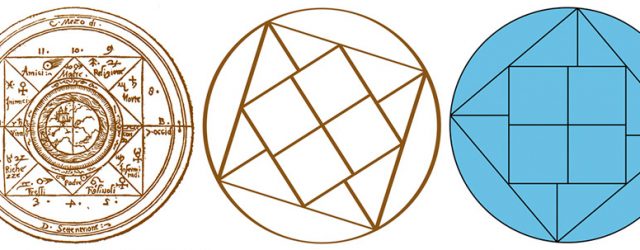
Inspired from the astrological tables, here is a new puzzle of my creation designed according to the ‘Golden Number Rules’, which is reflected in the proportion of each single piece of the game. Thanks to the balanced dimensions of its pieces, this puzzle acquires some intriguing magical properties!

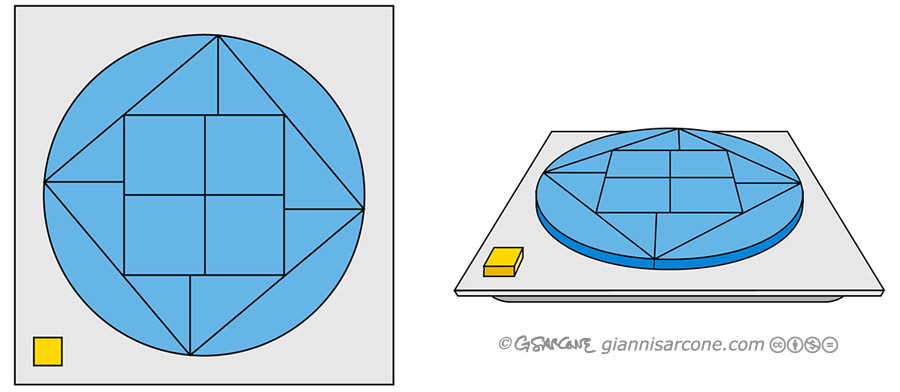
This “math-magical” puzzle is composed of a tray in which the pieces are assembled.

Quadrix puzzle 2
Puzzle Quadrix (aka Quirinus), © 1992, G. Sarcone.

Object of the puzzle game
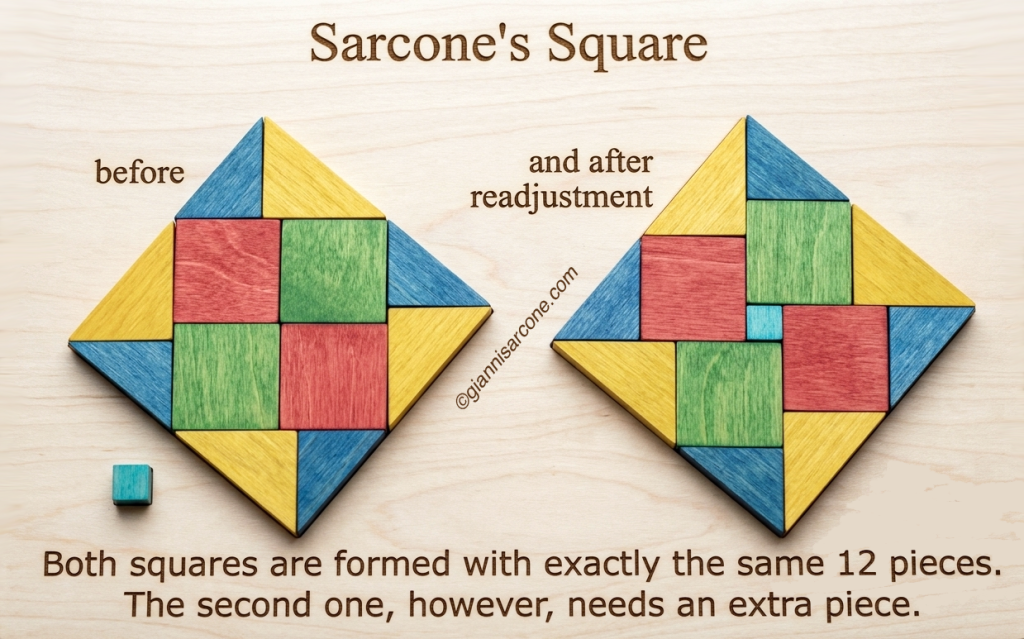
Fit the small extra piece into the puzzle without apparently altering its original dimensions. All the pieces must lie tight and flat! Impossible? See the solutions below.

Quadrix puzzle 3

The animated demonstration below is more eloquent than all theories. The puzzle shown in the video is a variant made in hard plastic, and cut using water-jet technology with an accuracy/precision of 0.01!

Here’s a wooden version of the puzzle I designed in the late 1990s. Each set of pieces is made in a different color, giving the puzzle a clean, elegant look while making its deceptive geometry even more striking.

I am looking for a game manufacturer able to produce and distribute this incredible puzzle. You can contact me through my website.

☞ Further reading: explore the complete Vanishing Piece Puzzle project on my Behance profile.

Apparitions

This ghostly face appears to mysteriously change its features when you look at it for a while (Some viewers have even reported experiencing traumatic visions!). But that’s not all – if you unfocus your eyes and look steadily through the image, you’ll notice that after about 10-15 seconds, the face gradually disappears…

Ghost Faces / Apparition – Mixed media (2011)

This spooky portrait is created by merging together 50 common human faces. The process of averaging multiple exposures of human faces isn’t really new. In fact, as early as 1879, Sir Frances Galton experimented with this photographic technique, and others have since followed suit, using it for artistic or social purposes. Artists like Ken Kitano, Jason Salavon, Donald Scott Bray have all borrowed this technique for their own work.

Continue Reading