Is this a real perpetual motion machine?
Obviously not… The closest thing to a “perpetual motion machine” is the Beverly clock whose mechanism is driven by variations in atmospheric pressure, and by daily temperature variations.

Is this a real perpetual motion machine?
Obviously not… The closest thing to a “perpetual motion machine” is the Beverly clock whose mechanism is driven by variations in atmospheric pressure, and by daily temperature variations.
This is one of my earliest color optical illusions. There is no yellow or green in the diamond shapes, just vertical black lines! (If you don’t believe it, use a eyedropper tool to check it.) This intriguing visual effect is mainly due to “simultaneous color contrast induction“.

Salvador Dalí : Sept corps nus et un crâne, 1951 (Human skull consisting of seven naked women).

Often symbols of MORTALITY (or some romantic notion of immortality – as the belief that a spiritual part of a person survives death) and POWER, skulls have been employed in human rituals and art since the dawn of humanity: from the ancient animal skulls in Paleolithic burial sites, to the curlicued cattle skulls that haunt Georgia O’Keeffe’s canvasses. Skulls cannot be assumed to be only a mere symbol of death, they are also used in initiation rituals as a symbol of REBIRTH, symbolizing the ‘sephirah daath’ (סְפִירָה – sephirah, “enumeration” in Hebrew) on the cabalistic tree of life, the gateway to a higher awareness only achievable through spiritual death and rebirth.
Curiously enough, the cubes don’t move only the background color changes…

Here is my tutorial to create an amazing autokinetic animation.
Our visual system can interpret colors and shades in surprising ways. This 3×3 Tic-Tac-Toe grid, for example, showcases how easily our perception of brightness can be fooled.
Do you notice anything unusual in the grid below?

The looping animation below brings the illusion to life, revealing the trick in action. That large green square behind the grid isn’t actually uniform—it’s made up of alternating dark and light green squares. Our visual system works like a “comparative computer”. In fact, we never see colors in isolation, as the appearance of any color is affected by the colors surrounding it. So, under certain conditions, colors that are identical may appear different, while colors that are different may look the same. In our visual system there is a mechanism that enhances the contrast of the outline of an object relative to its background: it is called “lateral inhibition”.
Show / Hide the Trick
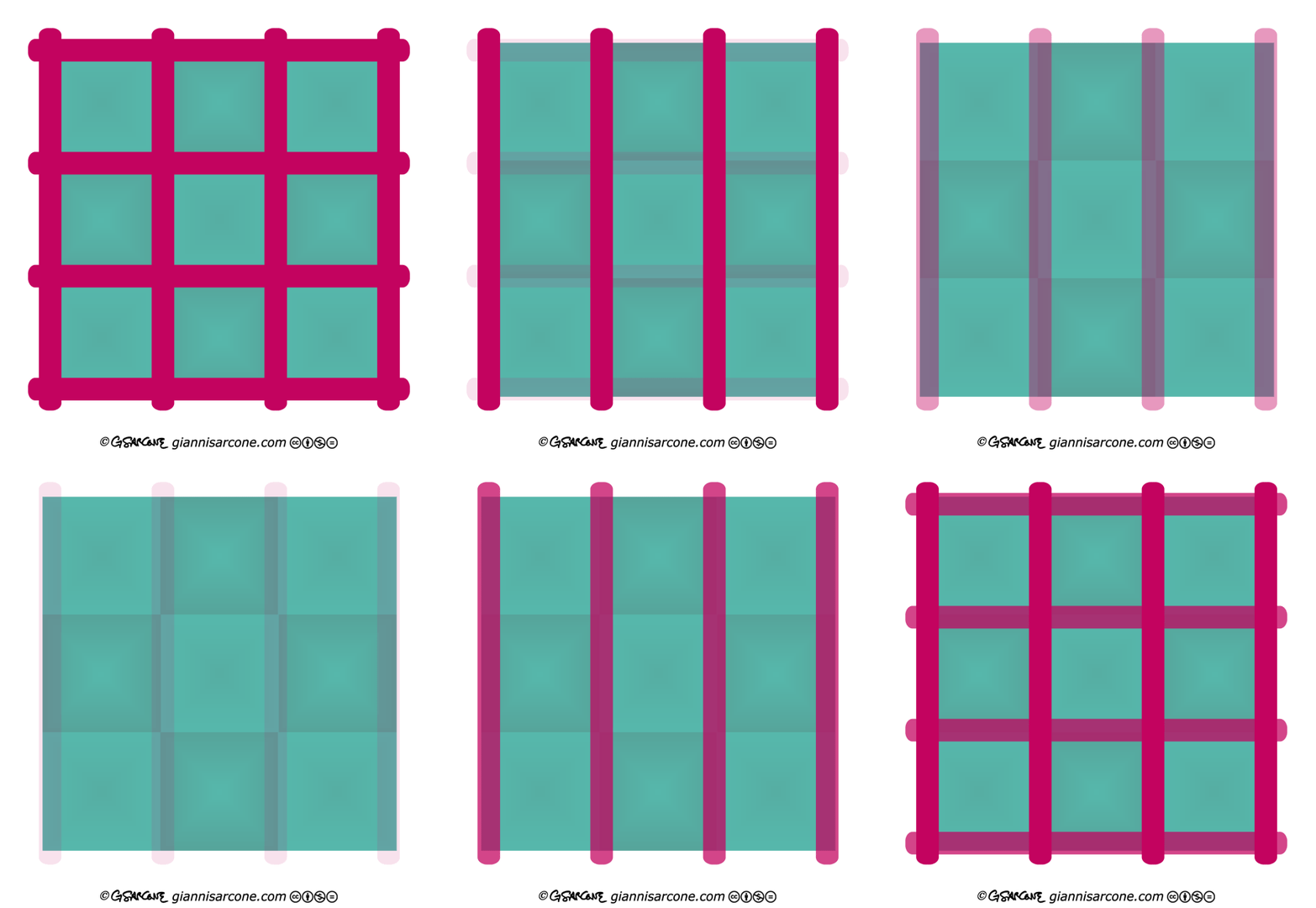
Thus, even small differences in brightness between adjacent zones, or objects, are deliberately increased by our visual system and the brain to better distinguish them. But something strange happens when the brightness boundaries of the color zones are concealed: the cues the brain needs to trigger the lateral inhibition no longer exist and consequently we become blind to variations in color brightness, as shown in the animated gif.
Recognitions
My optical illusion “Magic Tic-Tac-Toe” has been chosen to be among the top 10 finalists for the “2019 Best Illusion of the Year Contest”
Paper cutting & Motion

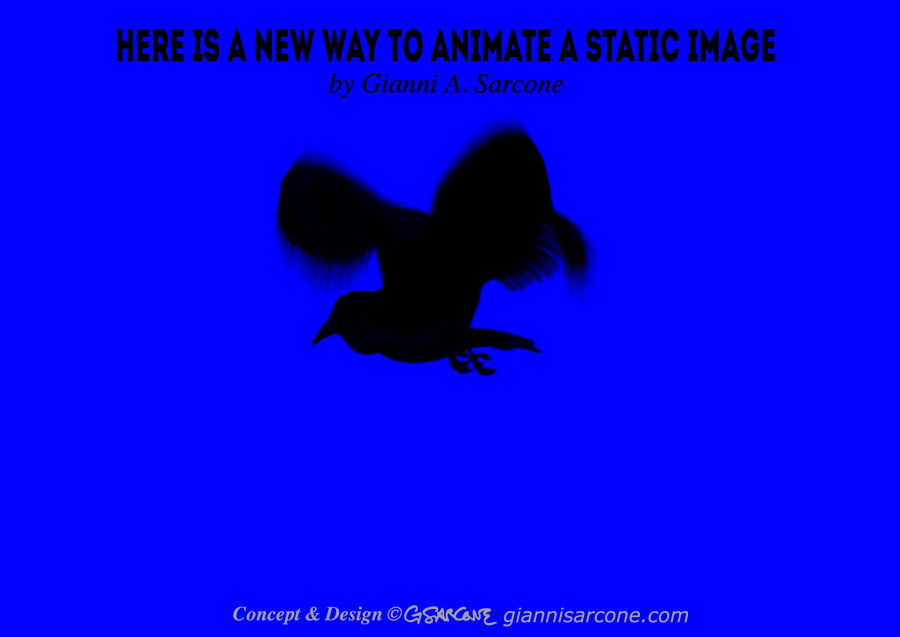
Kinechromatics (patent pending) is a method of my invention for animating static images through retinal persistence and controlled interactions between additive and subtractive color systems. It produces apparent motion by sequential color filtering across layered chromatic structures, rather than relying on conventional frame-by-frame animation.

The static image above is made of 3 layers having each a different subtractive primary color (magenta, yellow, or cyan) blended in ‘multiply mode’…
What happens if we alternately overlay this image with transparent colored acetate sheets, each carrying an additive primary color (red, green, and blue)?

Kinechromatics: red filter
When viewed through a red acetate sheet, the magenta and yellow components are largely absorbed, while the cyan layer remains visible, appearing black.

Kinechromatics: green filter
Through a green acetate sheet, the cyan and yellow components are suppressed, revealing the magenta layer in black.
Kinechromatics: blue filter
Through a blue acetate sheet, the magenta and cyan components are reduced, allowing the yellow layer to emerge but appear black due to its lack of transmission in the blue range.
The animated GIF below produces a continuous motion effect using only four elements: a static base image and three full-color layers blended in multiply mode.

Colored light can also replace acetate filters, creating a seamless optical animation. Stroboscopic illumination in primary colors has the added effect of merging perceptually into white light, making the transitions visually smooth. This approach can be particularly effective in museum or gallery installations, offering a direct demonstration of how color interaction is processed by human vision. The setup consists of a static image containing the Kinechromatics pattern, illuminated sequentially by red, green, and blue projection, as shown in the animation below.
For inquiries about exhibition or collaboration, feel free to contact me.

A second example, a simple animated dancing skeleton, demonstrates the same principle:

See also:

This is one of my earliest self-moving op art works (2003). Have a look at the static image above, don’t you have the feeling that the sets of lenticular shapes seem to expand?
This piece is accessible in various formats, including prints, posters, and t-shirts, through my art gallery shop.
Continue ReadingI am working on a new two-dimensional variant of the Müller-Lyer illusion… You may be surprised to know that the Müller-Lyer illusion isn’t only linear: it involves plane geometry too! In fig. A shown below, the ends of the blue and red collinear segments, arranged in a radial fashion around a central point, delimit two perfectly concentric circles. However, for most observers, they seem instead to define a large ovoid that circumscribes another one, slightly eccentric (Fig. B). This comes from the fact that the red segments seem to stretch towards the lower part of the figure, while the blue segments seem to stretch towards the upper part of the same. As you can see, in this variant comes also into play the “neon color spreading” effect. In fact, a bluish inner oval-like shape appears within the black arrow heads (Fig. A), though the background is uniformly white.

From the static image shown below (representing an automated conveyor system), it is possible to create a looping seamless animation…
