How a Human Bone Inspired the Eiffel Tower

Few people know that the human femur—the body’s largest and strongest bone—played an indirect role in the thinking behind the design of the Eiffel Tower.

Part of the tower’s structural logic can be traced to Swiss engineer Maurice Koechlin, chief engineer in the firm of Gustave Eiffel. While determining how forces would travel through the iron frame, Koechlin applied a principle that places material along the natural paths of tension and compression.

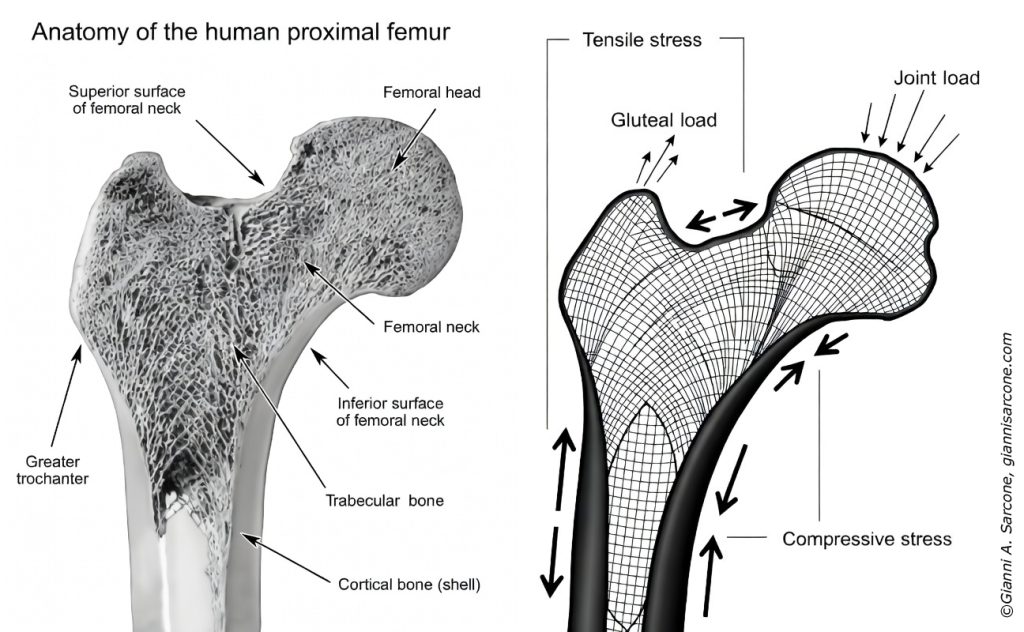
A comparable pattern had been described earlier by Zurich anatomist Hermann von Meyer. His research revealed that the femur’s internal structure forms a network of delicate struts known as “trabeculae.” These tiny elements follow the directions of mechanical stress inside the bone, creating a highly efficient system of support—even though the femoral head sits off-center from the shaft.

The mathematician Karl Culmann later showed that these trabecular patterns correspond closely to the principal stress lines calculated in engineering. His method, called graphic statics, provided a visual way to map how forces move through structures.

This link between anatomy and engineering influenced nineteenth-century structural thinking. The same principle—placing material only where forces demand it—guided the development of lighter, more efficient frameworks in bridges, cranes, and reinforced-concrete designs.

Humble, Yet Indispensable

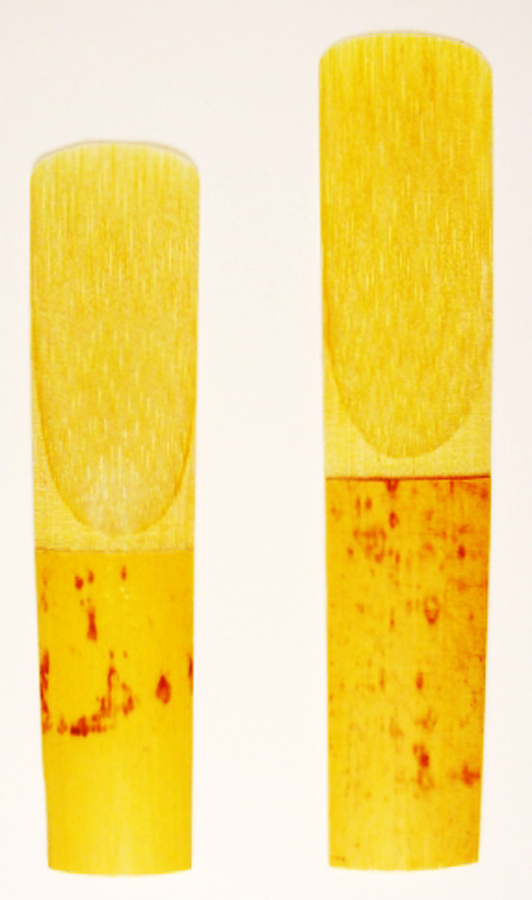
A reed—sometimes called a “lamella”—is a thin strip of material that vibrates to produce sound in a musical instrument. Most woodwind reeds are cut from Arundo donax, the so-called giant cane.
Take that small, stubborn sliver away and the clarinet or saxophone becomes what it truly is: a hollow tube. No tone, no music—just breath wasted in polished plumbing.

The reed looks trivial, almost laughably so. A scrap of cane shaved to a sliver. Yet it is the only part that dares to vibrate. Without that fragile defiance, the instrument stays mute.

Humanity functions in much the same way. Each of us is a reed in a colossal instrument that calls itself civilization. Frail, replaceable, easy to overlook—yet necessary.

History loves to celebrate the instrument: the grand structures, the shining mechanisms, the impressive machinery. But the sound—when it happens—always begins with a thin piece of cane trembling under pressure.

The Haunting Song of Inca Whistling Vessels

Ancient Inca “whistling vessels” (huaco silbadores in Spanish) could mimic animal calls—powered by nothing more than air and water. As water moves between connected chambers, it forces air through hidden whistles, releasing haunting, lifelike sounds.

These remarkable ceramics, found across several pre-Columbian cultures including the Inca, Chimu, and Moche, date back more than 2,000 years. Often uncovered in tombs and ceremonial sites, they likely played a role in rituals to honor nature, communicate with spirits, or accompany sacred ceremonies—though their exact purpose remains a mystery.

Layering Up: A Creative Look at AI

Ever wondered how Convolutional Neural Networks (CNNs) process images? Imagine putting a photo through a pasta machine… TWICE! This creative experiment, inspired by artist Kensuke Koike, demonstrates how CNNs break down data into smaller, layered features, just like the pasta machine creates four clear images from a single input.

© Kensuke Koike

THE FIRST GREATEST ILLUSION

The very first illusion is to believe that there is one, unique world of perception. The mind and the world we experience are inseparable, as it is the mind that makes the world meaningful. Our mind IS our world. Despite the fact that our mental construct of what is perceived is distinct from the objective reality, our mind accepts it as real.

Every organism, man as well as animal, lives in its own subjective spatiotemporal world that semiotic philosophers call ‘Umwelt’ (from the German Umwelt, ‘surrounding world’, or ‘life-world’). According to the biologist Jakob J. von Uexküll, organisms and their life-world shape each other in a functional loop (see fig. below): interactions between the subject and the outer world, mediated through the sense and effect organs, determine the world framework of the subject. Thus, a particular stimulus which has a perceptive cue or meaning to the subject induces always a purposeful reaction.

feedback loop of information

Continue Reading

Early Projector

This Roman artifact is considered a possible precursor to the magic lantern. According to the Italian engineer and author Flavio Russo, placing the flame of a candle or small lantern behind the elliptical lens could project the image or portrait painted on its surface onto a white wall, operating on the same basic principle as modern slide projectors. A comparable concept was later explored in the 17th century by Athanasius Kircher, who demonstrated the projection of images using light and lenses—an early step toward the development of the magic lantern.

elliptic lens with portrait
Portrait on an elliptic lens, artifact from Pompei – Naples National Archaeology Museum.

Reuleaux-triangle intermittent mechanisms

The Reuleaux triangle is a curious geometric shape: it looks like a rounded triangle, yet it has a remarkable property. Each side is an arc drawn from the opposite vertex, and together these arcs form a curve of constant width. In other words, no matter how you measure it—between two parallel lines—the width always remains the same.

Because of this property, a curve of constant width can act as a rotor inside a square. As it turns, the shape remains in contact with all four sides of the square at every moment, tracing a continuous motion while never leaving the boundary.

Mechanisms based on intermittent motion appeared early in mechanical engineering. One of their first practical uses was in sewing machines, where motion had to advance in precise steps rather than continuously. Today similar mechanisms are widely used in devices that move film frame by frame—such as cameras, projectors, and film-processing equipment—where controlled, stop-and-go motion is essential.

Reuleaux mechanism
Reuleaux mechanism 2