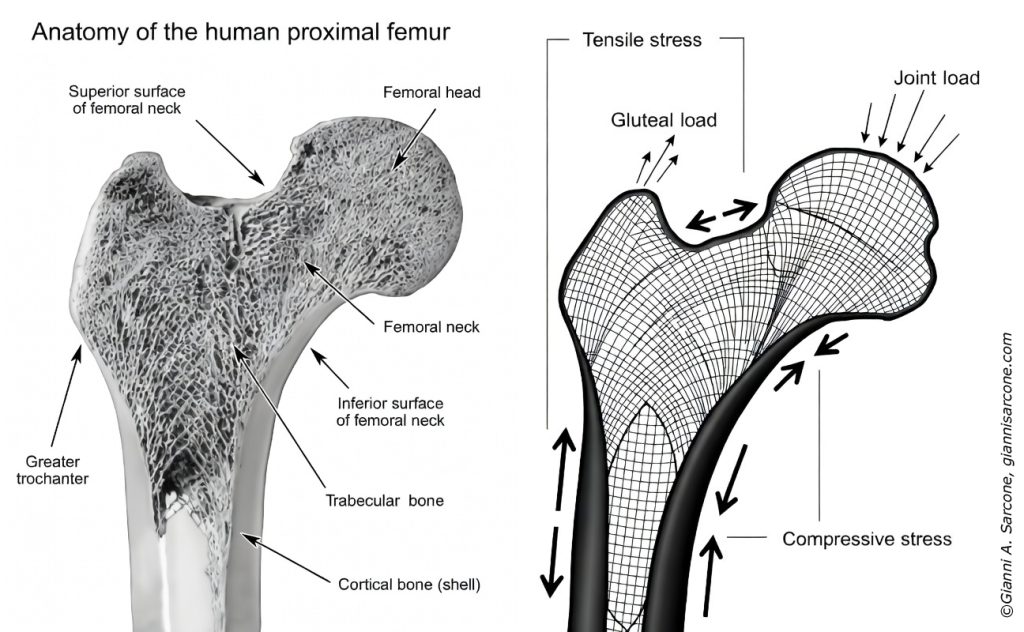
Few people know that the human femur—the body’s largest and strongest bone—played an indirect role in the thinking behind the design of the Eiffel Tower.
Part of the tower’s structural logic can be traced to Swiss engineer Maurice Koechlin, chief engineer in the firm of Gustave Eiffel. While determining how forces would travel through the iron frame, Koechlin applied a principle that places material along the natural paths of tension and compression.
A comparable pattern had been described earlier by Zurich anatomist Hermann von Meyer. His research revealed that the femur’s internal structure forms a network of delicate struts known as “trabeculae.” These tiny elements follow the directions of mechanical stress inside the bone, creating a highly efficient system of support—even though the femoral head sits off-center from the shaft.
The mathematician Karl Culmann later showed that these trabecular patterns correspond closely to the principal stress lines calculated in engineering. His method, called graphic statics, provided a visual way to map how forces move through structures.
This link between anatomy and engineering influenced nineteenth-century structural thinking. The same principle—placing material only where forces demand it—guided the development of lighter, more efficient frameworks in bridges, cranes, and reinforced-concrete designs.