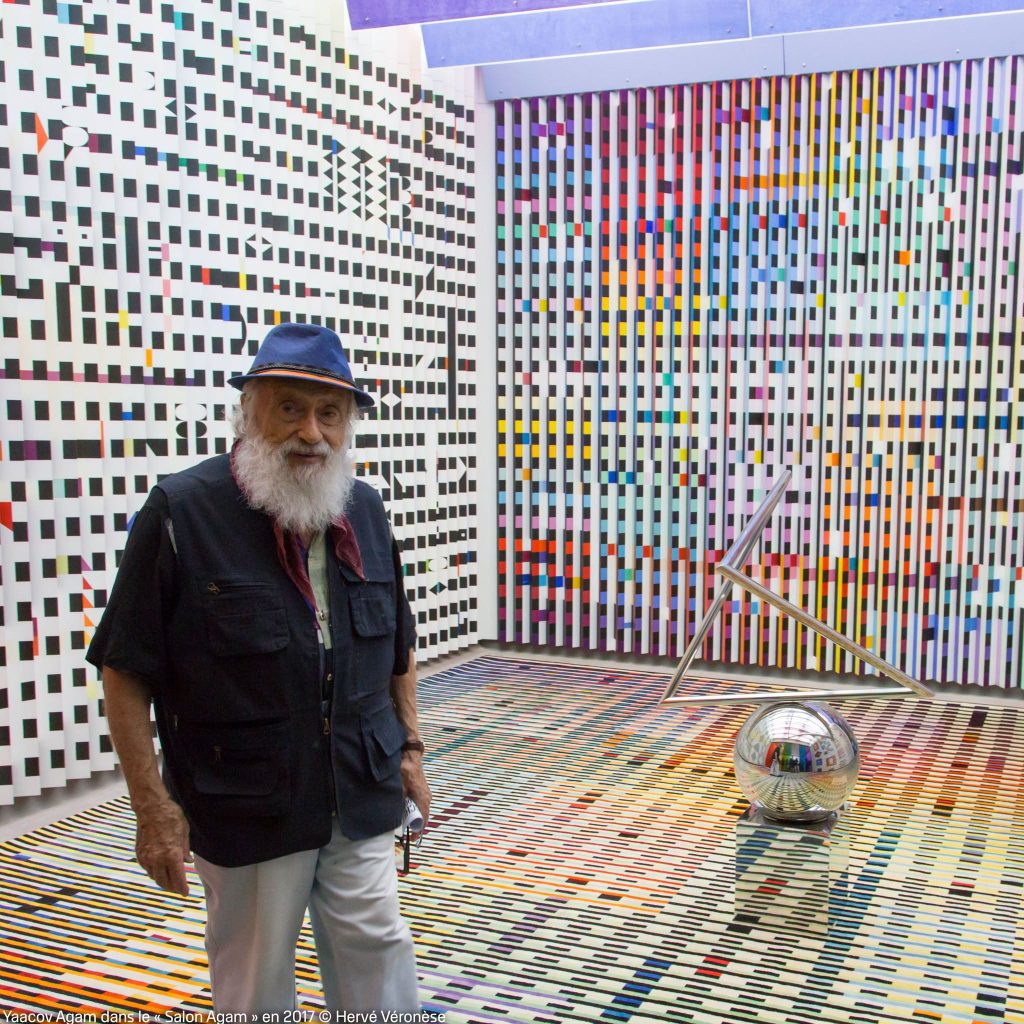
“When I finish a work, it is just starting.” — Yaacov Agam
One of my favorite Op Art artists and a true visionary, Yaacov Agam (Hebrew: יעקב אגם) was a pioneer of kinetic and Op Art. His work explored movement, color, time, and perception, making the viewer an active part of the artwork rather than a passive observer.
Born in Rishon LeZion in 1928, Agam studied at the Bezalel Academy in Jerusalem and later with Johannes Itten in Zurich. He moved to Paris in 1951, where he became one of the leading figures of the European avant-garde. His first solo exhibition was held there in 1953.
Agam died in June 2026, at 98, after receiving the Israel Prize for Visual Arts. His work is represented in major museums around the world.
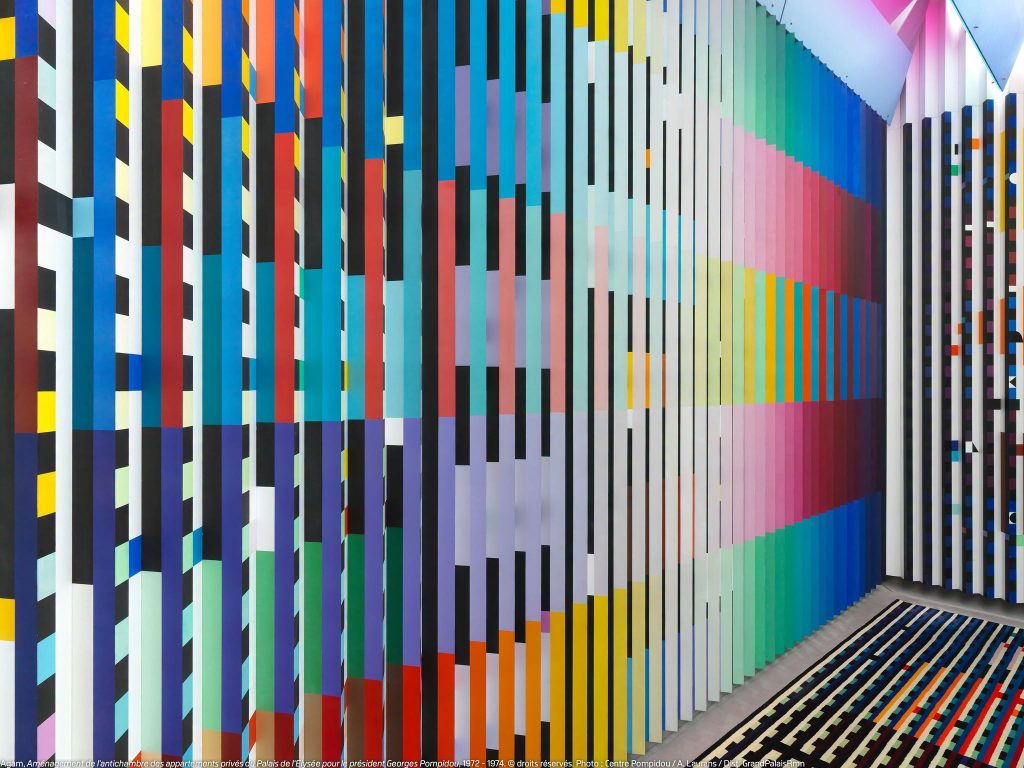
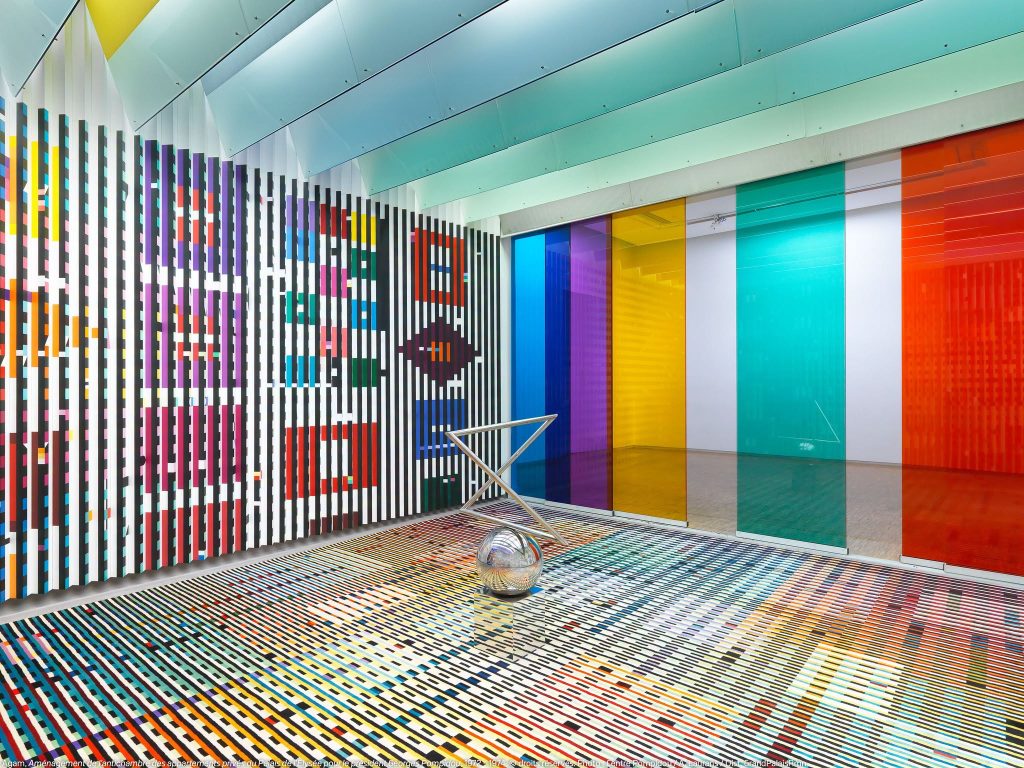
Among his most remarkable achievements is the Salon Agam, commissioned by President Georges Pompidou for the private apartments of the Élysée Palace and created between 1972 and 1974. Now in the collection of the Centre Pompidou, it is essentially a kinetic environment: walls, doors, ceiling, carpet, color and geometric forms change as the viewer moves through the space.
Agam understood something fundamental about visual art: the work is not always what you see. It is also what happens when you move, look again, and see something different.
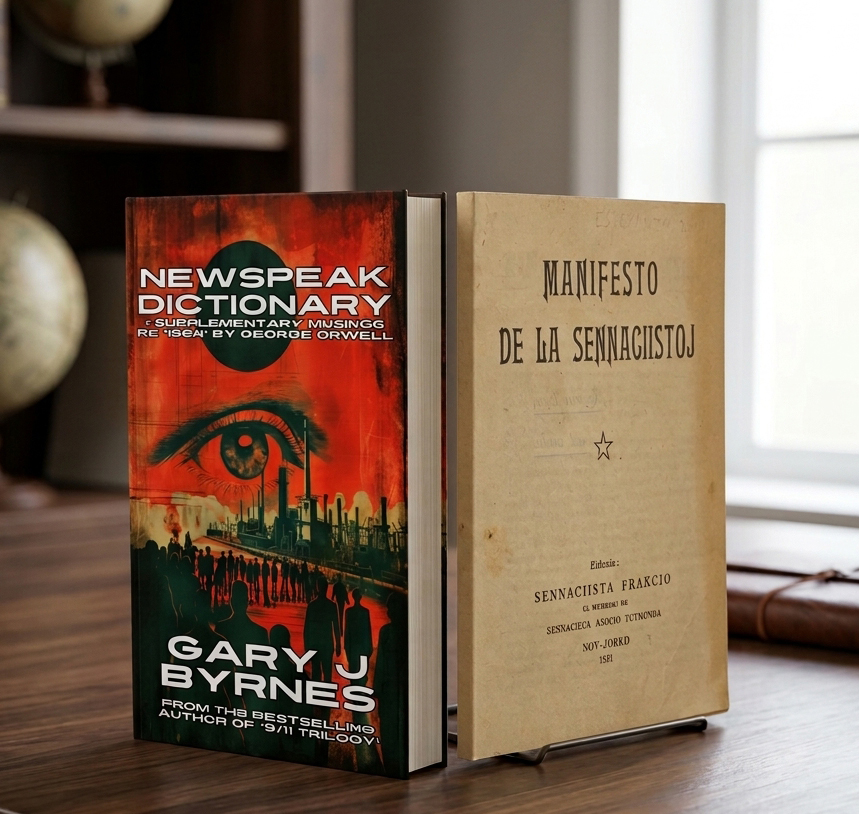
At first glance, Orwell’s Newspeak in 1984 and Esperanto seem to have little in common. One is the fictional language of a totalitarian regime; the other was created by L. L. Zamenhof as an international language designed to make communication easier between people from different countries.
Yet they share an interesting structural principle: the simplification of language through regularity and word formation.
In Newspeak:
good → ungood → plusgood → doubleplusgood
Instead of good, bad, better, or excellent, one basic word does much of the work through prefixes and modifiers.
A surprisingly similar pattern exists in Esperanto:
bona → malbona → pli bona → bonega
good → bad → better → excellent.
The resemblance is structural, but the intentions are radically different. Esperanto uses regularity to make a language easier to learn and to generate words without memorizing endless irregular forms. Zamenhof’s aim was not to restrict thought, but to facilitate international communication.
Newspeak, by contrast, is designed to reduce the space in which thought can operate. Its ultimate purpose is not merely to simplify communication, but to make certain ideas increasingly difficult—or eventually impossible—to formulate.
There is, however, an intriguing historical footnote.
For decades, it has been speculated that Orwell’s antagonism toward his aunt’s husband, Eugène Lanti, a French socialist and prominent Esperanto speaker, may have influenced his conception of Newspeak. The claim remains speculative, not an established fact. But the story is fascinating in its own right because it leads back to the 1920s and 1930s, when many people on the political left regarded Esperanto as more than a neutral language: they saw it as a vehicle for international solidarity, social change, and working-class emancipation.
That makes the apparent linguistic connection even more intriguing—but it is important not to confuse historical speculation with evidence.
The deeper issue lies elsewhere.
A language does not merely describe thought. It also provides many of the distinctions through which we organize it.
Words do not correspond one-to-one with things or ideas. They exist within a network of synonyms, antonyms, associations, contrasts, and cultural practices. Meaning is therefore, in an important sense, holistic: a word cannot be fully understood in isolation from the larger linguistic system in which it lives.
If excellent, remarkable, magnificent, admirable, and exceptional are all reduced to variations of good, we have not merely simplified the dictionary. We have reduced the palette of distinctions available to us.
Of course, structural simplicity does not automatically produce impoverished thinking. Esperanto is a good example: a language can be highly regular and economical while remaining capable of expressing complex ideas. The danger begins when simplification stops removing unnecessary complexity and starts removing meaningful distinctions.
And that is perhaps the point worth remembering:
Distinctions matter.
So don’t be afraid of linguistic complexity. When you write, use a good thesaurus. Look at the synonyms and antonyms. Explore the neighboring words and the subtle differences between them. Then choose the word that says exactly what you mean.
Because language is not beautiful despite its complexity.
Our visual system does not work like a camera shooting at a fixed number of frames per second. There is no single human “FPS.”
Reality is continuous, but our brain processes visual information on different time scales. Some visual mechanisms are remarkably fast; others are much slower. What we perceive depends on what we are looking at, the stimulus, its brightness and contrast, and even where it falls on the retina.
Flicker is a good example.
When a light flickers fast enough, we stop seeing individual flashes and perceive a steady light. But there is no universal cutoff such as 30 or 60 FPS. Under some conditions, humans can detect flicker well above 60 Hz, and the threshold changes with luminance, contrast, stimulus size, retinal location, and other factors.
And detecting a very brief visual event does not mean that we see at 250 FPS. Temporal resolution is not a single number. Different visual tasks have different limits.
Then there is the famous wagon-wheel illusion.
A spinning wheel can appear to slow down, stop, or even rotate backward. In films, this is a straightforward consequence of the camera sampling the motion at discrete intervals. Interestingly, similar effects can also occur under continuous illumination, suggesting that temporal sampling or aliasing may also occur within the visual system itself. The exact mechanism, however, is more complicated than simply saying that the brain “takes snapshots.”
And what about the feeling that time slows down during danger?
It can certainly feel that way. But experiments have found no evidence that frightening situations suddenly increase our temporal resolution—as if the brain switched to a higher frame rate. Instead, the experience seems to involve changes in attention, memory, and the way the event is reconstructed afterward.
So forget the idea that your brain runs at 30, 60, or 250 FPS.
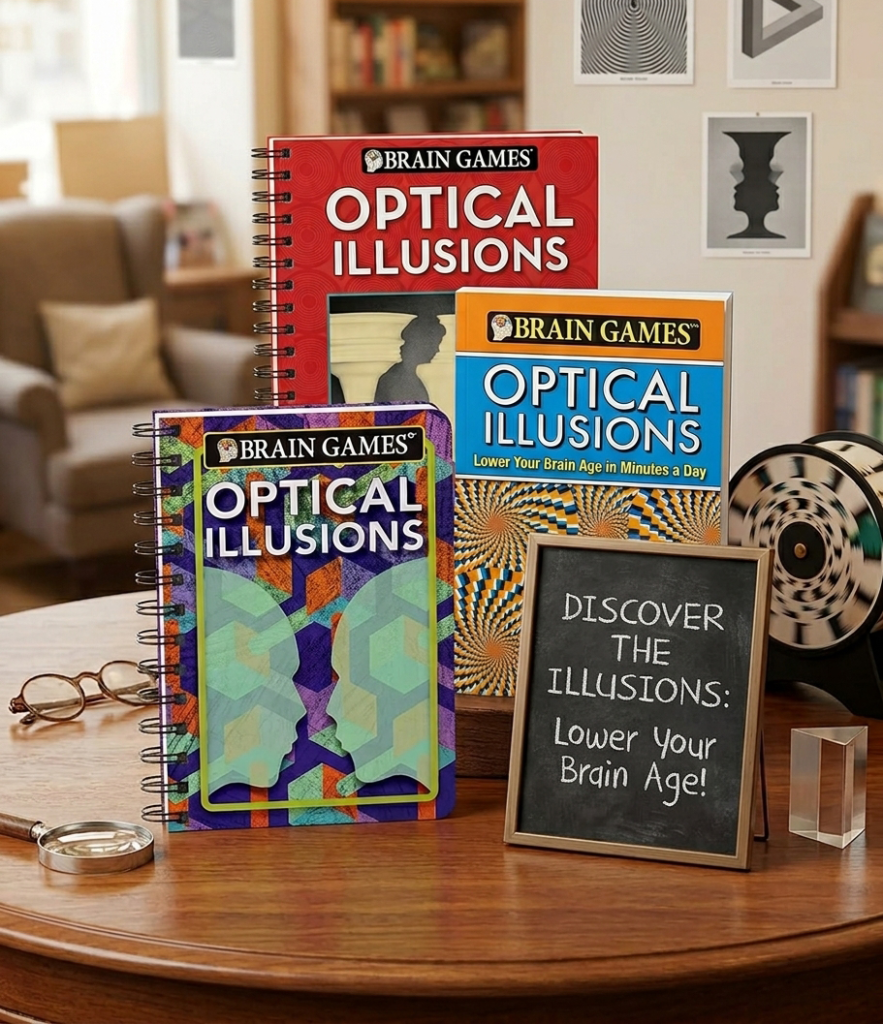
For many years, I collaborated with Publications International Ltd. (PIL) on the Brain Games™ series, creating hundreds of optical illusions for three books designed to challenge visual perception, observation, spatial reasoning, attention, and visual logic.
Optical illusions are more than visual tricks: they make the brain question its first interpretation, detect discrepancies, and construct a different explanation of what it sees. In that sense, they provide a stimulating workout for perception and reasoning.
I now put my expertise in visual perception and optical illusions at the service of publishers, educational institutions, medical centers, and other organizations looking for engaging ways to challenge and stimulate the mind.
Sometimes I wonder how we got here. As someone who has spent a lifetime reading and writing, I can usually spot AI-generated prose. The clichés, recycled formulas, suspiciously polished sentences, and repetitive rhythms often give it away. But apparently, most readers can’t. That’s a little unsettling.
A peer-reviewed study from Villanova University asked 1,682 people to read six short stories. Sometimes they were correctly told whether the author was human or AI; sometimes they were deliberately misled.
The result is uncomfortable.
The AI-written stories were rated 6% higher in quality and 8% more engaging than the human-written ones. Even more telling: when readers believed an AI story had been written by a person, they rated it even higher.
The real story isn’t AI. It’s us.
We don’t necessarily value authenticity—we value the belief that something is authentic. We romanticize the author’s life, struggle, and voice. Remove the label, and our judgment shifts.
AI may not have become a writer. It may simply have become remarkably good at producing the kind of prose that feels familiar, readable, and broadly appealing.
The disturbing question isn’t whether AI can write. It’s whether we can still recognize a genuine voice—or whether we’ve grown so comfortable with the average that we mistake it for excellence.
And yet, there is another layer to this uneasiness. It brings to mind Roland Barthes, who famously wrote: “The birth of the reader must be at the cost of the death of the Author.”
Barthes argued that meaning ultimately belongs to the reader, rather than to the author’s intentions or biography. AI adds a rather disturbing twist to that idea: what happens when the Author is no longer even a person—and when the reader cannot reliably tell the difference?
Beyond the conformity and mediocrity that AI may encourage, this makes me wonder how little we actually know about why we like what we read. Perhaps the real illusion is not that AI has learned to imitate us, but that we are far more predictable than we ever imagined.
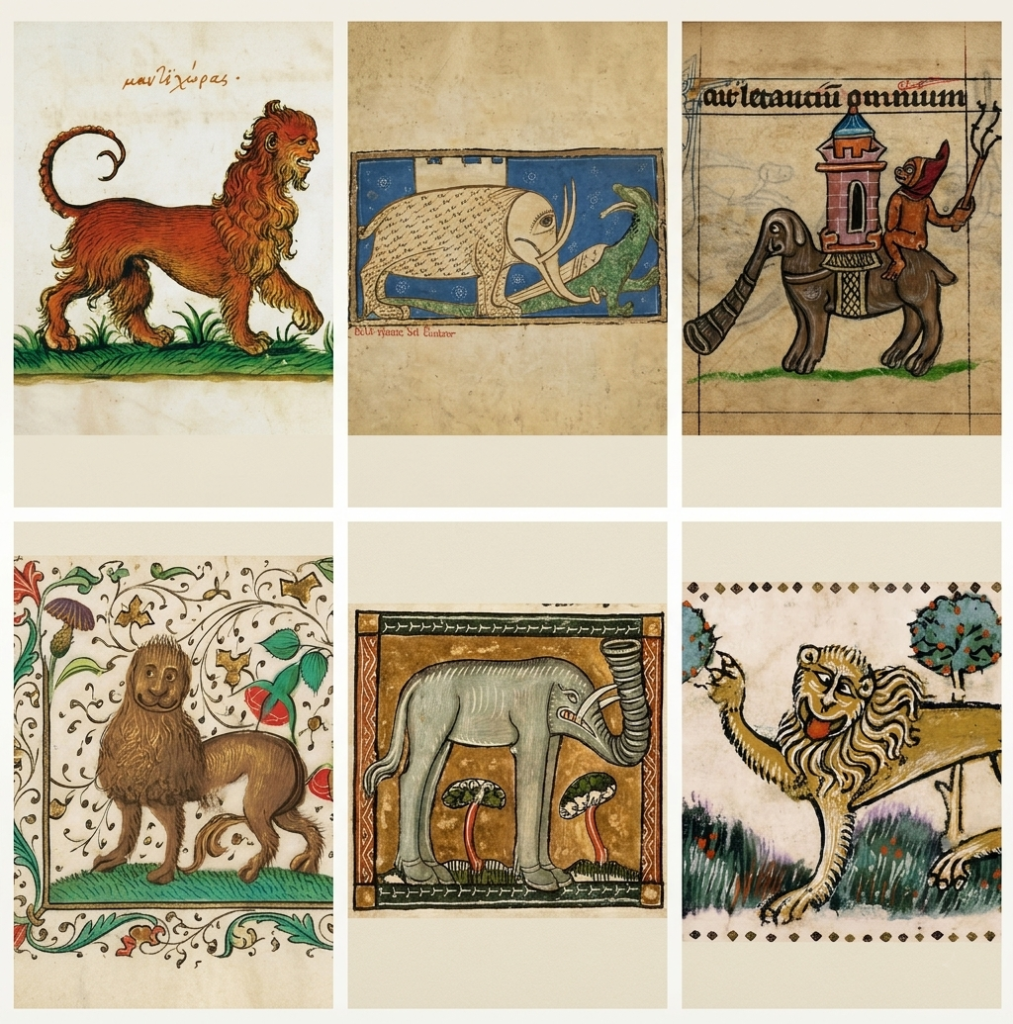
Lions had already appeared in Roman arenas, where they were set loose to devour Christians. Hannibal famously dragged elephants across the Alps. Yet, strangely enough, very few artists left us reliable images of these exotic beasts from the time.
So, centuries later, European artists faced a minor problem: how do you draw an animal you have never seen?
Simple. You copy someone who also never saw it.
This was the medieval version of the telephone game. A lion might be described in a manuscript, copied from an older drawing, or reported by a traveler as “a huge cat with a mane.” Each artist then copied, misunderstood, embellished, and passed the result on. After enough generations, the lion could acquire a human face, bizarre feet, and the general appearance of a creature that had escaped from someone’s nightmare.
The same problem survived well into the Renaissance. Take Albrecht Dürer’s famous 1515 rhinoceros. Dürer had never seen a rhinoceros. He worked from a written description and a sketch made after a real Indian rhino arrived in Portugal. He added armor-like plates that the animal did not actually have.Yet his rhinoceros became so influential that Europeans kept copying Dürer’s imaginary details for centuries.
There is something wonderfully philosophical about this: we rarely inherit reality itself. We inherit other people’s descriptions of it—and then confidently mistake the copies for the truth.
Details and Attributions for Each Picture
Top Row (Left to Right)
1. Top-Left (Manticore / μαντιχώρας) Author / Artist: Unknown Medieval/Renaissance Illuminator (Greek manuscript tradition) Date: Unknown (c. 16th Century / Early Modern Era) Source / Context: Greek bestiary depicting the legendary Manticore with a lion’s body, human head, and scorpion-like tail.
2. Top-Middle (Elephant and Dragon / “De La Nature Del Olifaunt”) Author / Artist: Unknown French Illuminator Date: Unknown (c. 13th–14th Century) Source / Context: Old French bestiary manuscript (Bestiaire) detailing the natural history and allegorical nature of the elephant and its rival, the dragon.
3. Top-Right (Monkey Riding an Elephant / Text: “aut letanias omnium”) Author / Artist: Unknown Medieval Illuminator Date: Unknown (c. 13th–14th Century) Source / Context: Medieval manuscript marginalia / Book of Hours depicting a caped monkey riding a castle-bearing elephant (Howdah).
Bottom Row (Left to Right)
4. Bottom-Left (Smiling Lion in Floral Border) Author / Artist: Unknown European Illuminator / Miniature Artist Date: Unknown (c. 15th Century) Source / Context: Illuminated manuscript page with ornate floral acanthus border work showing a stylized lion.
5. Bottom-Middle (Trumpet-Trunked Elephant with Trees in Framed Border) Author / Artist: Unknown English or Northern European Illuminator Date: Unknown (c. 13th Century) Source / Context: Latin Bestiary miniature showing a stylized medieval elephant with trumpet-like trunk and tusks.
6. Bottom-Right (Paw-Raising Lion under Fruit Trees) Author / Artist: Unknown Medieval Illuminator Date: Unknown (c. 13th–14th Century) Source / Context: Medieval Bestiary illustration depicting a lion gesturing toward fruit trees.
Many people believe that a book’s title is born directly from the author’s brilliant mind. Cute idea… but often completely wrong.
In reality, titles are frequently chosen by publishers — and, above all, by their marketing teams, who sometimes treat a book title like a product label rather than a piece of literature.
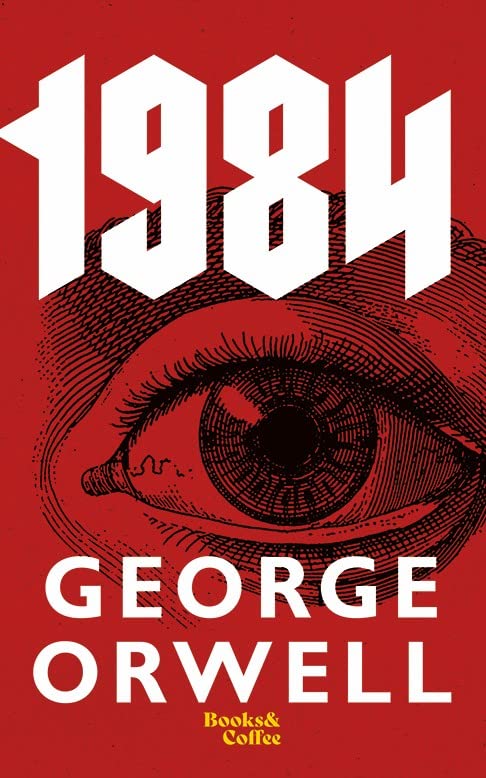
Take one of the most famous titles of the 20th century: 1984 by George Orwell, the great English political writer. When Orwell wrote the novel in 1948, its working title was The Last Man in Europe. His publisher found it a little too gloomy and uninspiring, suggested reversing the last two digits of the current year, and voilà: 1984 was born.
Not a bad decision. That “commercial” title went on to become a cultural landmark, and many ideas and expressions from the book are still part of today’s political vocabulary.
As an author, I’ve often had to fight battles to prevent publishers from giving my books painfully dull — or downright silly — titles. One of my books, for example, was given the wonderfully imaginative title Optical Illusions by the publisher. A title so original it could probably hide in a crowd of a thousand other books.
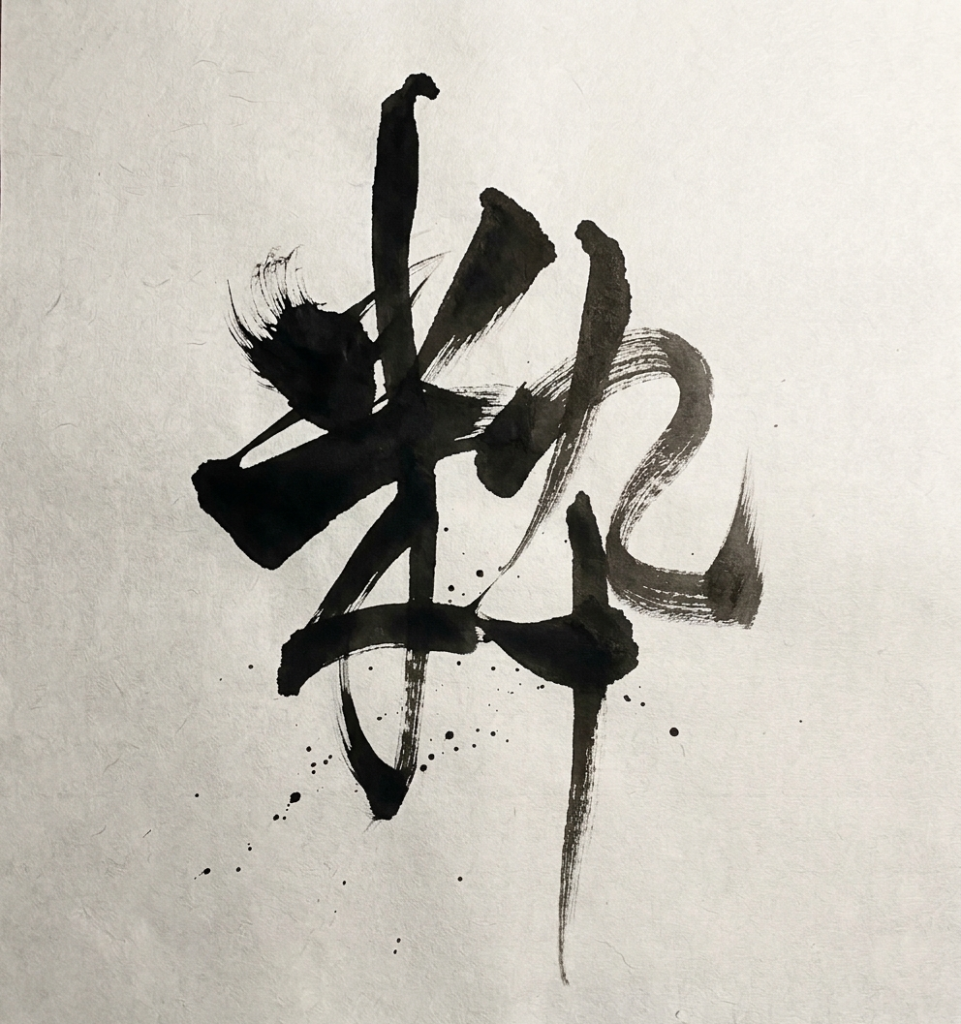
Edo, under the Tokugawa shogunate. Merchants wealthy enough to unsettle the hierarchy, yet still ranked below the samurai. Power without status—watched closely, dressed carefully.
Sumptuary laws did the rest: no gold, no loud silk, no bright declarations. Only browns, greys, indigo. A forced muting of visibility.
Constraint rarely suppresses imagination. It concentrates it.
From this narrow register emerged a refined spectrum known as Shijuhattcha Hyakunezumi (四十八茶百鼠)—“48 browns, 100 greys.” Not literal numbers, but a cultural way of naming excess within restraint: an almost infinite sensitivity to difference inside what first appears uniform.
Fashion became a coded language. Subtle shifts in tone, legible only to trained eyes. Outside, discipline. Inside, excess held in reserve. A lining of rare fabric. A color hidden against the skin. A private flash revealed only when a sleeve turns in the wind.
This is iki: elegance that refuses emphasis. Presence without display. A form of refinement that collapses the moment it is named.
Its opposite is yabo (野暮): excess, insistence, the compulsion to be seen. Not morality—measure. Or the lack of it.
Today, the direction has inverted. Visibility has become currency. Those who do not perform disappear; those who do not declare are not counted. What was once failure has become strategy.
And yet the counter-move remains simple.
Lower the volume. Leave gaps. Let meaning breathe in what is not shown.
Some say abstract art is non-representational—that it avoids visual reality and relies on color, shape, form, and gesture to trigger emotion or thought. I see it differently. Abstraction does not reject reality; it reframes it. It is a change of optics, not a disappearance of the world.
Take, for example, this video of goldfinches perched on swaying thistles. At first glance, does it not resemble an abstract painting? Rhythms, repetitions, subtle chromatic tensions, forms dissolving into movement. From there, one could push the abstraction further with the slightest shifts in shape or color—without betraying reality, only rephrasing it.
This idea is hardly new. From Cézanne’s insistence on treating nature through cylinder, sphere, and cone, to Kandinsky’s claim that abstraction reveals inner necessity rather than surface likeness, many artists and thinkers have argued that abstraction sharpens perception instead of diluting it. Even in cognitive science, perception is understood as an active construction, not a passive recording of facts.
Abstraction starts precisely there: with attention. Not with denial, not with decoration, but with the recognition that reality is already structured, already abstract, long before the artist intervenes.
I’ve always wondered about the limits of shape and color needed for us to represent or recognize an object. Take a stemmed glass, for example. To depict it, you might need just two circles and a straight line—and perhaps a red disc to suggest the wine inside.
But we can go further: by turning it from a flat image into a 3D form with a simple rotational movement, like in Duchamp’s rotoreliefs, the object suddenly comes alive in space.
All these graphic shortcuts rely on memory. Our brains interpret what we see based on past experience, filling in missing information and reconstructing the object from just a few essential cues. This process aligns with the principles of visual perception: the Gestalt laws of closure and continuity explain why we perceive a complete glass even when much of it is absent. Minimalist perception highlights how human cognition distills visual information, showing that a few simple shapes and colors are enough to evoke a rich, instantly recognizable image.