Exploring Tessellations & Op Art: Hidden Arrows

This brief tutorial explores an Op Art tessellation that plays with bistable perception, figure–ground reversal and negative space. By combining modular geometric tiles with contrasting colors, the pattern creates a visual interplay in which arrows can be perceived as either foreground shapes or background forms, depending on how the pattern is interpreted.

Experiment 1:

· Preparation — Fig. A: Start with a 3 × 3 square. Divide it along its diagonals into four triangles, then add a 1 × 1 square to the outer side of each triangle, as shown. Color the resulting cross-shaped tile with two contrasting colors, ensuring that adjacent sections are different colors. The construction produces four inward-pointing arrows.

· Preparation — Fig. B: Following the construction shown, subdivide a 2 × 2 square to create five diamonds arranged in a staggered pattern. Use the same two contrasting colors. This produces a complementary tile containing four outward-pointing arrows.

· Assembly — Fig. C: The two tiles are complementary and fit together. Interlock the cross-shaped tiles with inward-pointing arrows and the square tiles containing the diamond pattern to create a continuous tessellation.
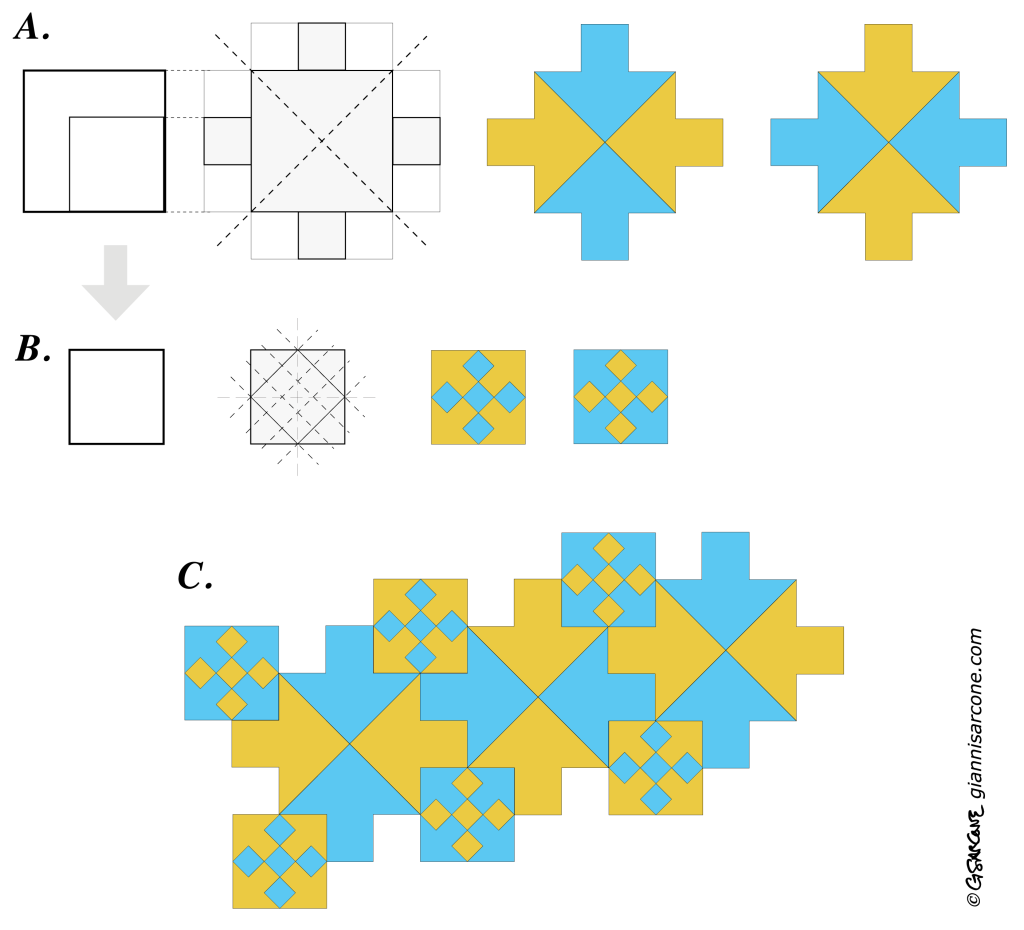
Visual result: The alternating geometric modules form a large geometric Op Art pattern in which arrows emerge through figure–ground reversal. And hidden within it are, believe it or not, 100 arrows. Yes, one hundred arrows!
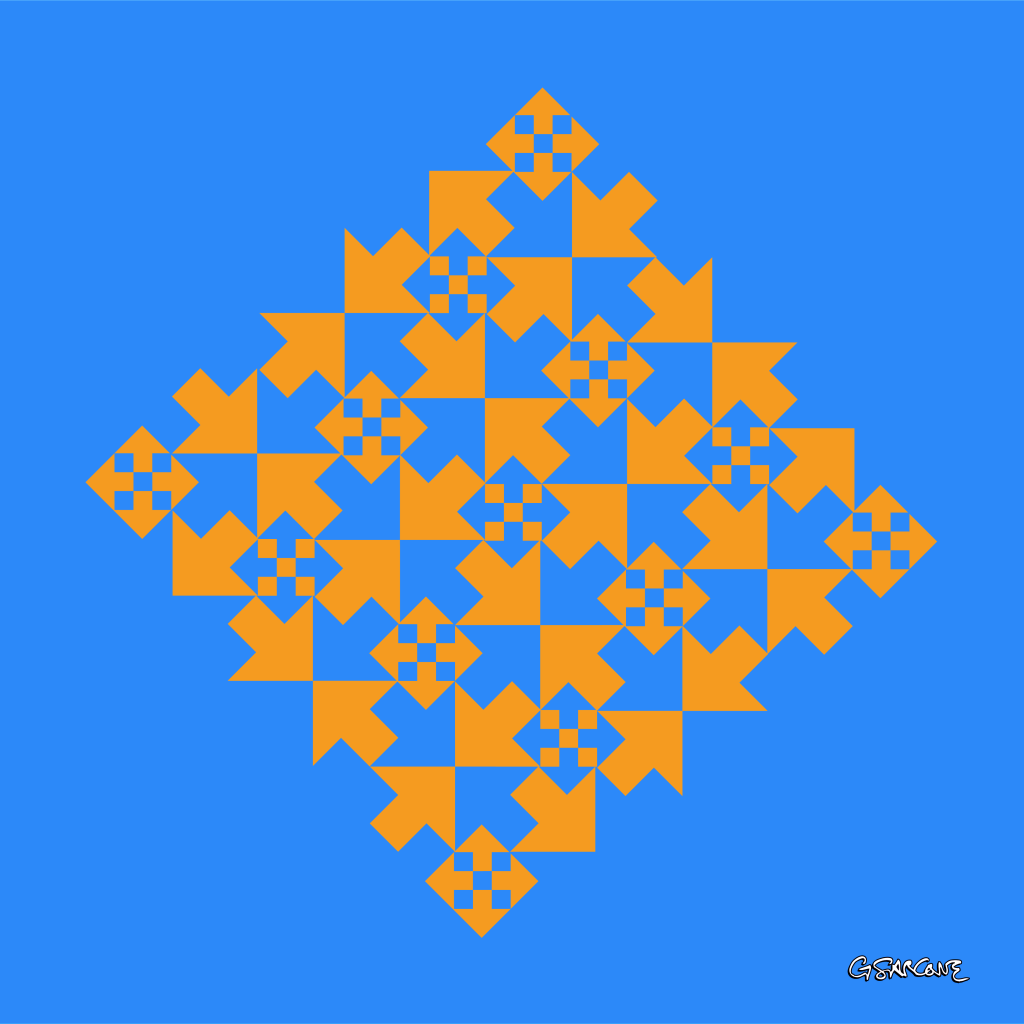
This op art work is available as fine art prints and canvases from my online official gallery.

Experiment 2:

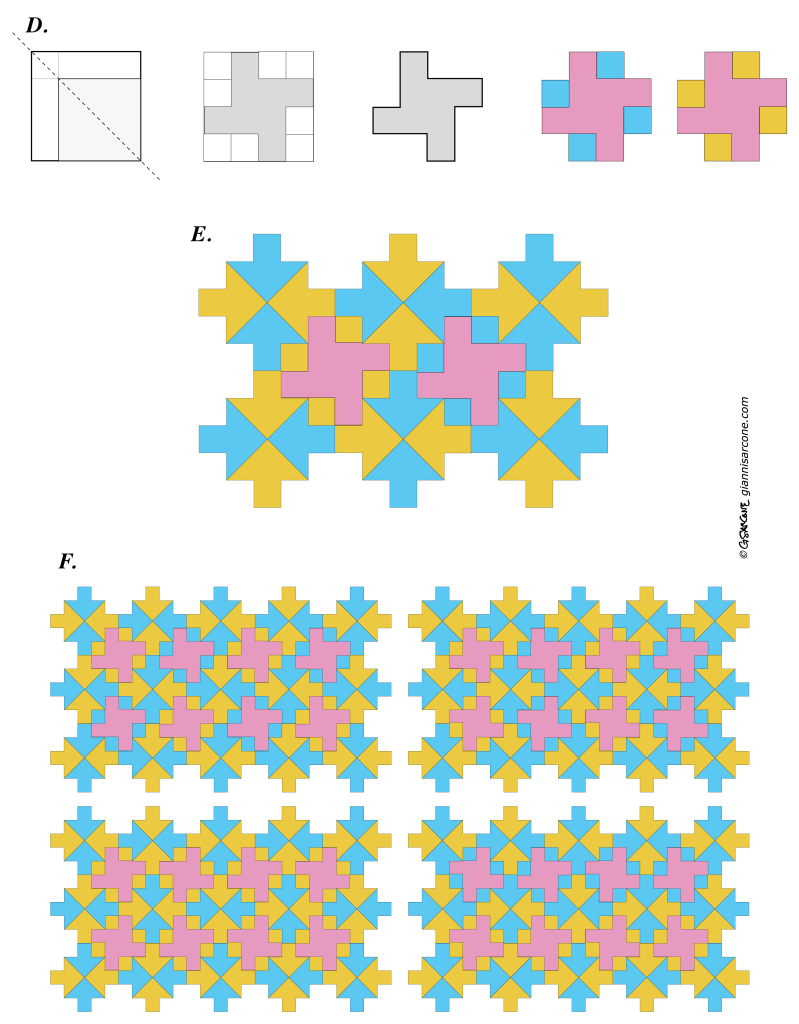
· Preparation — Fig. D: Build a four-armed pinwheel shape from a 4 × 4 square, as shown.

· Assembly — Fig. E: Interlock the four-armed pinwheel shape with the cross-shaped motifs containing the inward-pointing arrows.

· Assembly — Fig. F: As shown, these four-armed pinwheel shapes can be assembled in four or more different ways, producing different geometric configurations.
Visual Result: As seen in the example below, the contrasting colors make the bright blue arrows radiating around the pink central hubs—the pinwheel shapes—stand out, while the yellow arrows, matching the background color, virtually disappear from view.
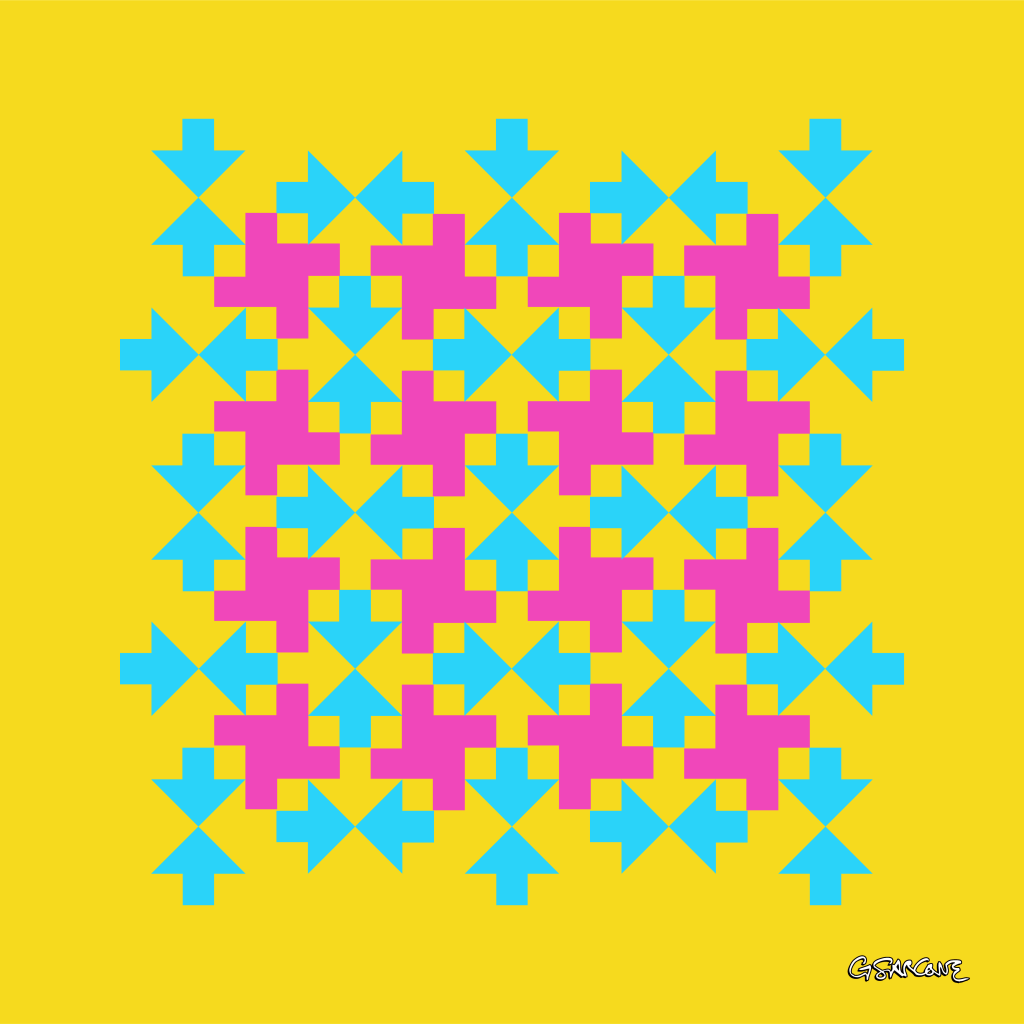
pattern with pinwheel shapes

Experiment 3:

· Preparation & Assembly — Fig. G: Combine square tiles containing interior diamond arrangements with tiles featuring four inward- and four outward-pointing arrows formed by negative space. Arrange them alternately to create a checkerboard pattern.
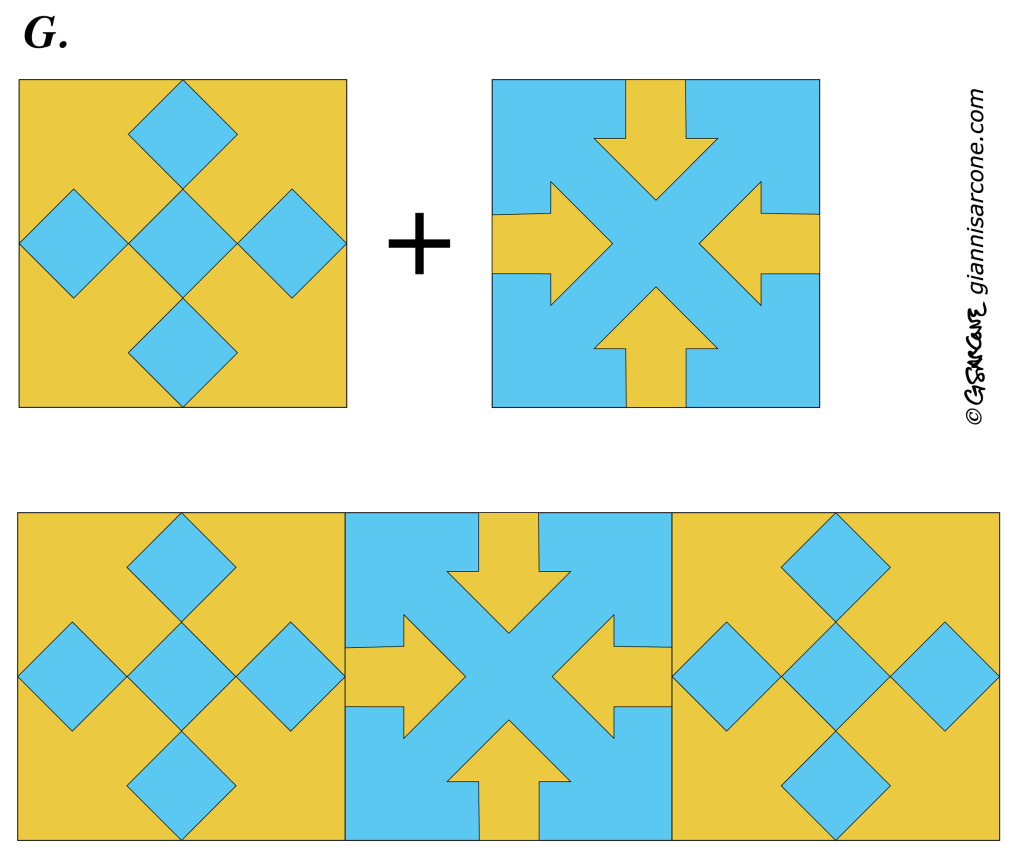
The example below shows a 3 × 3 alternating checkerboard configuration that surprisingly reveals 52 arrows in total.
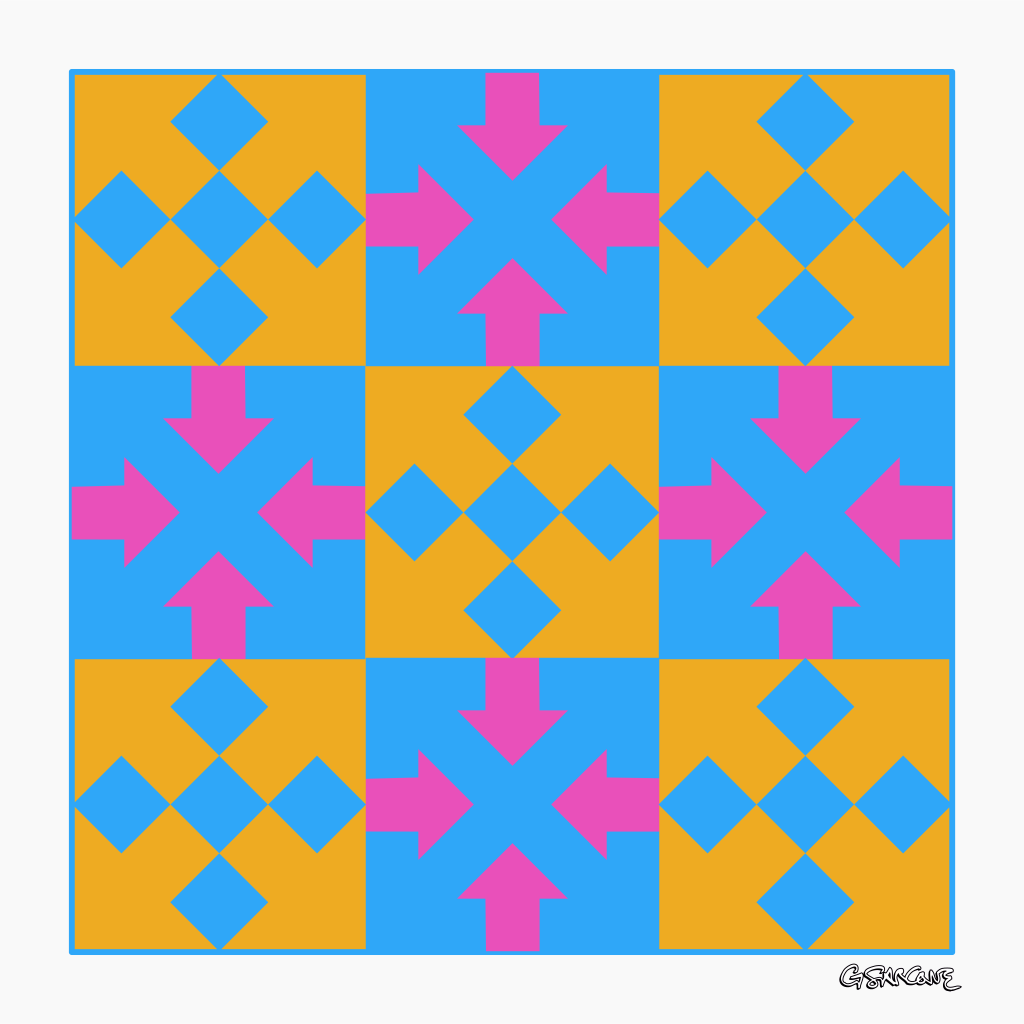
Variation: Here is a striking variation of the tile with four inward- and outward-pointing arrows. The inward arrows extend into continuous paths on a white background, creating the effect of interwoven arrowed ribbons.

Extra 3D Arrow Illusion

Let’s take a different direction from the experiments above and explore a 3D isometric illusion. This construction is inspired by classic impossible figures depicting ambiguous stacks of cubes, whose apparent number can change depending on how you interpret their spatial arrangement.

Start with a hexagonal boundary (Fig. 1) and overlay a triangular isometric grid (Fig. 2). Then draw six interlocking arrow shapes around a central point, folding their tails inward (Fig. 3).

Finally, use three colors to shade the isometric planes, or apply directional line hatching, to give the flat arrows a three-dimensional, interlocking appearance.
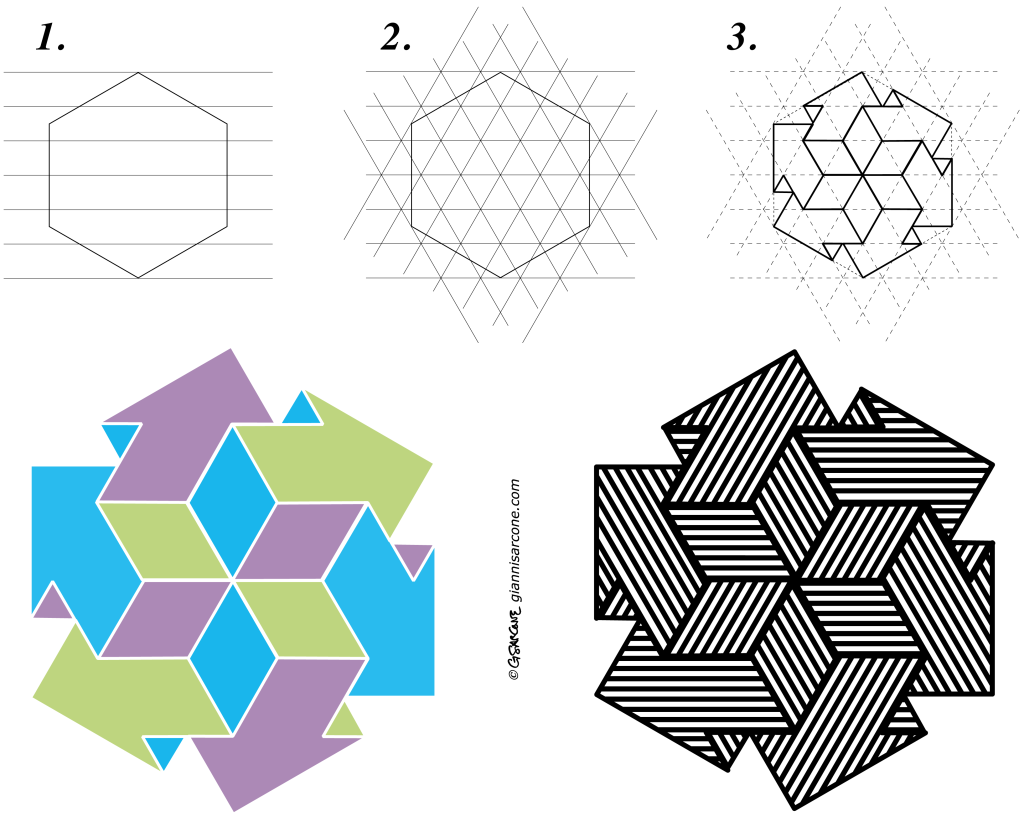
Curious about the mathematics behind these impossible 3D arrows? Math lovers can explore the geometry and construction 👉 here.

Master of Numbers

“The Master of Numbers” is an Op Art photomosaic portrait of the renowned physicist, created from a collection of photographs of numbers. Each detail contributes to a visual exploration of mathematics, perception, and pattern. The project took me two years to complete, photographing numbers in the most unusual places and objects, and bringing them together into a single portrait.


And a little secret: tucked inside the mosaic is a tiny portrait of me and my wife—a fun, hidden signature and a personal touch.

Limited edition posters and prints are available through my online gallery.

Layering Up: A Creative Look at AI

Ever wondered how Convolutional Neural Networks (CNNs) process images? Imagine putting a photo through a pasta machine… TWICE! This creative experiment, inspired by artist Kensuke Koike, demonstrates how CNNs break down data into smaller, layered features, just like the pasta machine creates four clear images from a single input.

© Kensuke Koike

Quando l’arte incontra la scienza: l’enigmatica Moona Lisa

Sono felice di condividere che la mia opera congiunta Moona Lisa, realizzata in collaborazione con l’astrofotografa Marcella Giulia Pace, è ora esposta presso il Dipartimento di Fisica e Astronomia dell’Università di Firenze. Potete scoprire di più su quest’opera qui: Moona Lisa – UniFi. Moona Lisa sarà inoltre parte della mostra permanente di Enlighting Mind, un’esposizione dedicata alla connessione tra arte e scienza.

Il prossimo 13 dicembre, Marcella terrà un seminario al dipartimento dal titolo preliminare “Moona Lisa e l’enigma della luna”, dove esplorerà il mistero e la bellezza della nostra opera attraverso la lente dell’astrofotografia.

Per chi fosse interessato ad acquistare l’opera sotto forma di stampa, potete farlo nella mia galleria online: Redbubble.

Triangles of Beauty

Introducing my latest creation, Triangles of Beauty—a minimalist mosaic that blends geometric precision with visual intrigue. This op art piece showcases a striking arrangement of triangular shapes in sepia tones, merging rich shades of brown and beige. The triangle, a timeless symbol, embodies the balance of masculine and feminine energies, forming a harmonious third element that transcends duality. It represents strength, unity, and the divine—a visual echo of the trinity, where individual components unite into something greater.

Step back and let the patterns unfold to reveal the depth within this thought-provoking piece.

This thought-provoking op art piece is available in my online galleries:

· Redbubble

· Fine Art America

Moona Lisa

In 1997, I reimagined Leonardo da Vinci’s Mona Lisa through a system of 142 color beads, each precisely positioned at the nodes of an invisible two-dimensional triangular grid. Up close, the pattern appears abstract, yet from a distance, the arrangement resolves into the familiar features of the portrait, inviting viewers to recognize the image through perception and suggestion.

hidden mona lisa
Hidden Mona Lisa (1997), © Gianni A. Sarcone
Continue Reading →

The Master of Numbers

Presenting “The Master of Numbers,” my acclaimed artwork. This photomosaic portrait, assembled from 288 random number-themed photos, creates a captivating optical illusion, revealing the image of a great physicist from a distance.

Currently showcased in numerous Museum of Illusions globally, posters and prints of this optical art can be found on my online store.

einstein large Continue Reading →

Subliminal Faces

This series of works questions the many cognitive aspects of faces’ recognition. People often see hidden faces in things, clouds, landscapes, or in architectural structures… Finding the latent or virtual image hidden in the manifest image is a mental process related to the concept of the “lost object” used in psychoanalysis. As an artist, I enjoy including subliminal messages or figures in my work. My paintings, photographs and collages play on the foreground and background relationship of our visual perception and represent common or iconic faces the viewer has to rediscover.

The Master of Numbers
Collage – mixed media, 2006

Photomosaic portrait of Albert Einstein made with random photographs of numbers.
It is only when the viewer moves away from the image that the portrait of Einstein appears. It is the distance that creates and unveils the truth, because everything is relative as Einstein once said and everything depends on the context, the environment or the point of view.

Continue Reading →

Shadows Creating The Illusion of Depth

I particularly enjoyed the fishpond mosaics with 3D trompe-l’oeil effects by Gary Drostle. Gary is a UK award winning artist specializing in murals and mosaics. He made a series of fishpond floor mosaics with golden fish, the shadow of which creates the illusion of depth. The circular concentric ripples even boost the 3D depth effect of the compositions. I love the simplicity and ingenuity of these stunning pieces of art!

3D Mosaic fishpond

3D Mosaic fishpond 2

Continue Reading →