Algae in my eyes

Deep in the retina, an ancient memory persists. Our visual cells rely on “opsins“—light-sensitive molecules inherited from unicellular organisms that existed long before animals. For over a billion years, life has refined this simple act: catching light.
In the sea, the same logic still plays out. Some oysters host algae on their mantle; they feed them, and in return these light-sensitive cells signal the presence of light. A quiet watch system—almost an eye, spread across a surface.
In certain algae, like Chlamydomonas reinhardtii, a tiny eyespot—the stigma—is enough to steer the organism toward light. Not an eye, but already a direction, a choice.
Our rods and cones extend that first invention: a long lineage of light detectors, slowly shaped over time, linking our vision today to the faint glimmers of the earliest oceans.
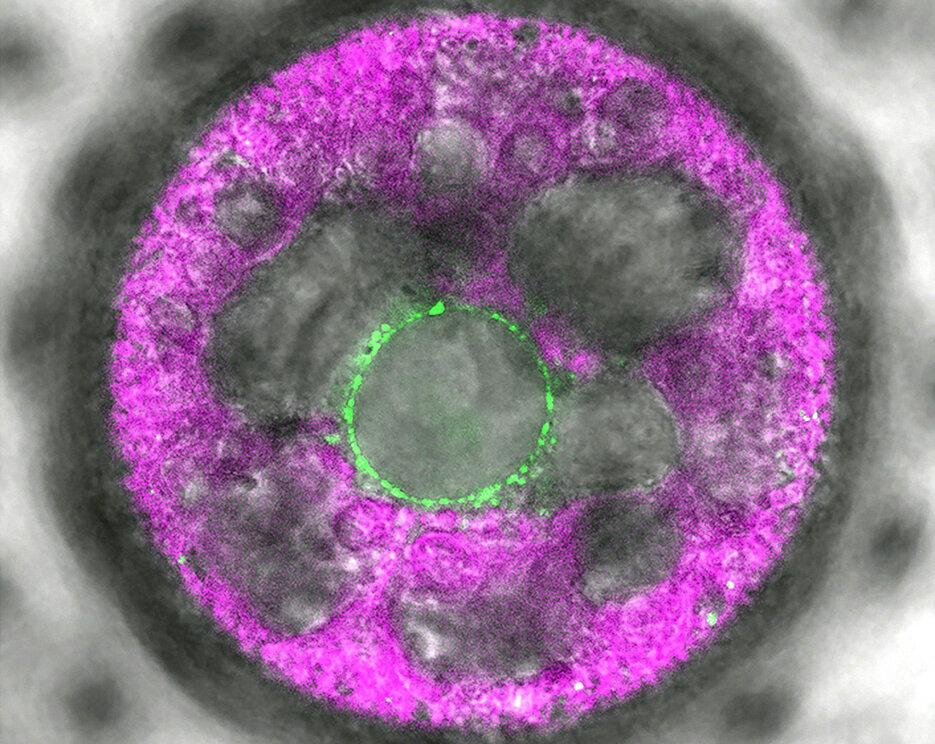
In the tiny alga Volvox, a newly found light sensor glows green, showing where it sits around the cell’s center. (Image: Eva Laura von der Heyde / University of Bielefeld)

Further reading.

A Window on the World

The human being is a sponge who absorbs the changes of the physical world surrounding him. Actually, if the physical world had been unchanging, we wouldn’t need to receive sensations on the world that surrounds us since all would be static and everything would definitely have its final place!

Our sense organs continuously check, then, the changes of our immediate environment to allow us to act and react in keeping with it. If we see a wall in front of us, for example, we won’t charge into it, of course, but try to avoid it! Our senses however detect only a part of the reality – the most useful for us – and translate it in an ‘analogical’ way. Yes, our senses work analogically… For instance, it’s difficult to consider a single color in a distinct way, but always in relation to others. The same red color will be perceived differently according to the content or the context where it lies within.

Every living being has a ‘repertoire’ of sense organs which is peculiar to him, with a particular predilection for one or two sense organs: the human being favors sight; the dog, smell; for bats, it’s hearing… Concerning the color’s perception, animals do not all see in the same way because they aren’t perceptive to the same part of the luminous spectrum. Here are two extreme cases: insects, for example, see the ultraviolet rays, while on the other hand, some snakes can perceive infrared rays.

Continue Reading