“The Master of Numbers” is an Op Art photomosaic portrait of the renowned physicist, created from a collection of photographs of numbers. Each detail contributes to a visual exploration of mathematics, perception, and pattern. The project took me two years to complete, photographing numbers in the most unusual places and objects, and bringing them together into a single portrait.
And a little secret: tucked inside the mosaic is a tiny portrait of me and my wife—a fun, hidden signature and a personal touch.
Limited edition posters and prints are available through my online gallery.
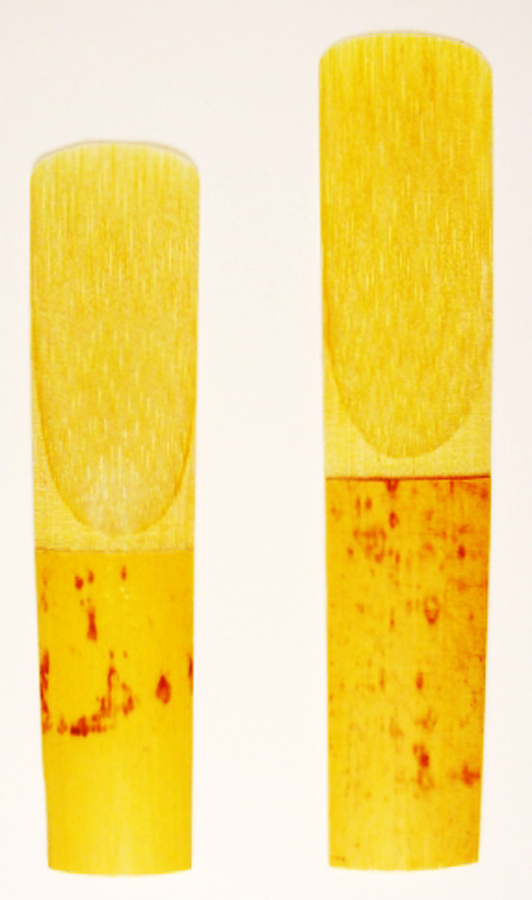
A reed—sometimes called a “lamella”—is a thin strip of material that vibrates to produce sound in a musical instrument. Most woodwind reeds are cut from Arundo donax, the so-called giant cane. Take that small, stubborn sliver away and the clarinet or saxophone becomes what it truly is: a hollow tube. No tone, no music—just breath wasted in polished plumbing.
The reed looks trivial, almost laughably so. A scrap of cane shaved to a sliver. Yet it is the only part that dares to vibrate. Without that fragile defiance, the instrument stays mute.
Humanity functions in much the same way. Each of us is a reed in a colossal instrument that calls itself civilization. Frail, replaceable, easy to overlook—yet necessary.
History loves to celebrate the instrument: the grand structures, the shining mechanisms, the impressive machinery. But the sound—when it happens—always begins with a thin piece of cane trembling under pressure.
First, observe the alignment of the red circles as they move in a straight vertical path, up and down. Then keep your gaze on one of the three Xs in the middle. What do you notice?
The red circles seem to drift away from their true physical trajectories, as if they were following the curves of the static lines. This perceptual shift is known as the “Mainz-Linez Illusion“.
When you keep your gaze on the central X, the moving dots shift into peripheral vision, where spatial resolution is limited and detail is reduced. The visual system compensates by interpolating missing information based on contextual cues and prior experience. As a result, the dots become perceptually “bound” to the nearby curved lines, as if threaded on them, and their straight vertical motion is misread as oscillating.
The Mainz-Linez phenomenon reflects a broader principle: peripheral vision is largely constructive. Under certain conditions, this predictive filling-in can also distort motion judgments in real-world tasks—such as driving—where events in the periphery may be misperceived.
As a visual creator, over the years I have developed a broad collection of mind games and hands-on activities designed to foster visual and critical thinking while supporting the learning of mathematics. These features, created for readers of all ages, are available for licensing to newspapers, magazines, and media platforms seeking distinctive, high-quality editorial content that captures attention and sustains reader interest.
Interested in adding a fresh editorial feature that energizes your publication? Explore the available offerings at Knight Features.
My minimalist tribute to M. C. Escher: an animated “impossible waterfall,” drawn frame by frame. It’s not exactly my usual artistic language, but I had great fun creating it, and I hope you’ll enjoy watching it as much as I enjoyed making it.
As you can see, the isometric structure links impossible angles to create a continuous water channel that appears to flow upward in a loop, falling from a high point yet seemingly returning to the top.
The “impossible waterfall,” reimagined in a lavish Rococo style, rendered as a surreal illustration for a book project.
Impossible or undecidable figures have long fascinated artists, mathematicians, and viewers alike. Their appeal lies in a delicate tension: the structure appears perfectly logical at first glance, yet closer inspection reveals spatial contradictions that cannot exist in the physical world. My latest work revisits an idea I first explored in the 1990s—an impossible Rubik’s-style cube—now developed into a new series built across several stages, from hand-drawn construction to digital refinement and photographic interpretation.
The project began with a simple geometric framework—interlocking beams arranged to suggest a stable cubic volume. The challenge was to reinterpret an apparently ordinary three-dimensional cube into an ambiguous form that still appears structurally plausible. Through careful adjustments of line weight, contrast, and directional and formal cues, the cube gradually shifts from perceived solidity to spatial uncertainty, so that as the eye moves across the image, the object quietly reorganizes itself, producing a surreal perception in place of a coherent physical structure.
Here is the original version of the project, refined from my initial hand-drawn construction and carefully reconstructed using FreeHand MX
Two of the final images belong to the Op Art tradition, where sharp black-and-white geometry emphasizes visual tension and rhythmic structure. These compositions highlight the cube’s architectural clarity while allowing the paradox to emerge naturally from the viewer’s perceptual processing. The remaining two images take a different path: they present the object in a photographic setting, rendered with realistic lighting and textures.
Together, the four images form a small visual narrative—construction, transformation, and illusion—showing how a purely conceptual structure can evolve into multiple aesthetic forms. The Op Art versions focus on perceptual mechanics, while the photographic interpretations suggest how an impossible form might inhabit the physical world, even if only in appearance.
Fine art prints and canvas editions from this series are available through my official gallery shop, where each piece is produced using archival materials designed for long-term display.
Collectors and galleries interested in larger formats or special editions may also contact me directly for availability and production details. This series continues my exploration of perceptual geometry, where simple shapes become instruments for questioning how we construct space, depth, and visual certainty.
Some say abstract art is non-representational—that it avoids visual reality and relies on color, shape, form, and gesture to trigger emotion or thought. I see it differently. Abstraction does not reject reality; it reframes it. It is a change of optics, not a disappearance of the world.
Take, for example, this video of goldfinches perched on swaying thistles. At first glance, does it not resemble an abstract painting? Rhythms, repetitions, subtle chromatic tensions, forms dissolving into movement. From there, one could push the abstraction further with the slightest shifts in shape or color—without betraying reality, only rephrasing it.
This idea is hardly new. From Cézanne’s insistence on treating nature through cylinder, sphere, and cone, to Kandinsky’s claim that abstraction reveals inner necessity rather than surface likeness, many artists and thinkers have argued that abstraction sharpens perception instead of diluting it. Even in cognitive science, perception is understood as an active construction, not a passive recording of facts.
Abstraction starts precisely there: with attention. Not with denial, not with decoration, but with the recognition that reality is already structured, already abstract, long before the artist intervenes.
Explore My World of Art, Books, and Creative Concepts