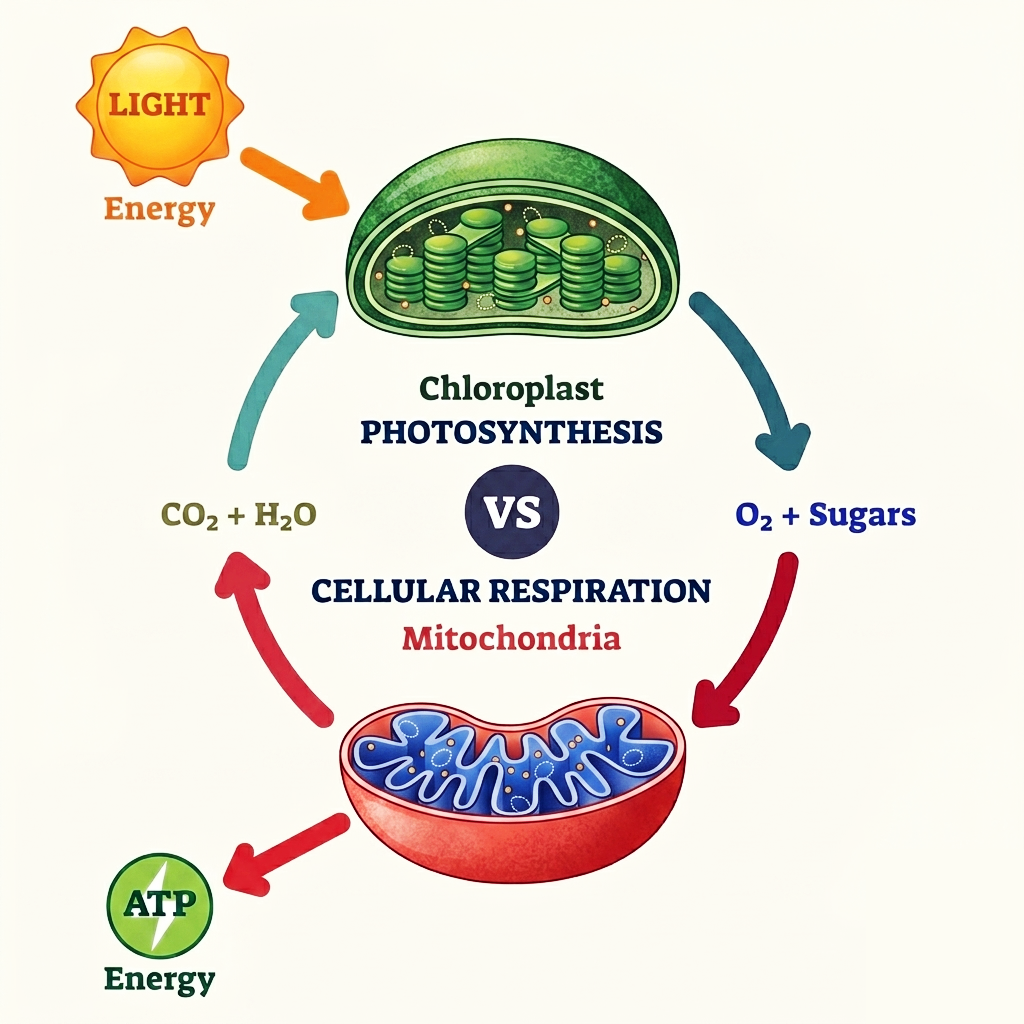
Inside plants and living beings, there are remnants of ancient independent beings that once lived on their own, long before becoming part of the cellular world we know today. Known in biology as “organelles,” these are the living proof of ‘endosymbiotic theory’. They survive not as ghosts, but as symbiotic, working structures—still active, still essential, still carrying their own ancient logic.
From the host cell, these once-independent bacteria receive what any free organism would constantly struggle to secure: a stable, protected environment. No predators. No sudden shifts in conditions. A controlled internal world with steady access to water, nutrients, and chemical balance. In short, they are sheltered inside a living system that maintains their continuity.
Chloroplasts are the light catchers. You can think of them as tiny green alchemists, turning sunlight and water into stored energy, like weaving daylight into sugar. They belong to plants and algae, quietly building the foundation of almost every food chain on Earth.
Mitochondria are the fire keepers. They don’t create energy from light, but unlock it from what we consume, breaking down fuel to release usable power for the cell. Without them, nothing in the body moves, thinks, or repairs itself.
There is also a quieter detail: mitochondria are inherited almost exclusively from the mother. They pass from mother to child through the egg, like an intimate biological thread, while paternal mitochondria are usually removed after fertilization. Every cell therefore carries a subtle maternal imprint within its energy system.
In simplified terms, chloroplasts harness sunlight and water to generate sugars, storing energy in chemical form, while mitochondria release that stored energy for the cell by breaking down those molecules. One captures energy from light; the other unlocks it from organic matter—together sustaining the energetic cycle of complex life.