When Straight Paths Bend

First, observe the alignment of the red circles as they move in a straight vertical path, up and down. Then keep your gaze on one of the three Xs in the middle. What do you notice?

© Thornton, I. M., Riga, A., Zdravković, S., & Todorović, D. (2025). The Mainz-Linez Illusion. I-Perception16(6). https://journals.sagepub.com/doi/10.1177/2041669525139912

The red circles seem to drift away from their true physical trajectories, as if they were following the curves of the static lines. This perceptual shift is known as the “Mainz-Linez Illusion“.

When you keep your gaze on the central X, the moving dots shift into peripheral vision, where spatial resolution is limited and detail is reduced. The visual system compensates by interpolating missing information based on contextual cues and prior experience. As a result, the dots become perceptually “bound” to the nearby curved lines, as if threaded on them, and their straight vertical motion is misread as oscillating.

The Mainz-Linez phenomenon reflects a broader principle: peripheral vision is largely constructive. Under certain conditions, this predictive filling-in can also distort motion judgments in real-world tasks—such as driving—where events in the periphery may be misperceived.

When Water Decides to Defy Gravity

My minimalist tribute to M. C. Escher: an animated “impossible waterfall,” drawn frame by frame. It’s not exactly my usual artistic language, but I had great fun creating it, and I hope you’ll enjoy watching it as much as I enjoyed making it.

As you can see, the isometric structure links impossible angles to create a continuous water channel that appears to flow upward in a loop, falling from a high point yet seemingly returning to the top.

The “impossible waterfall,” reimagined in a lavish Rococo style, rendered as a surreal illustration for a book project.

Creating a New Impossible Cube: From Concept to Print

Impossible or undecidable figures have long fascinated artists, mathematicians, and viewers alike. Their appeal lies in a delicate tension: the structure appears perfectly logical at first glance, yet closer inspection reveals spatial contradictions that cannot exist in the physical world. My latest work revisits an idea I first explored in the 1990s—an impossible Rubik’s-style cube—now developed into a new series built across several stages, from hand-drawn construction to digital refinement and photographic interpretation.

The project began with a simple geometric framework—interlocking beams arranged to suggest a stable cubic volume. The challenge was to reinterpret an apparently ordinary three-dimensional cube into an ambiguous form that still appears structurally plausible. Through careful adjustments of line weight, contrast, and directional and formal cues, the cube gradually shifts from perceived solidity to spatial uncertainty, so that as the eye moves across the image, the object quietly reorganizes itself, producing a surreal perception in place of a coherent physical structure.

impossible cube
Here is the original version of the project, refined from my initial hand-drawn construction and carefully reconstructed using FreeHand MX

Two of the final images belong to the Op Art tradition, where sharp black-and-white geometry emphasizes visual tension and rhythmic structure. These compositions highlight the cube’s architectural clarity while allowing the paradox to emerge naturally from the viewer’s perceptual processing. The remaining two images take a different path: they present the object in a photographic setting, rendered with realistic lighting and textures.

impossible cube etched
Astraea Paradox Cube: Available as fine art print.
Rubik’s Paradox Cube: Available as fine art print.

Together, the four images form a small visual narrative—construction, transformation, and illusion—showing how a purely conceptual structure can evolve into multiple aesthetic forms. The Op Art versions focus on perceptual mechanics, while the photographic interpretations suggest how an impossible form might inhabit the physical world, even if only in appearance.

Fine art prints and canvas editions from this series are available through my official gallery shop, where each piece is produced using archival materials designed for long-term display.

Collectors and galleries interested in larger formats or special editions may also contact me directly for availability and production details. This series continues my exploration of perceptual geometry, where simple shapes become instruments for questioning how we construct space, depth, and visual certainty.

Minimal Perception

I’ve always wondered about the limits of shape and color needed for us to represent or recognize an object. Take a stemmed glass, for example. To depict it, you might need just two circles and a straight line—and perhaps a red disc to suggest the wine inside.

But we can go further: by turning it from a flat image into a 3D form with a simple rotational movement, like in Duchamp’s rotoreliefs, the object suddenly comes alive in space.

All these graphic shortcuts rely on memory. Our brains interpret what we see based on past experience, filling in missing information and reconstructing the object from just a few essential cues. This process aligns with the principles of visual perception: the Gestalt laws of closure and continuity explain why we perceive a complete glass even when much of it is absent. Minimalist perception highlights how human cognition distills visual information, showing that a few simple shapes and colors are enough to evoke a rich, instantly recognizable image.

Duchamp rotoreliefs.

Where Illusions Begin: Travels, Cultures, and the Art of Seeing

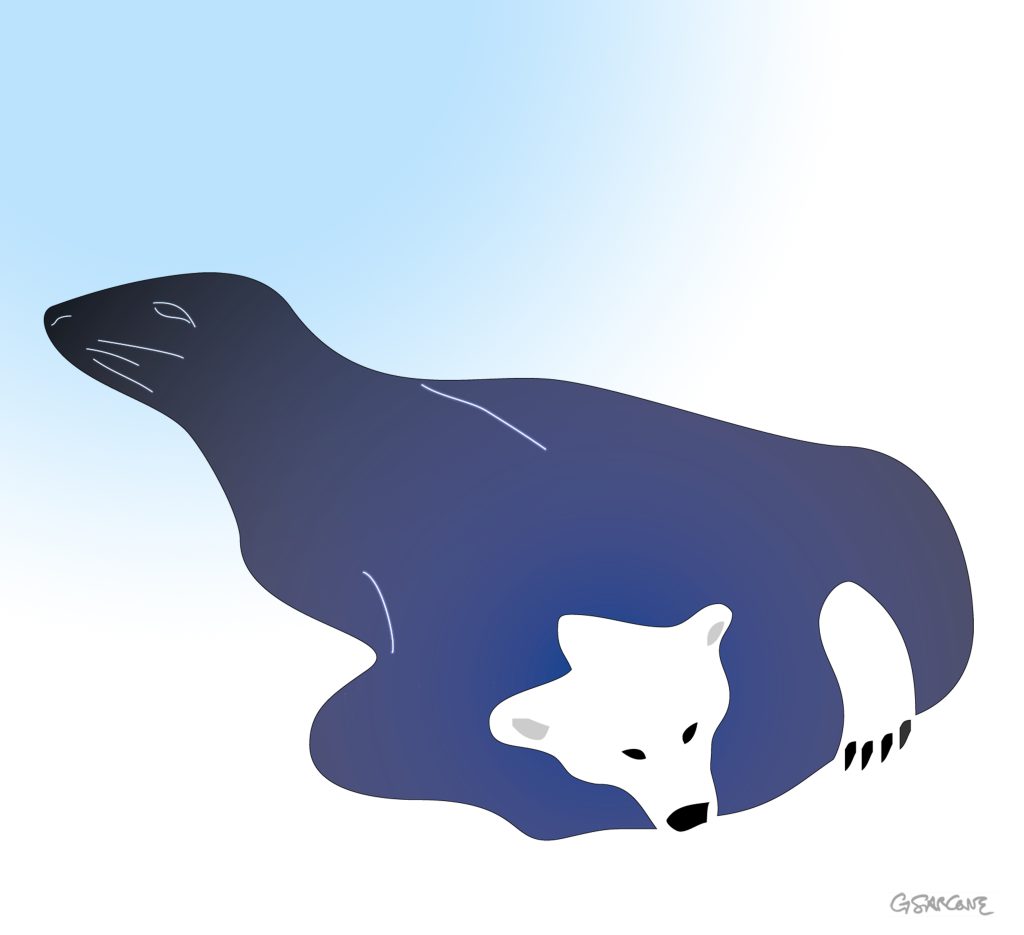
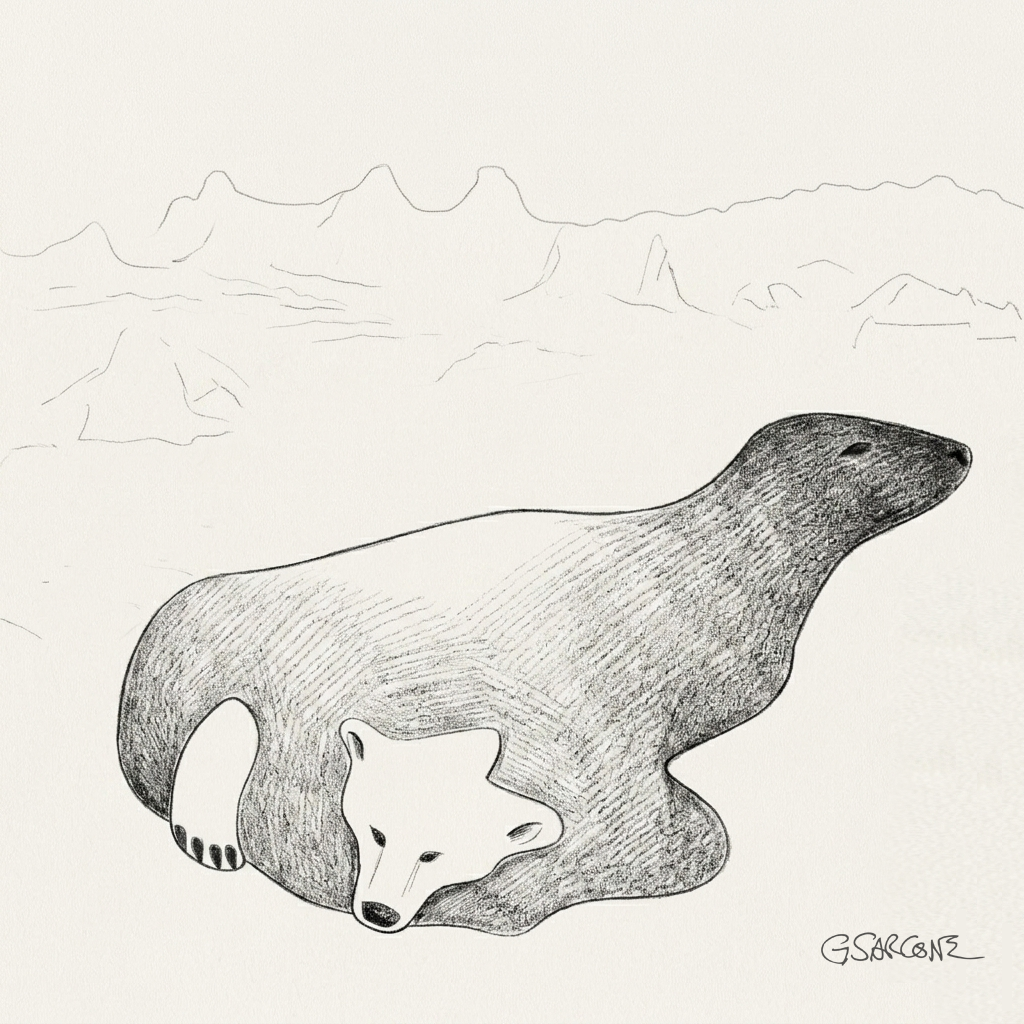
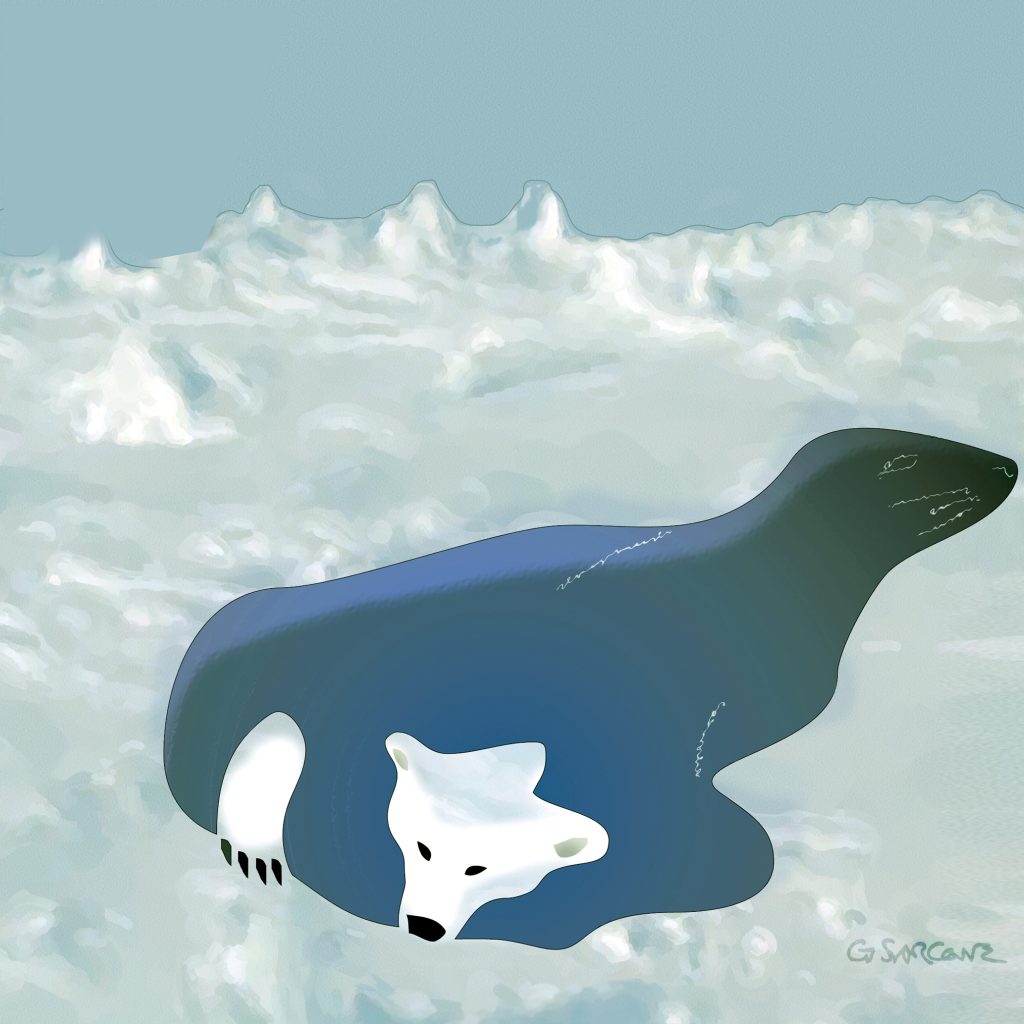
People often ask me where the ideas for my illusions come from. The truth is, they often arrive quietly, inspired by the places I’ve visited and the cultures I’ve encountered. During my travels, it’s not unusual for me to create something that reflects the spirit of a place. Take “Seal or Bear?” for example—it came to me while wandering through northern Canada, surrounded by the vast, silent landscapes of the Arctic and the rich traditions of Inuit culture. That illusion went on to become a classic in the 1990s and even made its way into textbooks on perception.

Later, during my journey through Japan between Tokyo and Kyoto, I was captivated by the delicate balance of light, shadow, and movement in the world around me. It was there that “How Many Birds?” took shape, in the ukiyo-e style. One of my earliest optical illusions, it explores bistable perception in a playful way. Depending on your gaze, you can see four birds nestled in their respective nests with one perched on a branch—or four chirping chicks gathered around their mother. I like to think that, in that moment, the spirit of the place and the quiet rhythm of daily life found a way into the lines and spaces of the image, letting viewers glimpse more than one reality at once.

Ultimately, I am like a sponge, absorbing everything that orbits around me, all while staying true to my own style. That is simply how I work.

Latest Update

The NHK Educational Corporation, a production subsidiary of Japan’s public broadcaster NHK responsible for a wide range of educational programming, will feature the “Seal or Bear?” illusion in 2026 and 2027 as part of a series on psychology education and visual perception.

The Human Condition: A Paradox

What strikes in the tiny space between God’s and Adam’s fingers in the Sistine Chapel is neither mysticism nor religion—it is humanity itself. Michelangelo, perhaps without realizing it, captures a simple yet profound truth: the hardest distance to cross does not depend on strength or span, but on “human will”—or its absence.

We perceive a tension in the image: God leans forward, taut and ready to give all He can. Adam, by contrast, extends his hand half-heartedly, hesitant, the finger limp and weak. That missing centimeter seems, at first glance, to symbolize free will—or the refusal of determinism: the choice to make a tiny gesture that can shift our understanding of life, to move forward with conviction, or to remain still, waiting for everything to arrive on its own.

The fresco speaks beyond faith: to moments when we could act, yet remain still. Stillness is not failure—it is awareness. Like Wu Wei (無為) in Zen philosophy, it is effortless action: a letting go, a recognition that life flows even when we do not grasp it. Free will and determinism fade into labels, defined only by belief.

That one-centimeter gulf becomes infinite. It stretches across light-years, embodying the human condition: our extraordinary capacity to feel and aspire, in tension with the world, facing life’s trials and the inevitability of our own mortality.

Punctum Temporis

What is an instant—the punctum temporis—that Plato called ἐξαίφνης (exaíphnēs), the sudden? Is it a vanishing point between past and future, or the hinge on which both unfold? Plato saw it as an interruption in the flow of time, a fleeting spark where change occurs, yet which itself seems to escape duration. Augustine later reflected that the present, though indivisible, lives within us as the tension between memory and expectation.

Bergson went further, arguing that real time—la durée—cannot be reduced to a series of measurable instants. If an instant is infinitely small, it cannot be summed; if it can be summed, it is no longer an instant. Thus arises the paradox: if the present is composed of infinite instants, how can it ever be said to exist?

Perhaps time is not made of points but of relations—of movement, perception, and becoming. The instant would then be less a unit of time than a threshold of consciousness, the meeting place of continuity and change. In that sense, punctum temporis is where time reveals its true nature: elusive, dynamic, and inseparable from the act of being.

Immergiti nel mondo dell’arte ottica!

Le mie opere, esposte permanentemente alla Città della Scienza e al Dipartimento di Fisica dell’UNIFI, offrono un’esperienza visiva che stimola curiosità e meraviglia. Non perdere l’occasione di vederle dal vivo!
Scopri di più.

Dipartimento di Fisica dell’UNIFI

🇬🇧 Dive into the world of optical art!
My works, on permanent display at Città della Scienza and the Physics Department of UNIFI, offer a visual journey that sparks curiosity and wonder. Don’t miss the chance to experience them in person!

Learn more.

Related links:

Moona Lisa

Forbidden Brews: When Coffee, and Chocolate Stirred Trouble

In the 17th century, some of today’s most beloved drinks — coffee, tea, and chocolate — were once viewed with deep suspicion. When these “divine beverages” first arrived in Europe, civil and religious authorities saw them as exotic, even subversive. Their foreign origins and stimulating effects made them objects of fascination, controversy, and at times, prohibition.

Coffee traces its roots to the highlands of Ethiopia, where the Coffea arabica plant produces the precious beans that, once roasted and brewed, yield the dark, fragrant drink we know today. From Ethiopia, coffee spread to Yemen and across the Islamic world before reaching Europe. In 1672, an Armenian merchant named Pascal introduced the first coffee to Paris, setting up a small stand near the Saint-Germain fair — an event that marked the beginning of France’s enduring love affair with the drink.

Chocolate has an equally captivating story. It comes from the seeds of the Theobroma cacao tree, native to Central and South America. The Maya and Aztec peoples prepared it as a sacred, bitter beverage, often mixed with spices and chili — a divine elixir meant to awaken both body and spirit.

These exotic drinks, however, sparked strong reactions. Coffeehouses became lively meeting places where new ideas brewed alongside cups of steaming coffee — much to the concern of kings and clergy. Chocolate, too, stirred debate within the Church: some saw it as sinful indulgence, others as a heavenly pleasure.

Even in the Age of Enlightenment, the story continued to brew with conflict. In 1777, Frederick the Great of Prussia tried to ban coffee altogether. He feared it would replace beer — the national drink and a source of tax revenue — and even claimed that beer made his soldiers strong, while coffee made them weak. To enforce his will, he appointed “coffee sniffers” (see picture) to hunt down those secretly roasting beans.

Despite resistance and regulation, these once-suspect beverages soon became powerful symbols of refinement, curiosity, and creative thought. Today, coffee, tea, and chocolate remain faithful companions of conversation, reflection, and imagination.

"Die Kaffeeriecher" (The Coffee Sniffers). After a painting by L. Katzenstein
“Die Kaffeeriecher” (The Coffee Sniffers, 1892). After a painting by L. Katzenstein.

A Personal Reflection: Forbidden Pleasures and Creative Sparks

This history of suspicion and fascination mirrors the journey of modern art. Like coffee, tea, and chocolate, art has often been feared, censored, or condemned. Impressionists were mocked for daring brushstrokes; avant-garde movements were branded degenerate under totalitarian regimes. But prohibition, ridicule, or misunderstanding never extinguished their appeal — instead, it made them irresistible.

I see in these stories a reflection of human curiosity itself: the desire to taste, to see, to explore what lies beyond the accepted, the safe, the ordinary.