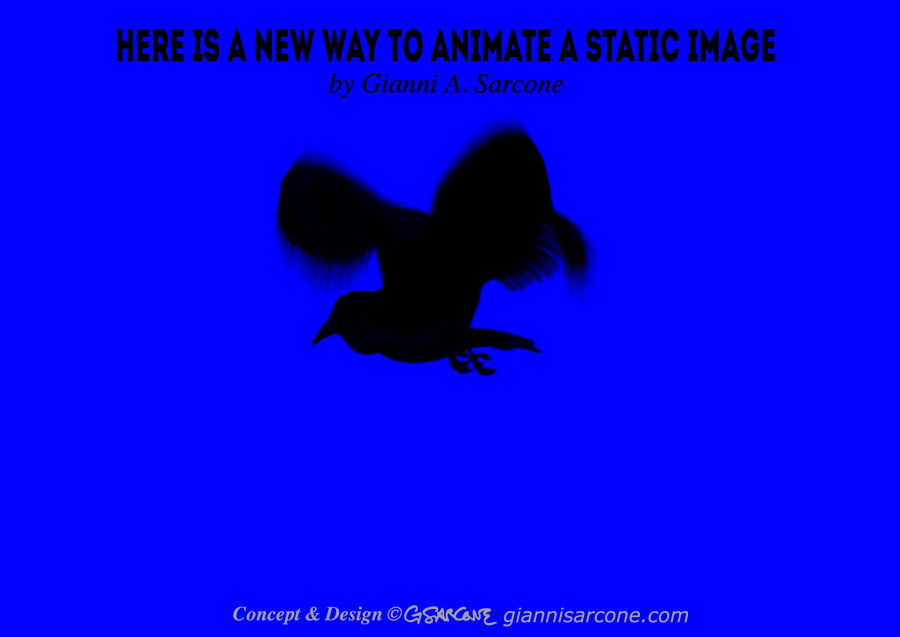
KINECHROMATICS: A new three-framed animation

Kinechromatics (patent pending) is a method of my invention for animating static images through retinal persistence and controlled interactions between additive and subtractive color systems. It produces apparent motion by sequential color filtering across layered chromatic structures, rather than relying on conventional frame-by-frame animation.

Kinechromatics static image

The static image above is made of 3 layers having each a different subtractive primary color (magenta, yellow, or cyan) blended in ‘multiply mode’…

What happens if we alternately overlay this image with transparent colored acetate sheets, each carrying an additive primary color (red, green, and blue)?

Kinechromatics red

Kinechromatics: red filter
When viewed through a red acetate sheet, the magenta and yellow components are largely absorbed, while the cyan layer remains visible, appearing black.

Kinechromatics green

Kinechromatics: green filter
Through a green acetate sheet, the cyan and yellow components are suppressed, revealing the magenta layer in black.

Kinechromatics blue

Kinechromatics: blue filter
Through a blue acetate sheet, the magenta and cyan components are reduced, allowing the yellow layer to emerge but appear black due to its lack of transmission in the blue range.

The animated GIF below produces a continuous motion effect using only four elements: a static base image and three full-color layers blended in multiply mode.

Kinechromatics animation

Colored light can also replace acetate filters, creating a seamless optical animation. Stroboscopic illumination in primary colors has the added effect of merging perceptually into white light, making the transitions visually smooth. This approach can be particularly effective in museum or gallery installations, offering a direct demonstration of how color interaction is processed by human vision. The setup consists of a static image containing the Kinechromatics pattern, illuminated sequentially by red, green, and blue projection, as shown in the animation below.

For inquiries about exhibition or collaboration, feel free to contact me.

projector

A second example, a simple animated dancing skeleton, demonstrates the same principle:

dancing skeleton


See also:

Kinegrams

Frankenstein’s Dream: Hybrid Picture

Frankenstein Marylin

This intriguing image is taken from my book “Curiopticals“. Look at Frankenstein from a certain distance – approximately 2-3 meters, or 7-8 feet – and you will see what he is dreaming about. This type of illusion is known as a cryptic or hybrid optical illusion, and is produced by merging two subjects with different resolutions. The result is that one subject is hidden or suggested in the ‘host’ image. Continue Reading

Dynamic Müller-Lyer Illusion

Prize illusion sarcone

I am very proud that my “Dynamic Müller-Lyer Illusion” won the third prize as best illusion of the year 2017!

As you surely know, the “BEST ILLUSION OF THE YEAR CONTEST” is a yearly competition under the patronage of Scientific American, organized by the Neural Correlate Company (New York, USA).

Müller-Lyer’s illusion proves that a segment can visually appear longer or shorter depending on the sense of the arrow heads at its ends. In what consists my variant? As shown in the animation, the red dot in the middle of the line is equidistant from the other two red dots, although the ends of the line visually appear to alternately stretch and shrink like a rubber band!

The radial version of the illusion is even more impressive:

The perceptual increasing and decreasing of the segments occurs in a very short time. Thus, I suppose it is more a physiological phenomenon, rather than a psychological bias. Our attention seems to be attracted by the receptive field WITHIN the V-shaped arrow heads, causing an illusory inward or outward shift of the ends of the line.

Continue Reading

THE FIRST GREATEST ILLUSION

The very first illusion is to believe that there is one, unique world of perception. The mind and the world we experience are inseparable, as it is the mind that makes the world meaningful. Our mind IS our world. Despite the fact that our mental construct of what is perceived is distinct from the objective reality, our mind accepts it as real.

Every organism, man as well as animal, lives in its own subjective spatiotemporal world that semiotic philosophers call ‘Umwelt’ (from the German Umwelt, ‘surrounding world’, or ‘life-world’). According to the biologist Jakob J. von Uexküll, organisms and their life-world shape each other in a functional loop (see fig. below): interactions between the subject and the outer world, mediated through the sense and effect organs, determine the world framework of the subject. Thus, a particular stimulus which has a perceptive cue or meaning to the subject induces always a purposeful reaction.

feedback loop of information

Continue Reading

Breathing Hexagon

This is one of my earliest self-moving op art works (2003). Have a look at the static image above, don’t you have the feeling that the sets of lenticular shapes seem to expand?

This piece is accessible in various formats, including prints, posters, and t-shirts, through my art gallery shop.

Continue Reading

Bidimensional Müller-Lyer Illusion

I am working on a new two-dimensional variant of the Müller-Lyer illusion… You may be surprised to know that the Müller-Lyer illusion isn’t only linear: it involves plane geometry too! In fig. A shown below, the ends of the blue and red collinear segments, arranged in a radial fashion around a central point, delimit two perfectly concentric circles. However, for most observers, they seem instead to define a large ovoid that circumscribes another one, slightly eccentric (Fig. B). This comes from the fact that the red segments seem to stretch towards the lower part of the figure, while the blue segments seem to stretch towards the upper part of the same. As you can see, in this variant comes also into play the “neon color spreading” effect. In fact, a bluish inner oval-like shape appears within the black arrow heads (Fig. A), though the background is uniformly white.
Müller-lyer oval

Continue Reading

The Astounding Art of Arrangements

Sometimes, man lets himself go to this abstracted ‘diversion’, which involves assembling or arranging pieces, counters or any small familiar object. This compulsive behavior is evidence of a geometrical sense, which is natural and irrepressible. This is the same behavior, which drives some birds instinctively when they collect and group shells, glittering or colored objects to lavishly decorate their bowers. So, assembling and arranging objects is not only a cerebral activity but, indeed, a primitive geometric urge.
Continue Reading

Bamboozle your mind with illusions

Bamboozle your mind with Super Optical Illusions – my book of brain boggling artworks is a clever gift for curious-minded children. Find hearts that beat in the middle of the page and snail shells that spiral off into infinity. Enjoy a preview of my eye popping illustrations below and look for many more in Super Optical Illusions – available now!

As an author, designer, and researcher in the field of visual perception and creative thinking, I like to combine art, psychology, cognitive sciences, and recreational logic to test people’s ingenuity.

I have created or adapted most of the illusions contained in my books. Many were created and perfected during my workshops which are held for the benefit of children and adults alike (more information at: http://www.archimedes-lab.org/prospatelier.html).

Try to solve the optical illusion puzzles below without looking at the answers.

The Football

The Football

Continue Reading

The Bullephant, an earliest bistable figure

Visual illusions where you experience two equally possible interchangeable states in perception are called “bistable illusions“. The Necker cube and the Rubin vase are ones of the most classic examples of a bistable figure. I have discovered that all over India, you may see many variants of an interesting bistable depiction, which represents a bull and an elephant with distinct bodies and only one head (painted or sculpted at least 850 years ago). If you look carefully at the whole picture, you may see how the body parts of both animals are skillfully overlapped. For instance, the trunk of the elephant is also the hump of the bull. The horns and ears of the bull have become the mouth or snout of the elephant. These are ones of the earliest documented “ambiguous figure” illusions…

Continue Reading