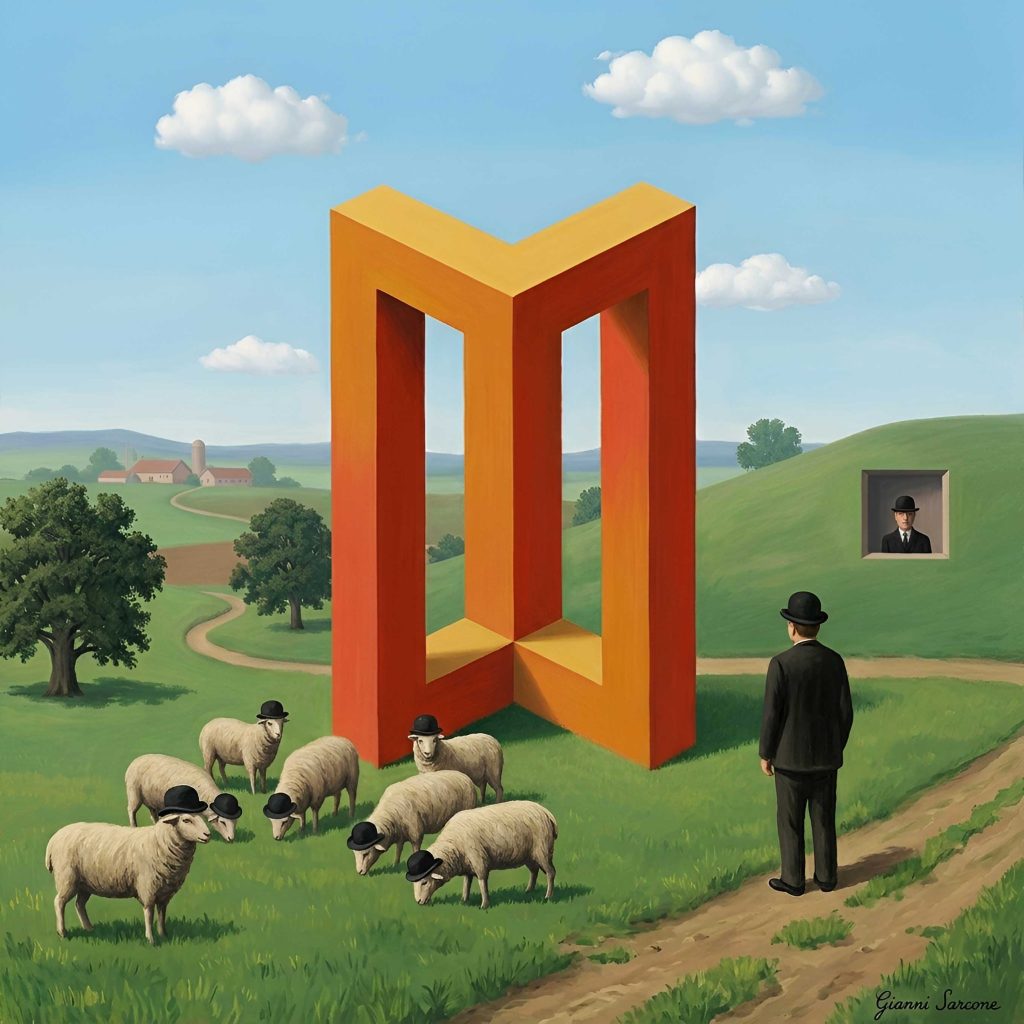
This image is part of a book project exploring visual illusions through paintings inspired by the styles of well-known artists. The idea is to revisit familiar artistic languages—Magritte, Picasso, and others—through invented works that play with visual illusions, perspective, and perceptual paradoxes.
I’m developing this as a richly illustrated book for a broad audience interested in art, perception, and visual thinking.
I’d be interested in hearing from publishers or art-book editors who might like to explore the project.
Impossible or undecidable figures have long fascinated artists, mathematicians, and viewers alike. Their appeal lies in a delicate tension: the structure appears perfectly logical at first glance, yet closer inspection reveals spatial contradictions that cannot exist in the physical world. My latest work revisits an idea I first explored in the 1990s—an impossible Rubik’s-style cube—now developed into a new series built across several stages, from hand-drawn construction to digital refinement and photographic interpretation.
The project began with a simple geometric framework—interlocking beams arranged to suggest a stable cubic volume. The challenge was to reinterpret an apparently ordinary three-dimensional cube into an ambiguous form that still appears structurally plausible. Through careful adjustments of line weight, contrast, and directional and formal cues, the cube gradually shifts from perceived solidity to spatial uncertainty, so that as the eye moves across the image, the object quietly reorganizes itself, producing a surreal perception in place of a coherent physical structure.
Here is the original version of the project, refined from my initial hand-drawn construction and carefully reconstructed using FreeHand MX
Two of the final images belong to the Op Art tradition, where sharp black-and-white geometry emphasizes visual tension and rhythmic structure. These compositions highlight the cube’s architectural clarity while allowing the paradox to emerge naturally from the viewer’s perceptual processing. The remaining two images take a different path: they present the object in a photographic setting, rendered with realistic lighting and textures.
Together, the four images form a small visual narrative—construction, transformation, and illusion—showing how a purely conceptual structure can evolve into multiple aesthetic forms. The Op Art versions focus on perceptual mechanics, while the photographic interpretations suggest how an impossible form might inhabit the physical world, even if only in appearance.
Fine art prints and canvas editions from this series are available through my official gallery shop, where each piece is produced using archival materials designed for long-term display.
Collectors and galleries interested in larger formats or special editions may also contact me directly for availability and production details. This series continues my exploration of perceptual geometry, where simple shapes become instruments for questioning how we construct space, depth, and visual certainty.
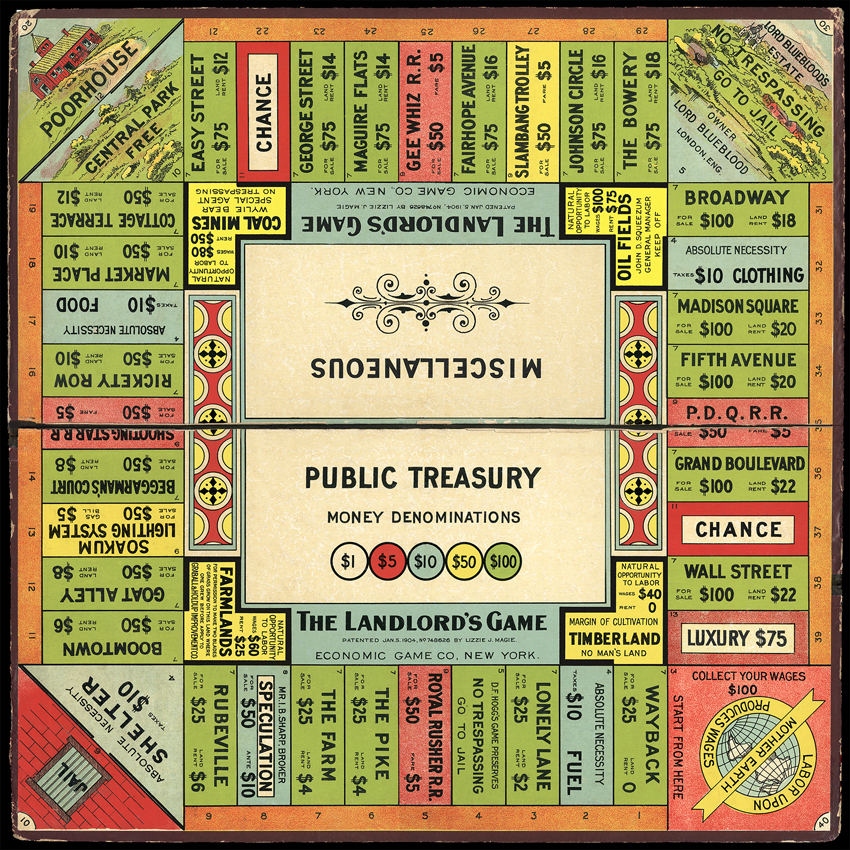
Few stories of creative and intellectual theft are as striking—or ironic—as the origins of the billion-dollar phenomenon known as Monopoly. It all began with Elizabeth “Lizzie” Magie, a brilliant economist and game designer, who in 1904 created The Landlord’s Game to illustrate the dangers of property monopolies and rent-seeking. Her game included two rule sets: one showing how wealth concentrates under monopolies, and another promoting shared prosperity—a subtle critique of unrestrained capitalism.
Over the decades, her game spread informally, with players adapting it to local streets and rules. In the early 1930s, Charles B. Darrow encountered a variant, tweaked it, and sold it as Monopoly. Parker Brothers bought the rights in 1935, marketed it as Darrow’s invention, and turned it into the family-friendly capitalist pastime we know today—while Magie received a mere $500 for her patent and vanished from the mainstream narrative.
The irony is bitter: a game designed to expose the dangers of monopolies became one of the most lucrative symbols of them. And the woman who invented it? Forgotten, while the world continues to pass “Go” and collect $200.
Back in the ’90s, my board game Trama made waves for its fresh take on strategy and design. Imagine the logic of chess, but with a twist: neutral pieces that both players can use. The board—plexiglass with screen-printed art—echoes the feel of an Op Art piece, while the Galalith tokens add tactile charm.
There are several design variants, with boards featuring different color schemes and patterns. Some versions include holes or extruded circular reliefs to securely hold marbles instead of tokens—offering a fresh, sensory-rich experience.
· Curious? The full rulebook (in French) is 👉 here. · More about 👉 Trama.
If you’re a manufacturer interested in bringing Trama back to the table, feel free to reach out.
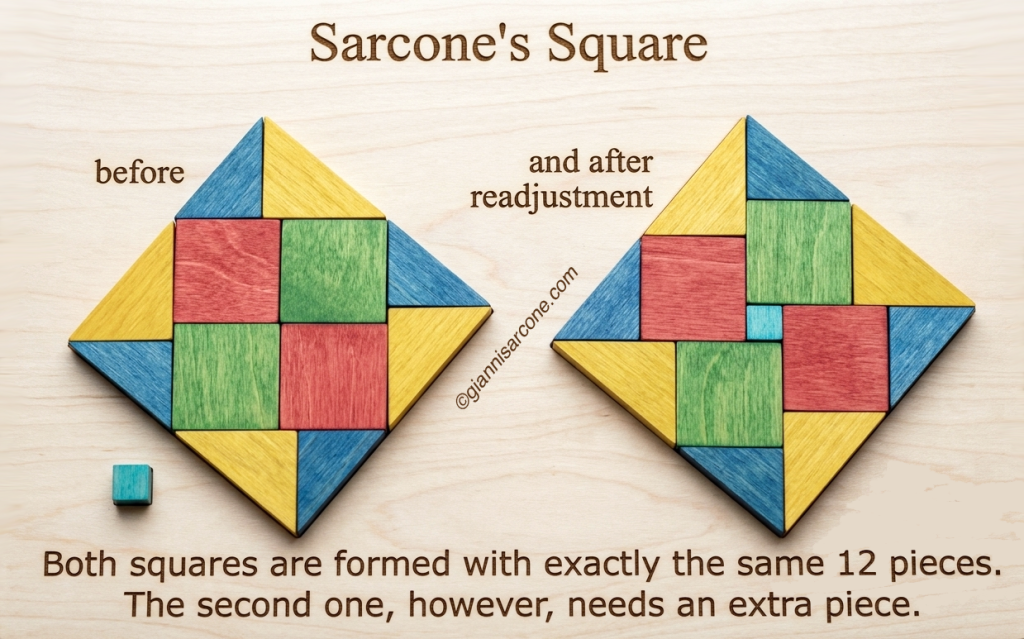
A math-magic article I wrote for the German magazine Zeit Wissen: with the 13 triangular and square pieces (fig. 1) it is possible to form two large squares shown in fig. 2. Though the second large square has an extra piece the dimensions of the squares seem to be the same! Can you explain why this is possible?
Here’s a wooden version of the puzzle I designed in the late 1990s. Each set of pieces is made in a different color, giving the puzzle a clean, elegant look while making its deceptive geometry even more striking.
I am looking for a game manufacturer able to produce and distribute this incredible puzzle. You can contact me through my website.
☞ Further reading: explore the complete Vanishing Piece Puzzle project on my Behance profile.
“Everything we see hides another thing;
we always want to see what is hidden by what we see.” – René Magritte
My book “Fantastic Optical Illusions” (ISBN: 178739235X) features all the best and most interesting illusion types: ambiguous and impossible figures, hidden objects, color and brightness effects, length, size and shape misperceptions, illusory moving patterns and image paradoxes.
This best-selling book has been first printed in 2004, since then I have made important updates on the latest discoveries in the world of perception, to be sure the book will continue to amaze both the young and the adult reader. Available from Amazon UK and Amazon USA.
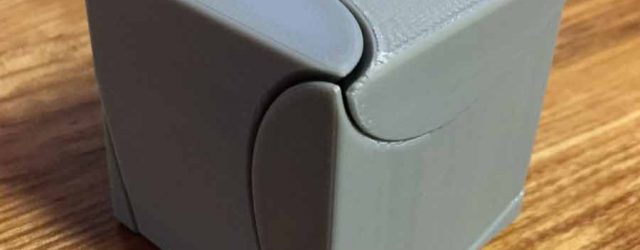
I really love puzzle with less pieces as possible and with a contemporary design… This neat three-piece puzzle has been invented by Robert Reid and designed by puzzle-master Oskar van Deventer. The fit of the puzzle is perfect, though assembly can be really challenging.
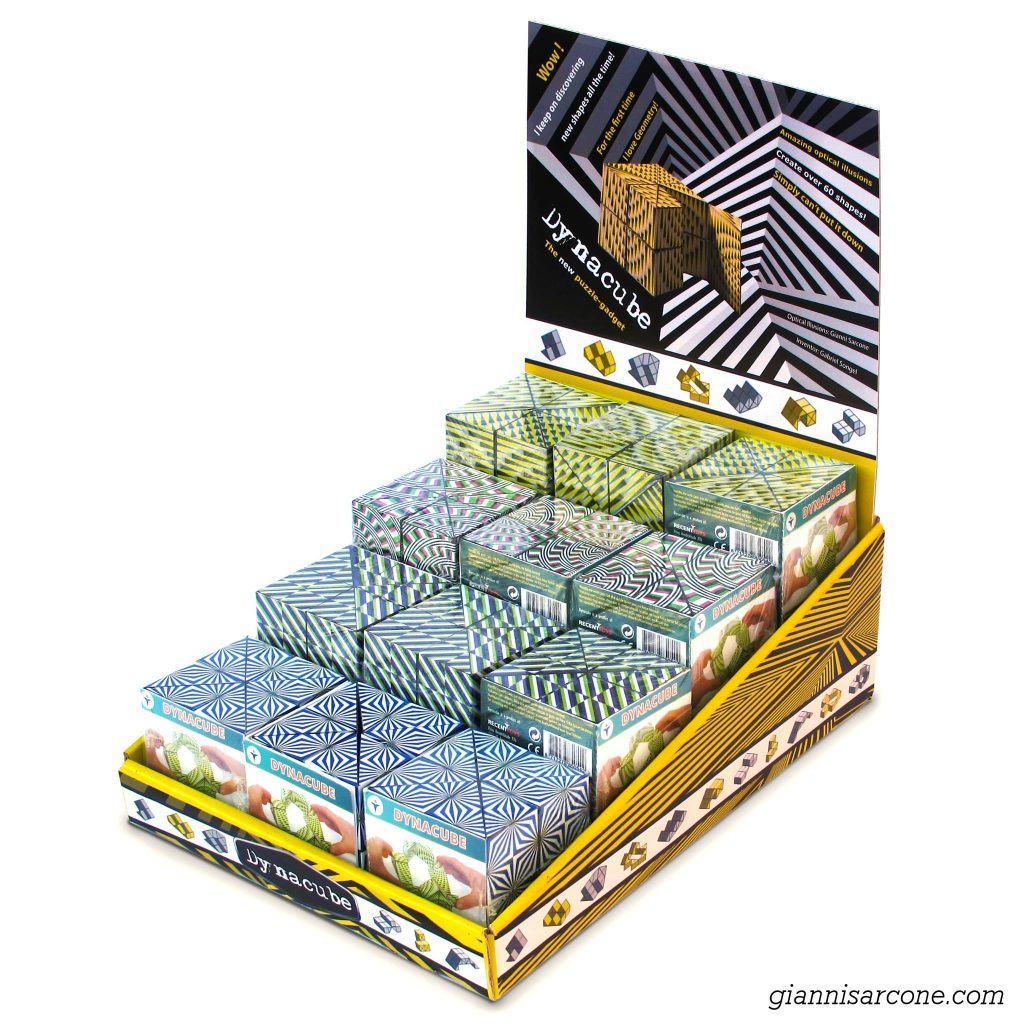
An op art sculpture and/or a fidget puzzle to play with over and over!
“Dynacube” is a new line of 3D puzzles featuring my optical art. It isn’t just a puzzle but also a living piece of art. This 3D game is available in 4 distinct styles from Recent Toys: http://www.recenttoys.com/project/dynacube/
Dynacube is a fun game for kids and adults alike to practice their logical thinking and motor skills.