My minimalist tribute to M. C. Escher: an animated “impossible waterfall,” drawn frame by frame. It’s not exactly my usual artistic language, but I had great fun creating it, and I hope you’ll enjoy watching it as much as I enjoyed making it.
As you can see, the isometric structure links impossible angles to create a continuous water channel that appears to flow upward in a loop, falling from a high point yet seemingly returning to the top.
The “impossible waterfall,” reimagined in a lavish Rococo style, rendered as a surreal illustration for a book project.
Impossible or undecidable figures have long fascinated artists, mathematicians, and viewers alike. Their appeal lies in a delicate tension: the structure appears perfectly logical at first glance, yet closer inspection reveals spatial contradictions that cannot exist in the physical world. My latest work revisits an idea I first explored in the 1990s—an impossible Rubik’s-style cube—now developed into a new series built across several stages, from hand-drawn construction to digital refinement and photographic interpretation.
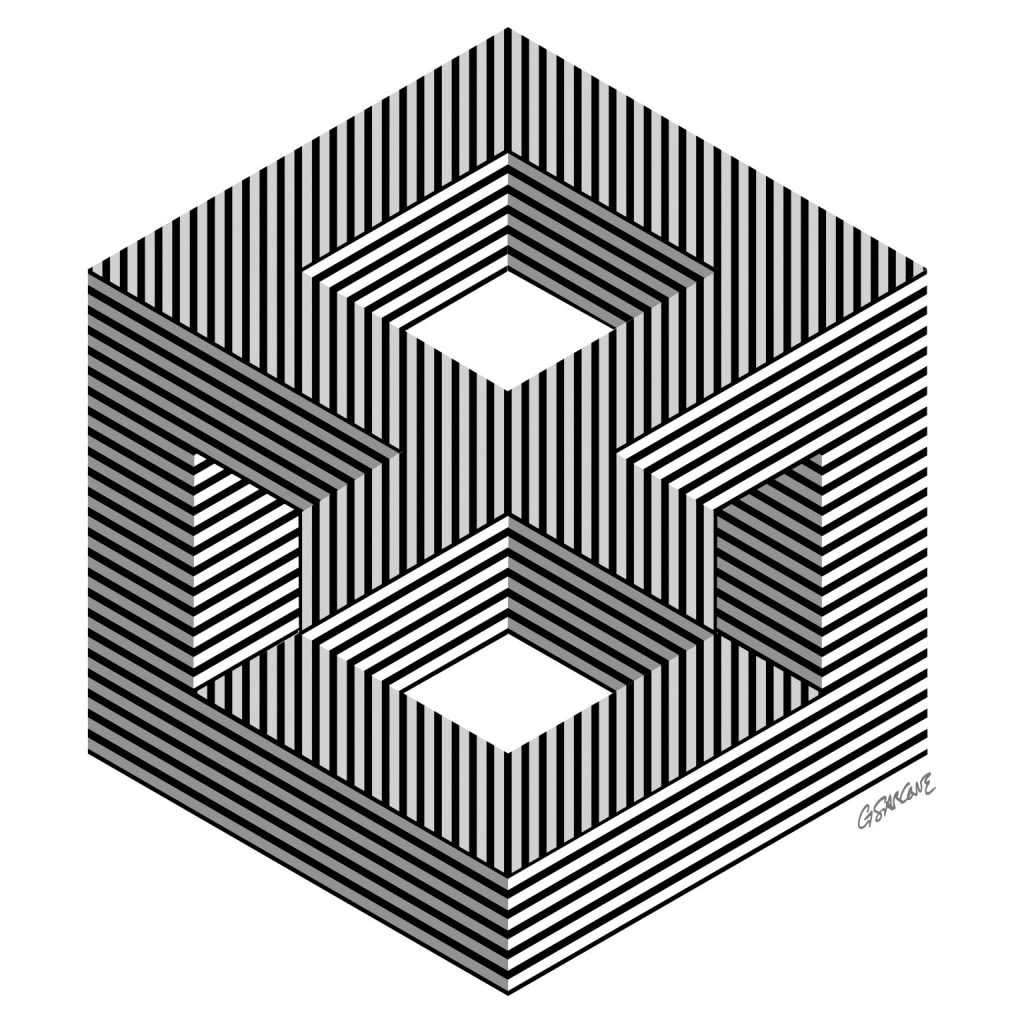
The project began with a simple geometric framework—interlocking beams arranged to suggest a stable cubic volume. The challenge was to reinterpret an apparently ordinary three-dimensional cube into an ambiguous form that still appears structurally plausible. Through careful adjustments of line weight, contrast, and directional and formal cues, the cube gradually shifts from perceived solidity to spatial uncertainty, so that as the eye moves across the image, the object quietly reorganizes itself, producing a surreal perception in place of a coherent physical structure.
Here is the original version of the project, refined from my initial hand-drawn construction and carefully reconstructed using FreeHand MX
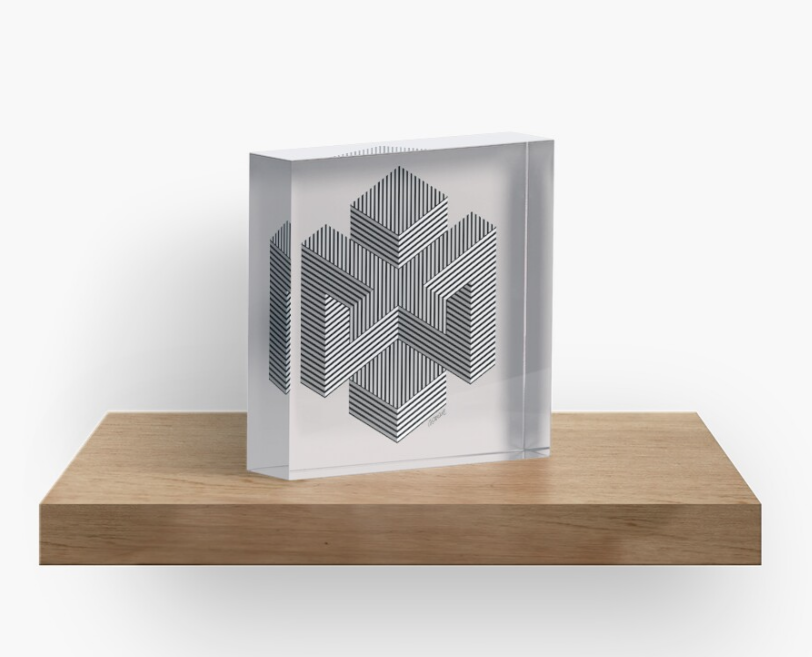
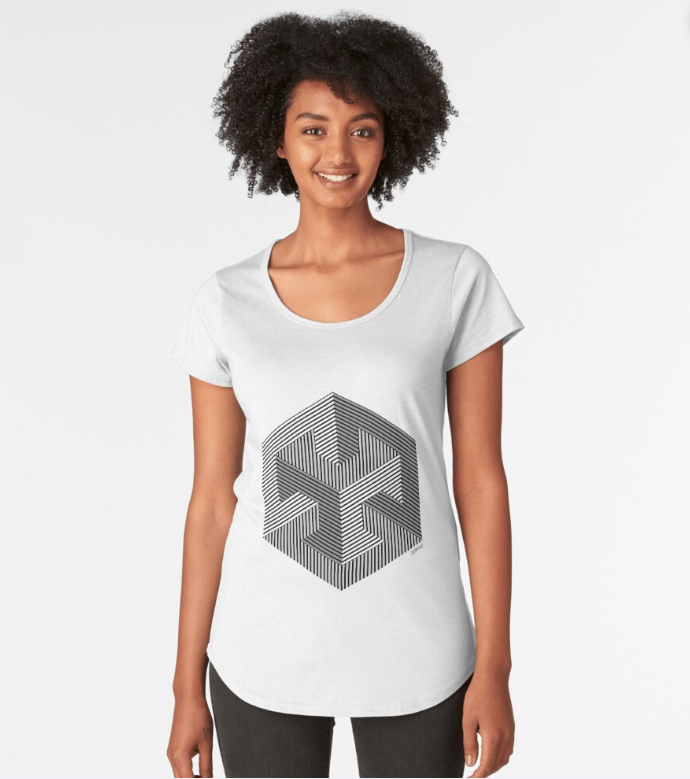
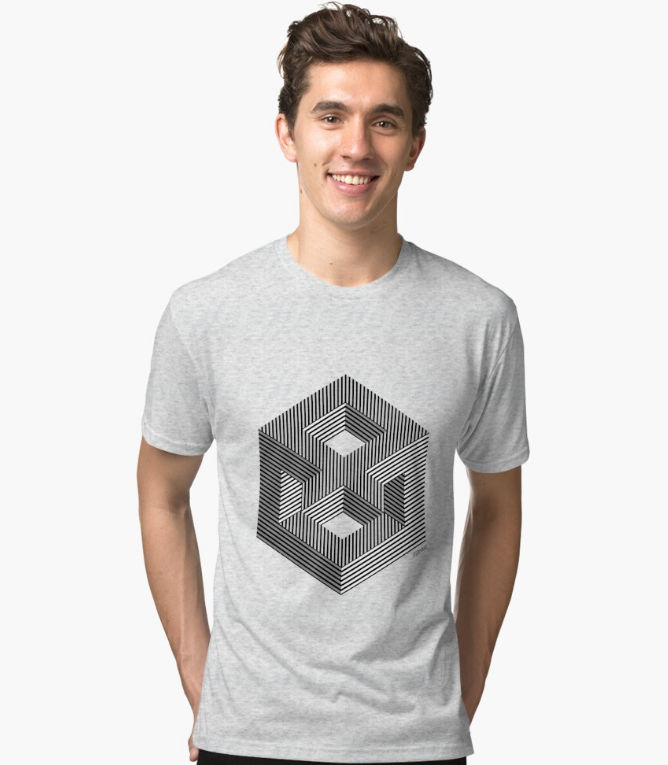
Two of the final images belong to the Op Art tradition, where sharp black-and-white geometry emphasizes visual tension and rhythmic structure. These compositions highlight the cube’s architectural clarity while allowing the paradox to emerge naturally from the viewer’s perceptual processing. The remaining two images take a different path: they present the object in a photographic setting, rendered with realistic lighting and textures.
Together, the four images form a small visual narrative—construction, transformation, and illusion—showing how a purely conceptual structure can evolve into multiple aesthetic forms. The Op Art versions focus on perceptual mechanics, while the photographic interpretations suggest how an impossible form might inhabit the physical world, even if only in appearance.
Fine art prints and canvas editions from this series are available through my official gallery shop, where each piece is produced using archival materials designed for long-term display.
Collectors and galleries interested in larger formats or special editions may also contact me directly for availability and production details. This series continues my exploration of perceptual geometry, where simple shapes become instruments for questioning how we construct space, depth, and visual certainty.
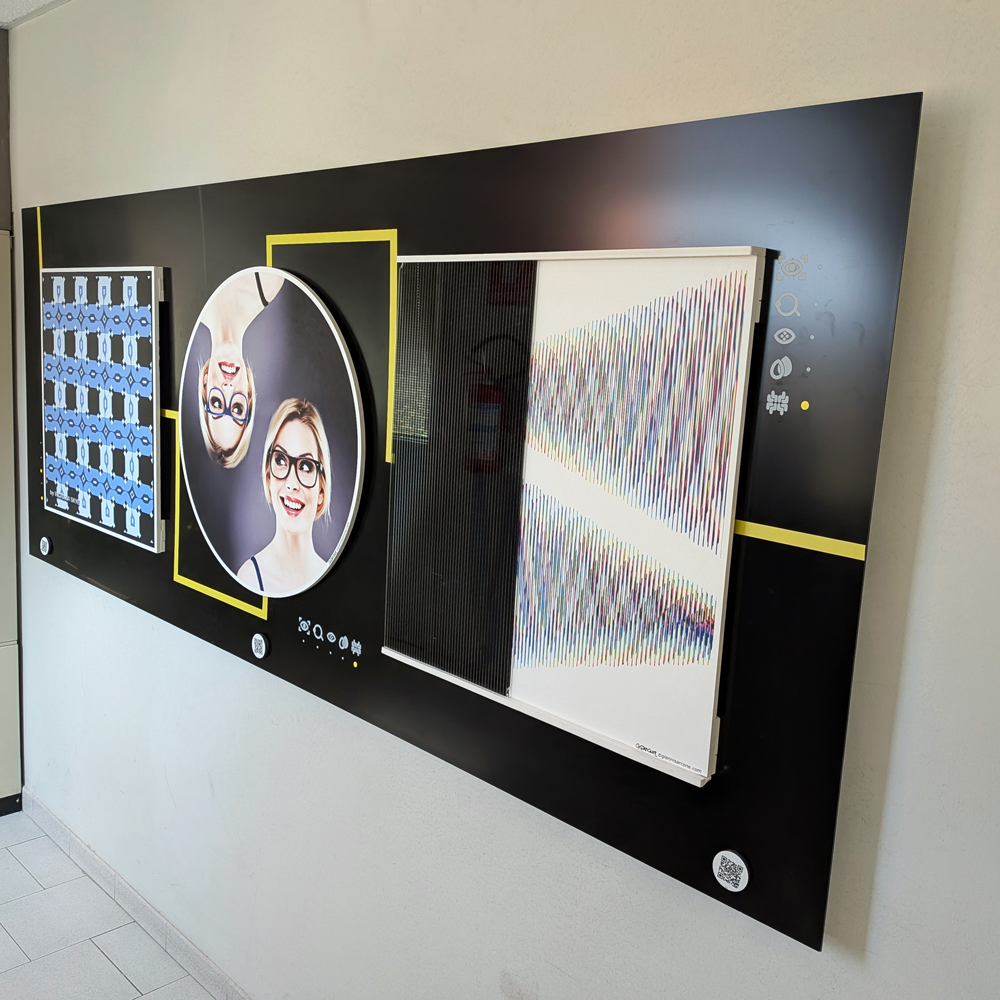
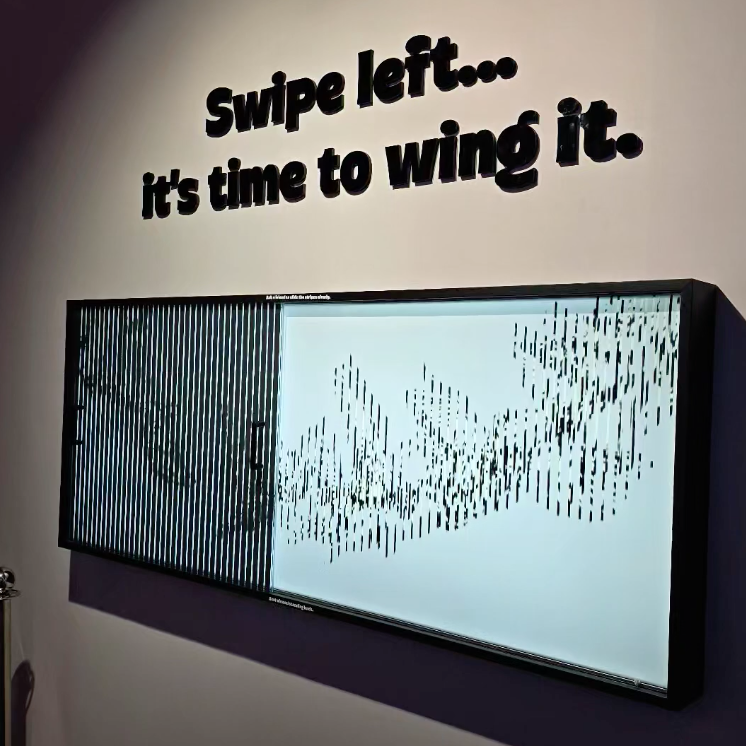
Here are two Kinegram installations I made, designed to educate, engage, and spark curiosity in visitors of all ages. These works make motion appear from static forms, offering an experience that is both playful and thought-provoking.
Kinegrams reveal movement through a sliding transparent panel printed with vertical black lines. As the panel moves over the underlying image, hidden sequences appear, animating the drawings like frames of a film. Each interaction lets the viewer explore how motion can emerge from stillness.
The concept of movement from static forms has long interested scientists and philosophers. Movement is a dimension unfolding in space and time—without time, there is no motion. Kinegrams make this idea tangible through touch and visual perception.
These exhibits are simple to set up but produce surprising results. I made the first panel for UNIFI, the University of Florence, and the second for the Mind Games Art Alive Museum in Sydney. Both projects engage and surprise visitors, combining education with visual impact.
“Twisting Cords,” Kinegram exhibit for UNIFI, Florence As the transparent panel etched with black lines glides across the design, colorful cords seem to twist, winding and unwinding in a mesmerizing, living rhythm.
“Flying Birds – Migration,” Kinegram exhibit for Mind Games, Sydney As the transparent panel etched with black lines glides across the static design in the background, the flock of birds rises and takes wing, transforming a still pattern into living, rhythmic motion.
A simple study in visual perception—an exploration of how a plain hexagon can evolve into the illusion of a cube. Through precise geometry and controlled form blending, static lines awaken into rhythm and volume, giving rise to a subtle sense of depth and movement.
Constructing the Illusion
Fig. A — The Base Shape Start with a regular hexagon. Divide it into three equal diamond shapes (rhombuses)—these represent the three visible faces of the cube. Each diamond has four equal sides: two acute angles (60°) and two obtuse angles (120°). Together, they form the geometric foundation of the cube.
Fig. B — Building Volume with Shape Blends In Illustrator, or any other vector software, use the Blend Tool to create a shape blend inside each diamond. Start with a small central circle and blend it toward the outer edge of the diamond. Adjust the number of blend steps to control how smooth or tight the transition appears. This process builds the cube’s apparent volume and visual tension. You’ll notice that the distance from corner to corner in the nested, diamond-like shapes is slightly greater than from side to side, creating subtle gaps that lead the eye to perceive an X across the surface.
Fig. C — Perspective and Transformation Distort slightly the hexagon to set the three diamonds in perspective. This step transforms the flat figure into a die-like cube, giving it spatial depth and presence.
Enhancing the Optical Effect Next, add horizontal background lines and some color, as shown in the two examples in the image. You can also adjust the illusion by making the visible faces of the die appear slightly concave, as in the figure on the right. This effect is created by shifting the concentric, nested diamond shapes slightly off-center—the position of the central ellipse determines whether the die appears concave or convex.
Below is the finished stage of the work. Curiously, the cube appears to hover, slide, and even emit a faint blue glow—though it remains entirely black and motionless. Ananke’s Die is a study I began in 2010, a continuing exploration of how repetitive lines and geometric precision can trick the mind into sensing motion and color where none exist.
You can get Ananke’s Die as a fine art print or canvas, available in different sizes and finishes. 👉 Buy it here
Why Ananke’s Die
I titled this work Ananke’s Die after Ananke, the Greek goddess of necessity and fate. The cube, a symbol of structure, represents order and control. Yet the three visible faces that seem to define its volume are an illusion—shifting and unstable. Under the viewer’s gaze, the shape changes, its meaning shifts, yet the form remains. This illusory die shows the balance between order, perception, and destiny, reminding us that what we think we control often exists within the unpredictable interplay of vision and inevitability.
This image also triggers multiple associations in a loop: hexagon, cube, die, chance, illusion, order, fate, contradiction. These connections show how perception mixes stability and randomness, revealing that what we see is shaped as much by the mind as by reality.
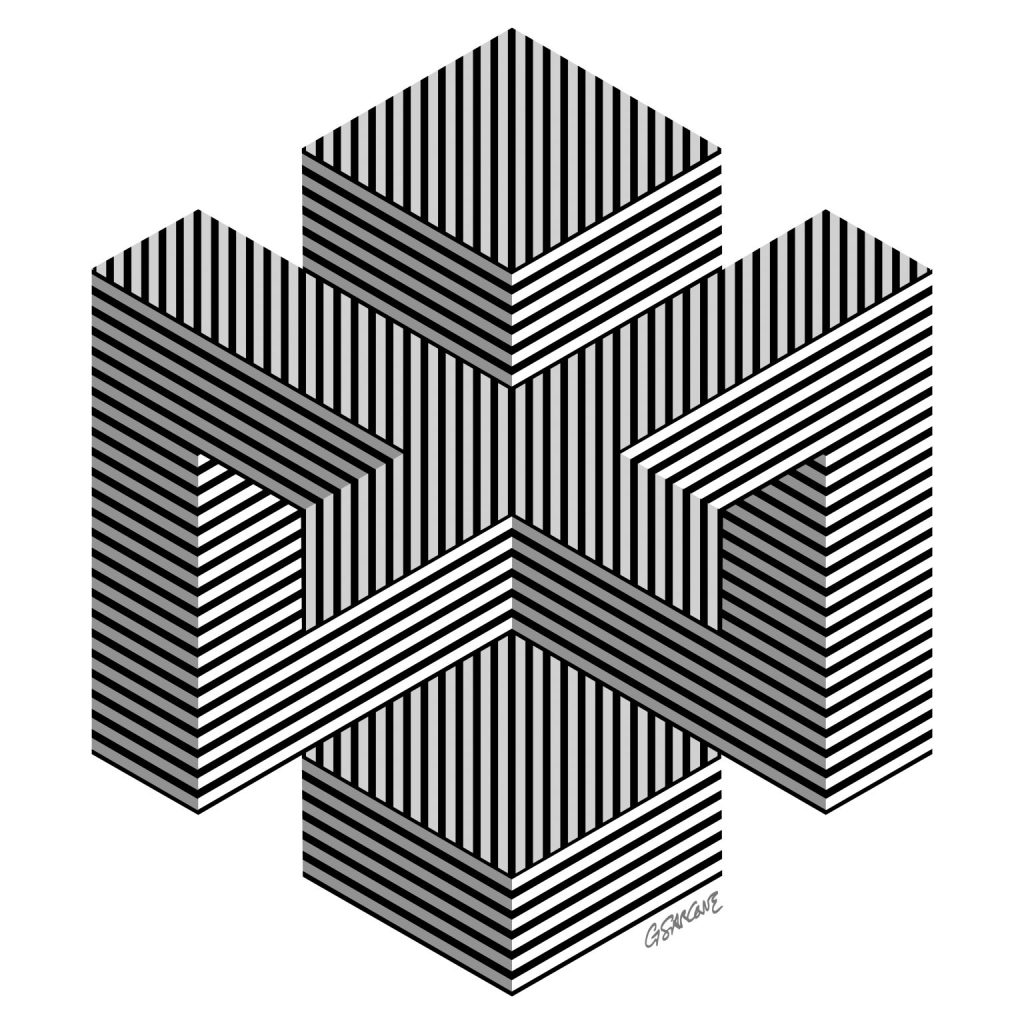
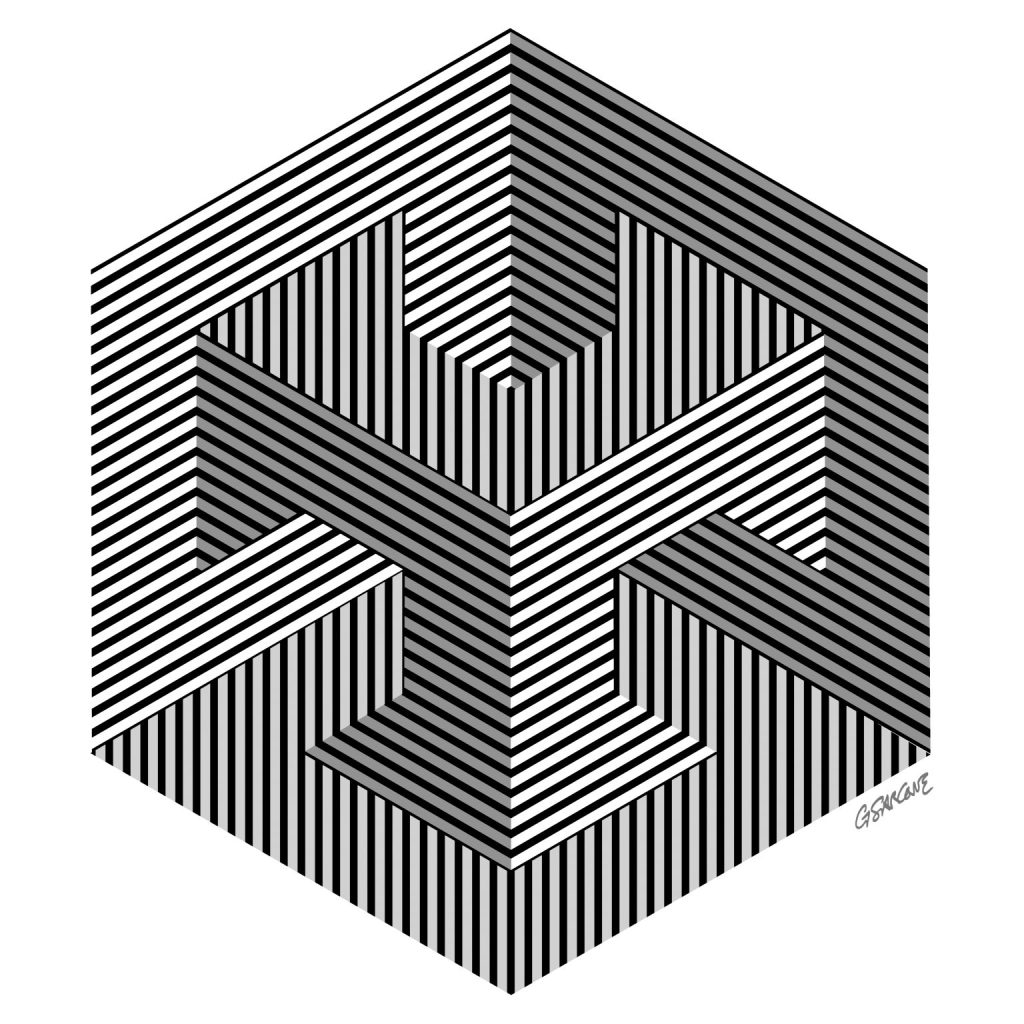
I’ve always been drawn to the architecture of geometry. The hexagon, with its quiet strength and symmetry, sits at the root of so many spatial illusions—it’s the seed of cubes, isometric grids, and 3D paradoxes. From this shape, I began exploring structures that bend logic and perception, eventually giving life to a trio of optical works: Enigma 1, Enigma 2, and Enigma 3.
Each piece is built around the visual tension of the impossible cube, created by merging two tribars in perfect isometric perspective. The lines suggest solidity, yet the form escapes reality—what looks structurally sound unravels the moment the eye tries to make sense of it. That’s the game I love to play: where geometry behaves, but perception rebels.
These “Enigmas” are spatial riddles dressed in stripes and angles, each one twisting the viewer’s reading of depth, volume, and continuity in its own way.
Although I’ve been working in the field of Op Art since the mid-1980s, it’s important to recognize that the movement itself has a deeper history. It began to take shape in the 1960s, led by pioneering figures such as Victor Vasarely and Bridget Riley.
However, the artists who truly captivate me—the ones who expanded the language of perception—are often the outsiders. One such figure is Julio Le Parc (b. September 23, 1928), an Argentine-born artist whose practice bridges Op Art and kinetic art. Le Parc studied at the School of Fine Arts in Argentina and went on to co-found the Groupe de Recherche d’Art Visuel (GRAV). His work, honored with numerous awards, holds a prominent place in Latin American modernism.
Le Parc’s recurring themes—color, light, and movement—have always resonated with me. During the ’60s and ’70s, he explored light not just as a visual element but as a living, dynamic material. Yet by the late ’70s, his presence in the art world had faded; his output became sporadic, and for decades his work slipped quietly out of the international spotlight.
Fortunately, recent years have witnessed a renewed appreciation of his explorations in light and movement, bringing his contributions once again to the attention of a wider public.
Back in the ’90s, my board game Trama made waves for its fresh take on strategy and design. Imagine the logic of chess, but with a twist: neutral pieces that both players can use. The board—plexiglass with screen-printed art—echoes the feel of an Op Art piece, while the Galalith tokens add tactile charm.
There are several design variants, with boards featuring different color schemes and patterns. Some versions include holes or extruded circular reliefs to securely hold marbles instead of tokens—offering a fresh, sensory-rich experience.
· Curious? The full rulebook (in French) is 👉 here. · More about 👉 Trama.
If you’re a manufacturer interested in bringing Trama back to the table, feel free to reach out.
The circle, a timeless symbol of wholeness, is found at the core of human thought. In the West, it evokes the Pythagorean harmony of the cosmos, the eternal return of Nietzsche, the indivisible unity of Being. A form without beginning or end, it embodies the perfect balance between presence and absence, the finite and the infinite. In Eastern traditions, the ensō (円相)—literally “circular form”—is a distilled gesture of perception, a visual echo of clarity. Not merely a shape, but an experience, it is drawn in a single stroke, capturing the ephemeral moment where thought and movement dissolve into pure expression. It is said that the earliest Zen painting was an ensō, traced to offer a student something tangible yet elusive, a paradox to ponder. A circle can be brushed on paper, traced in sand, drawn on a misted window, or merely imagined. It lacks nothing, needs nothing, yet contains all things. In its quiet completeness, it is not an answer, but an opening—an invitation to see beyond the limits of form.
Colors, though fundamentally phenomena of light, are not merely superficial aspects of perception. They play a structural role in organizing visual elements. For example, applying contrasting colors to a series of repetitive graphic patterns—while varying their distribution—can dramatically alter how they are perceived. This demonstrates how color is not just an embellishment but an active force in shaping visual reality.
As Goethe put it, “Colors are the deeds and sufferings of light.” More than a sensory experience, they influence our perception of space, depth, and meaning, revealing the intricate dialogue between vision and cognition.
When bending the sides of a square structure forward, each edge forming a sine wave shape, the structure reveals a circle when viewed from the reverse angle. This illusion plays with perspective, specifically utilizing an effect known as “anamorphosis“.
Anamorphosis refers to a artistic technique that uses perspective to create distorted images that can only be viewed correctly from a specific angle.
Explore My World of Art, Books, and Creative Concepts