Even bounded, my dynamic Müller-Lyer illusion works perfectly; the static segments of the star appear to alternately contract and expand.


Even bounded, my dynamic Müller-Lyer illusion works perfectly; the static segments of the star appear to alternately contract and expand.
With this work, I aim to push geometry to its limits, transcending the confines of color. My goal is to showcase the creative potential of simple concentric squares as a medium for experimentation and the discovery of new op art patterns. By delving into this exploration, I strive to unveil captivating illusions of color and mesmerizing motion.
Draw a large and a small square with thick lines and center them (Fig. A). Next, blend the inner and outer squares in six steps to create a set of concentric squares. Reproduce the set to form a larger square pattern, as shown in Fig. B.

In these minimalist op art works, I explore geometry as metaphor, using the hexagon as a building block for cubes and other regular solids. The forms appear stable and believable, yet they are impossible. Their contradiction isn’t obvious at first; it reveals itself only when the eye slows down and follows the structure closely. By merging incompatible viewpoints and softening the boundary between inside and outside, the drawings turn logic against itself. The more ordinary the form looks, the stronger the effect—these objects are meant less to trick the eye than to unsettle the mind and challenge our sense of space.

The two drawings displayed above and below combine paired tribars to form an impossible isometric cube, where form and illusion lock into a single structure.

Here, the “volume” turns itself inside out, quietly echoing the logic of a Klein bottle and unsettling the usual distinction between interior and exterior.

I am currently in the process of writing an informative book titled “Mastering Optical & Geometric Art: A Journey to Captivating Creations.” With a length of 136 pages, this book serves as an engaging guide to creating visually striking optical art and intricate 2D and 3D patterns. If you are interested in exploring further, I invite you to connect with me on Amazon.

Although NOTHING moves on the gif below – only the colors change! – it’s easy to spot which direction the wheel is “rotating”… But which side is in front? Which side the back?

Another hypnotic version in which still squares and diamonds seem to move, but only colors change slightly!

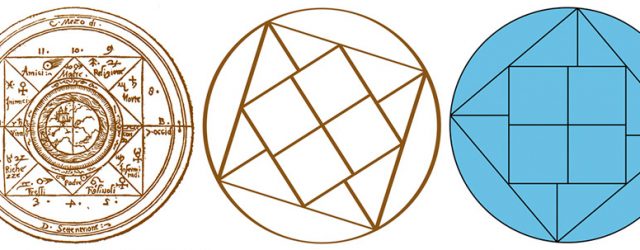
Inspired from the astrological tables, here is a new puzzle of my creation designed according to the ‘Golden Number Rules’, which is reflected in the proportion of each single piece of the game. Thanks to the balanced dimensions of its pieces, this puzzle acquires some intriguing magical properties!
This “math-magical” puzzle is composed of a tray in which the pieces are assembled.
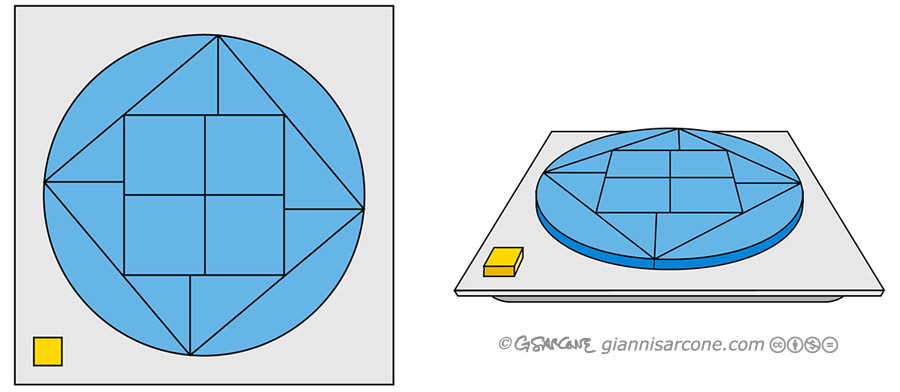
Object of the puzzle game
Fit the small extra piece into the puzzle without apparently altering its original dimensions. All the pieces must lie tight and flat! Impossible? See the solutions below.

The animated demonstration below is more eloquent than all theories. The puzzle shown in the video is a variant made in hard plastic, and cut using water-jet technology with an accuracy/precision of 0.01!
Here’s a wooden version of the puzzle I designed in the late 1990s. Each set of pieces is made in a different color, giving the puzzle a clean, elegant look while making its deceptive geometry even more striking.
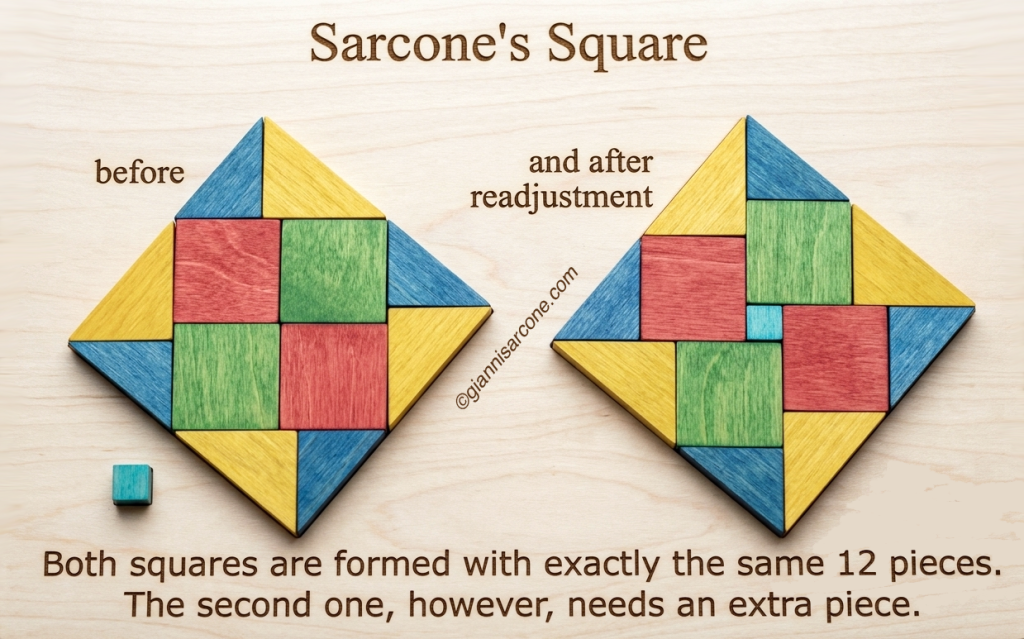
I am looking for a game manufacturer able to produce and distribute this incredible puzzle. You can contact me through my website.
☞ Further reading: explore the complete Vanishing Piece Puzzle project on my Behance profile.
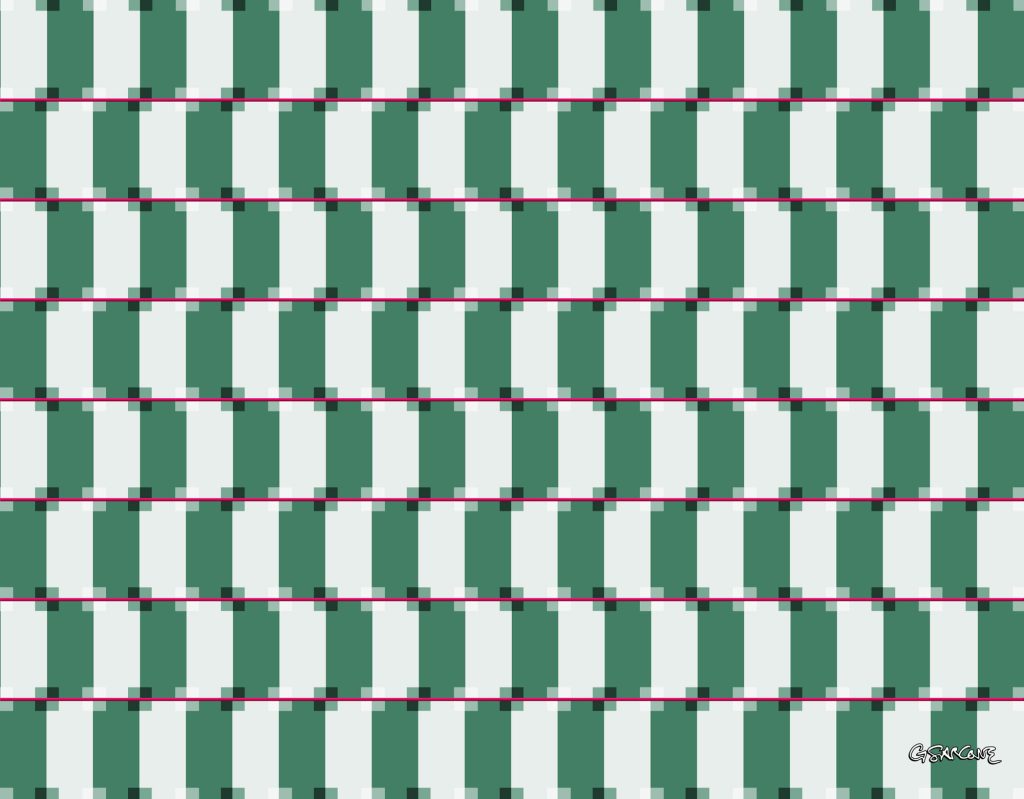
Some simple geometric patterns and designs, when repeated, can induce strong illusory shape distortions. Thus, visual misperceptions are very common in the op art world.
If dark and clear rectangular tiles are arranged in a checkered fashion, as shown below, there is obviously no illusion, but wait, just add at the intersection of these tiles some transparent dark and clear square patches, et voilà, magic appears!

So, transparencies can produce apparent linear distortions. The parallel red lines in this example look like being convergent / divergent.
Below are two neat optical illusion projects for which I was commissioned by “Art of Play”. From one perspective, the grooves in the metal die-cut bookmarks seem to be an abstract design but place the pattern against a solid clear or dark background and a familiar figure pops into view! These bookmarks are a sliver of wonder that hides between the pages to guard your place in any story.
Everything is relative with this magical bookmark of my creation depicting the famous theoretical physicist. Engraved with one of Einstein’s most famous quotations: “The most beautiful thing we can experience is the mysterious. It is the source of all true art and science. He to whom the emotion is a stranger, who can no longer pause to wonder and stand wrapped in awe, is as good as dead; his eyes are closed.”

Geometric shapes are not limited only to the figurative aspect, they can also play active roles, for instance, serving in microelectronics to build operational printed circuits such as: small inductors (magnified, fig. a below), resistors (fig. b) and capacitors (fig. c). (image taken from my book “Almanach du Mathématicien en Herbe“)

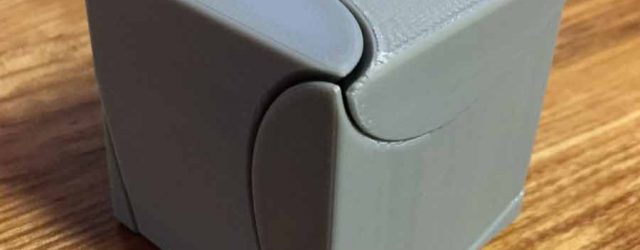
I really love puzzle with less pieces as possible and with a contemporary design… This neat three-piece puzzle has been invented by Robert Reid and designed by puzzle-master Oskar van Deventer. The fit of the puzzle is perfect, though assembly can be really challenging.
“Dynacube” is a new line of 3D puzzles featuring my optical art. It isn’t just a puzzle but also a living piece of art. This 3D game is available in 4 distinct styles from Recent Toys: http://www.recenttoys.com/project/dynacube/
Dynacube is a fun game for kids and adults alike to practice their logical thinking and motor skills.
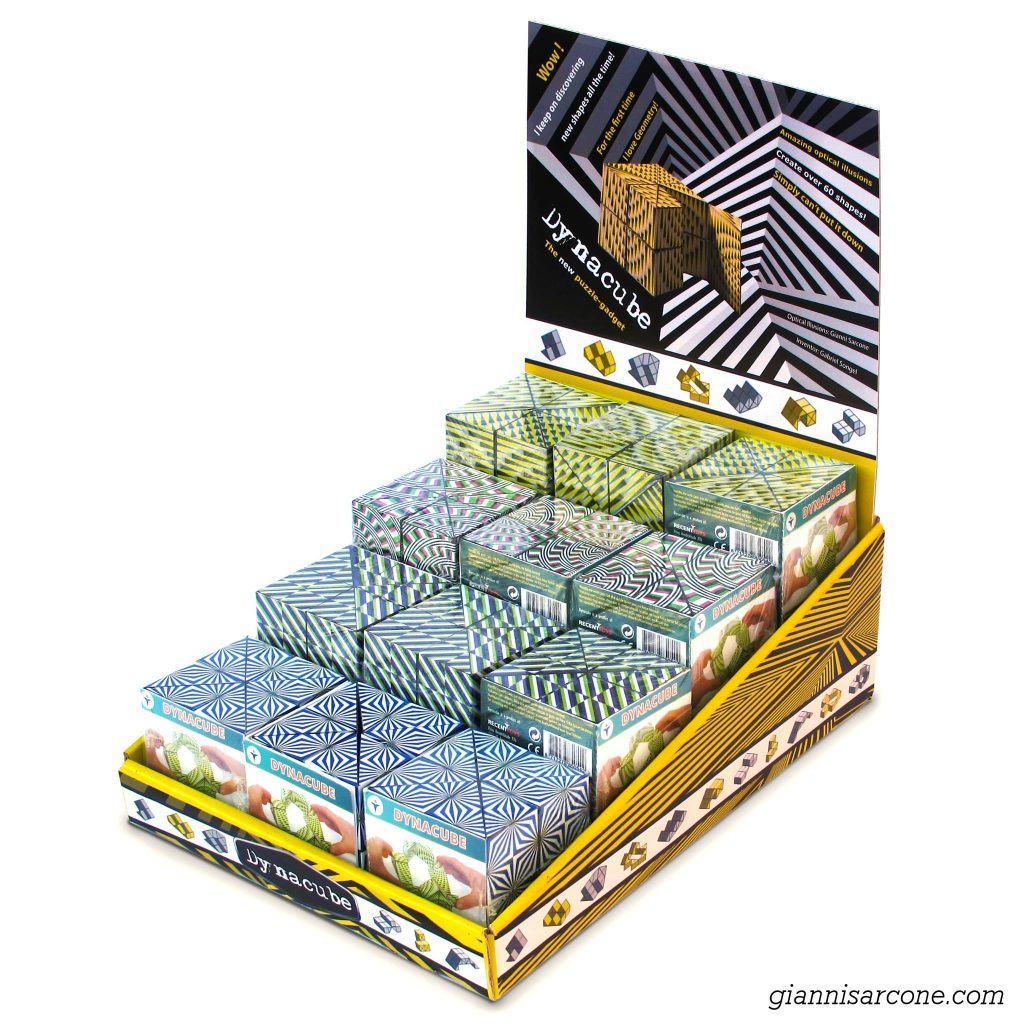
Display with 4 distinct styles of Dynacubes
