Dynamic Müller-Lyer Illusion

Prize illusion sarcone

I am very proud that my “Dynamic Müller-Lyer Illusion” won the third prize as best illusion of the year 2017!

As you surely know, the “BEST ILLUSION OF THE YEAR CONTEST” is a yearly competition under the patronage of Scientific American, organized by the Neural Correlate Company (New York, USA).

Müller-Lyer’s illusion proves that a segment can visually appear longer or shorter depending on the sense of the arrow heads at its ends. In what consists my variant? As shown in the animation, the red dot in the middle of the line is equidistant from the other two red dots, although the ends of the line visually appear to alternately stretch and shrink like a rubber band!

The radial version of the illusion is even more impressive:

The perceptual increasing and decreasing of the segments occurs in a very short time. Thus, I suppose it is more a physiological phenomenon, rather than a psychological bias. Our attention seems to be attracted by the receptive field WITHIN the V-shaped arrow heads, causing an illusory inward or outward shift of the ends of the line.

Continue Reading →

Breathing Hexagon

This is one of my earliest self-moving op art works (2003). Have a look at the static image above, don’t you have the feeling that the sets of lenticular shapes seem to expand?

This piece is accessible in various formats, including prints, posters, and t-shirts, through my art gallery shop.

Continue Reading →

Bidimensional Müller-Lyer Illusion

I am working on a new two-dimensional variant of the Müller-Lyer illusion… You may be surprised to know that the Müller-Lyer illusion isn’t only linear: it involves plane geometry too! In fig. A shown below, the ends of the blue and red collinear segments, arranged in a radial fashion around a central point, delimit two perfectly concentric circles. However, for most observers, they seem instead to define a large ovoid that circumscribes another one, slightly eccentric (Fig. B). This comes from the fact that the red segments seem to stretch towards the lower part of the figure, while the blue segments seem to stretch towards the upper part of the same. As you can see, in this variant comes also into play the “neon color spreading” effect. In fact, a bluish inner oval-like shape appears within the black arrow heads (Fig. A), though the background is uniformly white.
Müller-lyer oval

Continue Reading →

The Astounding Art of Arrangements

Sometimes, man lets himself go to this abstracted ‘diversion’, which involves assembling or arranging pieces, counters or any small familiar object. This compulsive behavior is evidence of a geometrical sense, which is natural and irrepressible. This is the same behavior, which drives some birds instinctively when they collect and group shells, glittering or colored objects to lavishly decorate their bowers. So, assembling and arranging objects is not only a cerebral activity but, indeed, a primitive geometric urge.
Continue Reading →

Reuleaux-triangle intermittent mechanisms

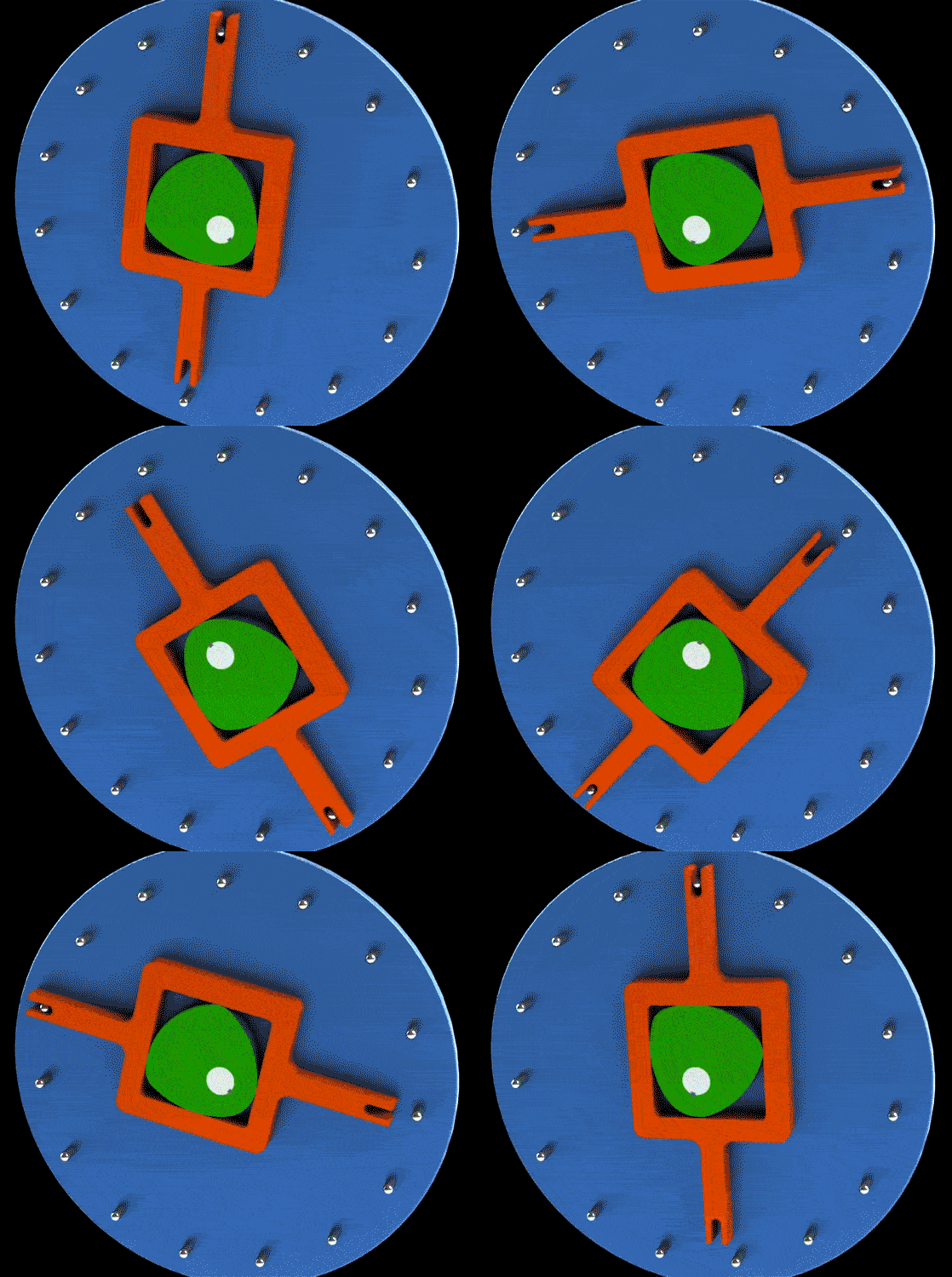
The Reuleaux triangle is a curious geometric shape: it looks like a rounded triangle, yet it has a remarkable property. Each side is an arc drawn from the opposite vertex, and together these arcs form a curve of constant width. In other words, no matter how you measure it—between two parallel lines—the width always remains the same.

Because of this property, a curve of constant width can act as a rotor inside a square. As it turns, the shape remains in contact with all four sides of the square at every moment, tracing a continuous motion while never leaving the boundary.

Mechanisms based on intermittent motion appeared early in mechanical engineering. One of their first practical uses was in sewing machines, where motion had to advance in precise steps rather than continuously. Today similar mechanisms are widely used in devices that move film frame by frame—such as cameras, projectors, and film-processing equipment—where controlled, stop-and-go motion is essential.

Reuleaux mechanism
Reuleaux mechanism 2

Would you dare run on it?

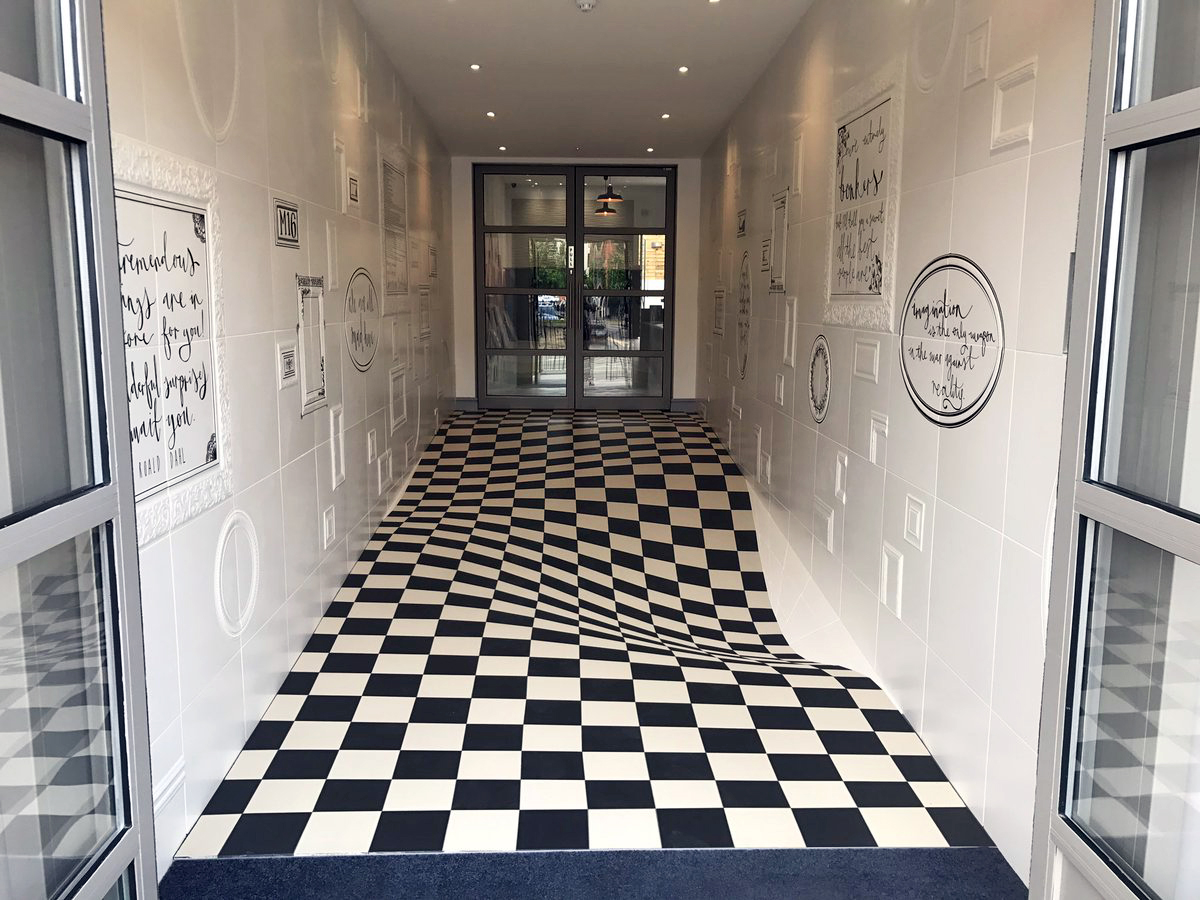
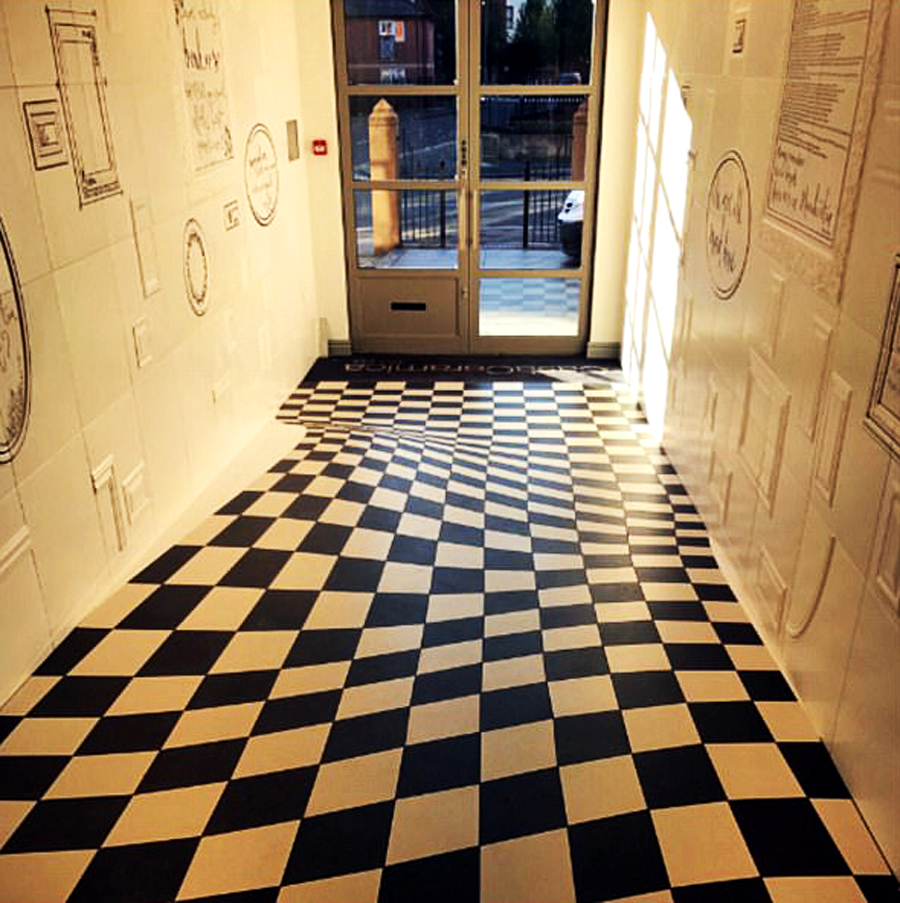
This wavy floor is actually a mind-boggling optical illusion that discourages people from running down the hallway (in fact, the floor is a completely flat surface!).

Manchester firm Casa Ceramica used a neat combination of black and white tiles to make the floor along the hallway look as though it is uneven making the tiles appear to slope away into a dip.

floor illusion 2

The illusion only works in one direction, so you will be perfectly safe on the way out.

floor illusion

The making of the floor.

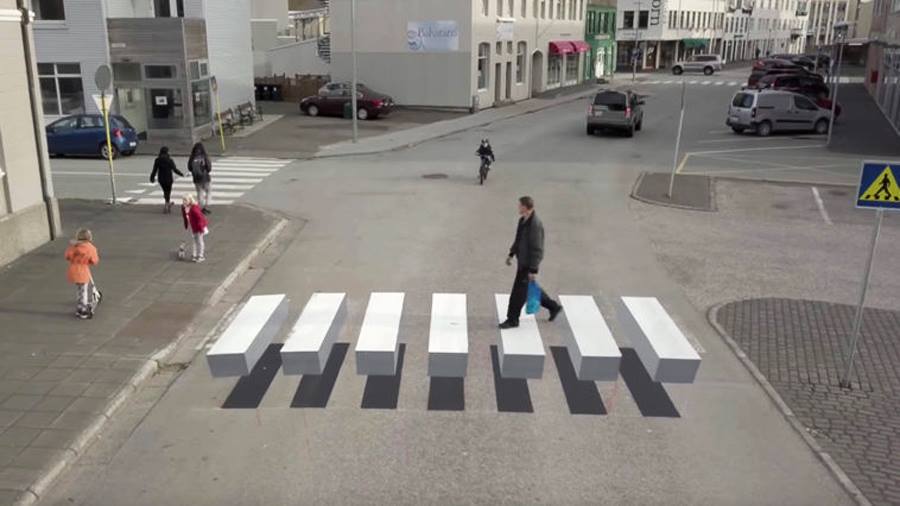
Many visual illusions have already been used to try and slow down traffic like this 3D-painted zebra crossing trialed in Iceland that provides an illusory effect of white blocks floating over the road.

zebra-cross illusion