In 1997, I reimagined Leonardo da Vinci’s Mona Lisa through a system of 142 color beads, each precisely positioned at the nodes of an invisible two-dimensional triangular grid. Up close, the pattern appears abstract, yet from a distance, the arrangement resolves into the familiar features of the portrait, inviting viewers to recognize the image through perception and suggestion.
It is often the little things that are the basis of progress… So let me tell you a little story about the tiniest thing on earth: the dot.
Thousands of years ago, a man in his solitude scanned the night sky and saw all those dots shining like so many still fireflies, and, perhaps for fun, he decided to join them together to form shapes. This is how zodiac signs and astronomy were born.
Far away, in ancient India, the dot symbolized beauty and the eye of knowledge. But even more, the dot they called “shunya-bindu” (शून्यबिन्दु) represented what we nowadays know as zero. It was first a placeholder and then a fully fledged number, for when it is added to the right of the representation of any given digit, the value of the digit is multiplied by ten. This is how our current numbers and decimal numeration system were born.
While drawing or painting, visual artists of all times used to fix a dot – or more specifically a point in space – which was traditionally visualized from the tip of their thumb. Eventually, when this point receded so far away in space, it became known as a “vanishing point”. A vanishing point is where all converging lines of a landscape meet at the horizon. This is how perspective and geometry were born.
One day, medieval musicians were tired of having to rely solely on their memories to remember songs. So they started to use dots, named “puncti”, placed on or between four lines to represent the pitch and duration of a sound. This is how musical notation and programming were born.
In the modern era, at the beginning of the nineteenth century, dots were used in many other symbolic forms: bumps, holes, single tones, flashes of light… Do the terms Braille, Morse, punched card, or pixel sound familiar to you? This is how communication and coding were born.
This is how the humble dot, often overlooked, has served as a fundamental building block for countless advancements throughout history. Never underestimate the power of small things; within a dot was the whole universe.
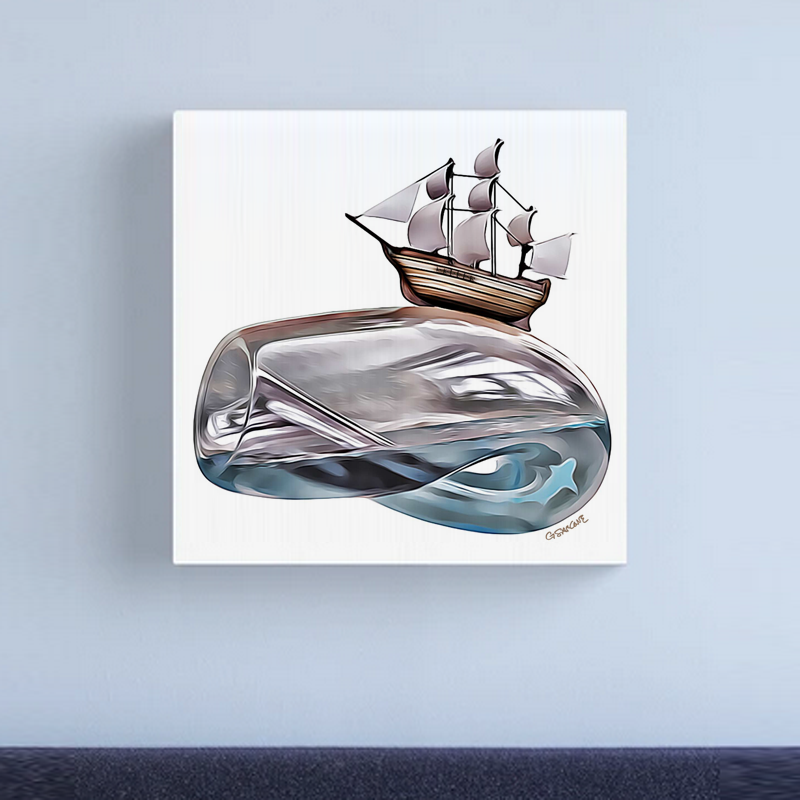
Embarking on a journey in a Klein bottle? Absolutely. A Klein bottle is a mind-bending non-orientable surface, defying the usual inside-outside norms. Technically, the ship’s navigating the interior…
Are you seeing spirals? Look again, they’re actually concentric circles! This unique variation of the “Fraser spiral” plays tricks on your eyes by blending a regular line pattern (representing the circle’s circumference) with misaligned elements (the spheres with varying brightness).
Would you like to learn how to create this mesmerizing illusion? Follow my simple visual tutorial. If you have any ideas to further enhance this project, please don’t hesitate to reach out.
Is yellow the true color of the sun? Our sun emits a broad spectrum of radiation, including visible light, which is crucial for life on Earth. In the vacuum of space, the sun appears white because it emits light across all wavelengths fairly evenly. However, when this light enters our atmosphere, it encounters air molecules and particles that scatter shorter wavelengths—primarily blue light—more effectively than longer wavelengths like red and yellow.
Simultaneous Color Contrast Explained…
Consider a small, clear disc placed against a blue background. The disc may appear slightly yellow due to the influence of the blue light surrounding it. This visual effect is similar to how we perceive the sun against the blue sky.In essence, while the sun itself emits white light, our atmosphere alters its appearance, leading us to see it as yellowish or orangish at times.
Additionally, not all species perceive colors in the same way. Different animals have varying sensitivities to wavelengths of light. This means their experience of color and light can be quite different from ours.
For more fun facts about color perception and optical illusions, visit Archimedes Lab.
Psychologist Diana Deutsch noticed something strange in 1995 while fine-tuning spoken commentary on a CD. The phrase “sometimes behave so strangely” sounded like a song when repeated on a loop. The phenomenon isn’t fully understood.
Deutsch’s illusion “Sometimes Behave So Strangely” experienced by the fifth graders of Atwater School, Shorewood, Wisconsin. Video created by their music teacher Walt Boyer.
Do our eyes truly act as the gateway to the world, as poets suggest? Not quite. We see the world through tiny pupils that act as spy holes. Our brain is like a creative ‘camera obscura‘, constantly comparing differences between images received by each eye and individual elements within each image. This makes our eyes highly sensitive to contrasts in brightness, sharpness, and depth. Sometimes, our brain tries to correct what we see.
Try this experiment: Look at the blurry face below next to the sharp one for 20-30 seconds (staring at the fixation star between them), then quickly shift your gaze to the same scene further below. You’ll notice that the previously clear face now appears blurry while the previously blurry face appears clearer. This illusion, called contrast adaptation or contrast gain control, occurs because prolonged exposure to blurry images affects our visual acuity and sensitivity to contrast.
As an artist, I enjoy including subliminal messages or figures in my work. My paintings, photographs and collages play on the foreground and background relationship of our visual perception and represent common or iconic faces the viewer has to rediscover.
In this magical bookmark of my creation, a portrait of M. L. King appears when held over a blank page or up to a light. From his famous words, we are reminded that, “Darkness cannot drive out darkness; only light can do that.” A neat gift available from Art of Play.
While in this one below, a portrait of Gandhi appears when held over a blank page or up to a light — a subtle reminder to read with intention and “Be the change you wish to see in the world.” Still available from my partner Art of Play.
Explore My World of Art, Books, and Creative Concepts