Although NOTHING moves on the gif below – only the colors change! – it’s easy to spot which direction the wheel is “rotating”… But which side is in front? Which side the back?
Another hypnotic version in which still squares and diamonds seem to move, but only colors change slightly!
When your brain lies… There is NO yellow, nor red, nor green in the picture below! The only real colors are blue, cyan and magenta. Scientists and artists call these color induction effects “simultaneous color contrast” and “color assimilation”.
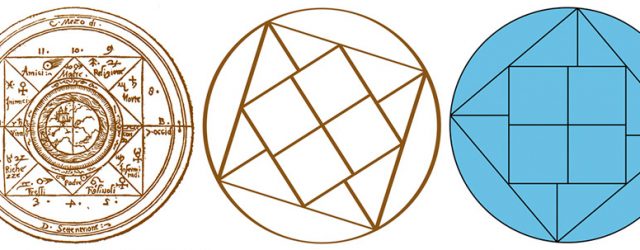
Inspired from the astrological tables, here is a new puzzle of my creation designed according to the ‘Golden Number Rules’, which is reflected in the proportion of each single piece of the game. Thanks to the balanced dimensions of its pieces, this puzzle acquires some intriguing magical properties!
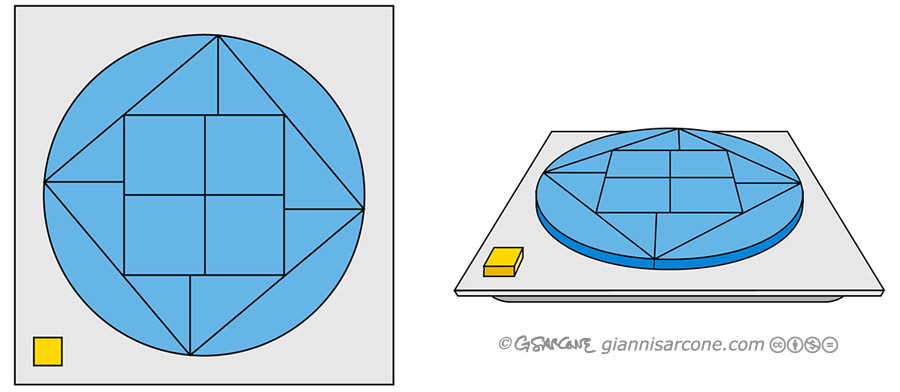
This “math-magical” puzzle is composed of a tray in which the pieces are assembled.
Object of the puzzle game
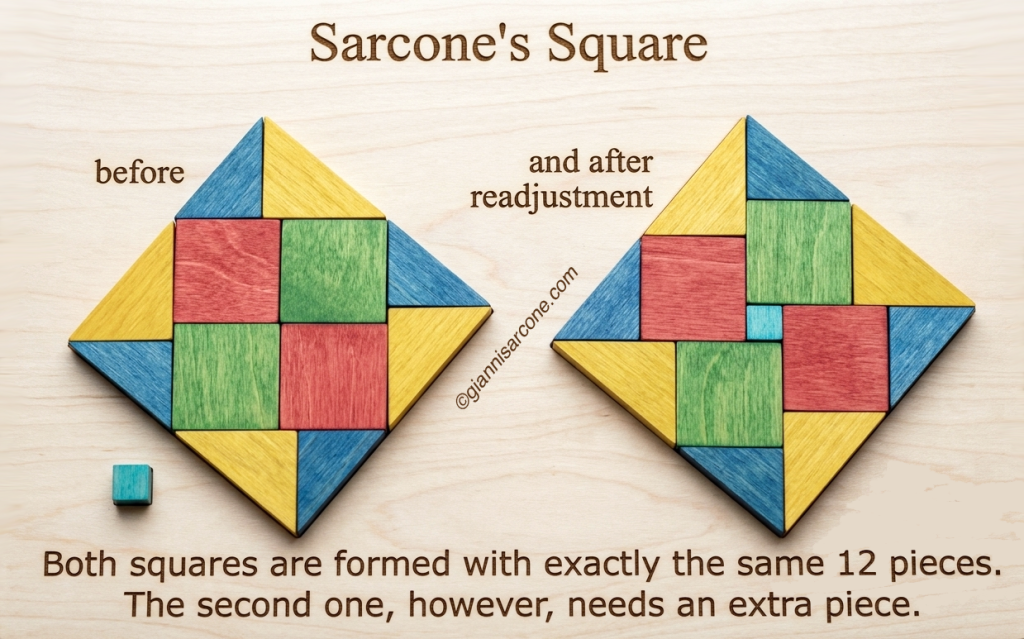
Fit the small extra piece into the puzzle without apparently altering its original dimensions. All the pieces must lie tight and flat! Impossible? See the solutions below.
The animated demonstration below is more eloquent than all theories. The puzzle shown in the video is a variant made in hard plastic, and cut using water-jet technology with an accuracy/precision of 0.01!
Here’s a wooden version of the puzzle I designed in the late 1990s. Each set of pieces is made in a different color, giving the puzzle a clean, elegant look while making its deceptive geometry even more striking.
I am looking for a game manufacturer able to produce and distribute this incredible puzzle. You can contact me through my website.
☞ Further reading: explore the complete Vanishing Piece Puzzle project on my Behance profile.
This series of works questions the many cognitive aspects of faces’ recognition. People often see hidden faces in things, clouds, landscapes, or in architectural structures… Finding the latent or virtual image hidden in the manifest image is a mental process related to the concept of the “lost object” used in psychoanalysis. As an artist, I enjoy including subliminal messages or figures in my work. My paintings, photographs and collages play on the foreground and background relationship of our visual perception and represent common or iconic faces the viewer has to rediscover.
Photomosaic portrait of Albert Einstein made with random photographs of numbers. It is only when the viewer moves away from the image that the portrait of Einstein appears. It is the distance that creates and unveils the truth, because everything is relative as Einstein once said and everything depends on the context, the environment or the point of view.
A visual surprise is hidden within this magical bookmark I created for my partner Art of Play. From one perspective, the grooves in the metal die-cut card seem to be an abstract radial design but place the pattern against a solid dark background and a familiar portrait emerges.
Can you guess who’s this female Mexican artist who once said: “Everything changes, everything moves, everything revolves, everything flies and goes away.”
Below are two neat optical illusion projects for which I was commissioned by “Art of Play”. From one perspective, the grooves in the metal die-cut bookmarks seem to be an abstract design but place the pattern against a solid clear or dark background and a familiar figure pops into view! These bookmarks are a sliver of wonder that hides between the pages to guard your place in any story.
Everything is relative with this magical bookmark of my creation depicting the famous theoretical physicist. Engraved with one of Einstein’s most famous quotations: “The most beautiful thing we can experience is the mysterious. It is the source of all true art and science. He to whom the emotion is a stranger, who can no longer pause to wonder and stand wrapped in awe, is as good as dead; his eyes are closed.”
“Unspirals” is a series of silkscreen-print projects (still in progress). These colorful geometric op art works appear to rotate and move. They are great promotional supports for companies and products.
An optical illusion I created years ago for the Gewerbemuseum of Winterthur, Switzerland. The orange halo around the contour of the eye doesn’t exist, it’s a construct of your brain.
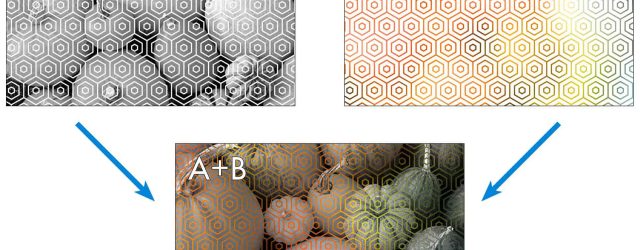
This is an old technique that uses the “color assimilation” effect to colorize pictures. This perceptual effect, also known by scientists as the Von Bezold spreading effect, occurs when our visual system transfers perceived colors to their adjacent areas.
Is the first photo of a variety of pumpkins in color?
Black and white photo overlaid with a geometrical tinted grid