Geometric shapes are not limited only to the figurative aspect, they can also play active roles, for instance, serving in microelectronics to build operational printed circuits such as: small inductors (magnified, fig. a below), resistors (fig. b) and capacitors (fig. c). (image taken from my book “Almanach du Mathématicien en Herbe“)
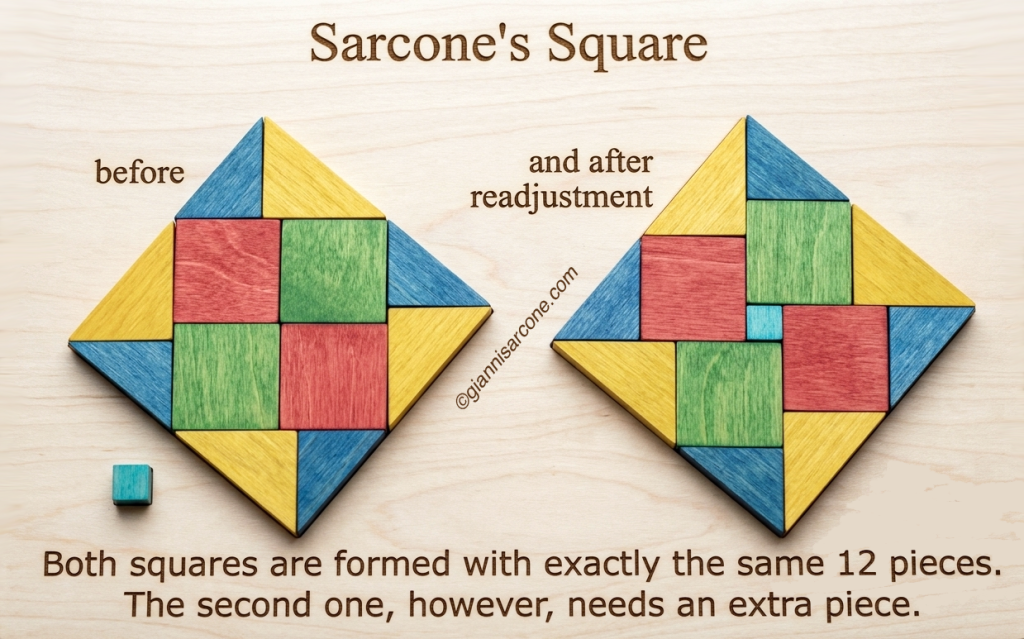
A math-magic article I wrote for the German magazine Zeit Wissen: with the 13 triangular and square pieces (fig. 1) it is possible to form two large squares shown in fig. 2. Though the second large square has an extra piece the dimensions of the squares seem to be the same! Can you explain why this is possible?
Here’s a wooden version of the puzzle I designed in the late 1990s. Each set of pieces is made in a different color, giving the puzzle a clean, elegant look while making its deceptive geometry even more striking.
I am looking for a game manufacturer able to produce and distribute this incredible puzzle. You can contact me through my website.
☞ Further reading: explore the complete Vanishing Piece Puzzle project on my Behance profile.
Convex / Concave, it all depends on your point of view! Although the plates are the same, in the second picture, the indents of the egg plate look more like convex domes rather than concave indents.
Obviously not… The closest thing to a “perpetual motion machine” is the Beverly clock whose mechanism is driven by variations in atmospheric pressure, and by daily temperature variations.
This is one of my oldest illusions I created in the 90s. In the picture you may see ghostlike dark radial beams. This illusion is a variant of the Herman’s scintillating grid illusion. I designed this illusion just by turning 45 degrees the Herman grid and then by applying a polar transformation.
Salvador Dalí : Sept corps nus et un crâne, 1951 (Human skull consisting of seven naked women).
Often symbols of MORTALITY (or some romantic notion of immortality – as the belief that a spiritual part of a person survives death) and POWER, skulls have been employed in human rituals and art since the dawn of humanity: from the ancient animal skulls in Paleolithic burial sites, to the curlicued cattle skulls that haunt Georgia O’Keeffe’s canvasses. Skulls cannot be assumed to be only a mere symbol of death, they are also used in initiation rituals as a symbol of REBIRTH, symbolizing the ‘sephirah daath’ (סְפִירָה – sephirah, “enumeration” in Hebrew) on the cabalistic tree of life, the gateway to a higher awareness only achievable through spiritual death and rebirth.