Visual illusions where you experience two equally possible interchangeable states in perception are called “bistable illusions“. The Necker cube and the Rubin vase are ones of the most classic examples of a bistable figure. I have discovered that all over India, you may see many variants of an interesting bistable depiction, which represents a bull and an elephant with distinct bodies and only one head (painted or sculpted at least 850 years ago). If you look carefully at the whole picture, you may see how the body parts of both animals are skillfully overlapped. For instance, the trunk of the elephant is also the hump of the bull. The horns and ears of the bull have become the mouth or snout of the elephant. These are ones of the earliest documented “ambiguous figure” illusions…
Curiosities
Optical Illusions Using Typography & Shadowcasting
With help of typography and light you can make a lot of amazing visual effects! The game is all a question of symmetry…
A l’aide de la typographie et de la lumière, on peut créer beaucoup d’effets visuels intéressants! Le tout tourne autour de la symétrie…
Snowmen Are Boring
Winter is approaching. Here is a geometric construction you can build with your children in your backyard: a perfect pentagonal snowdodecahedron…

Stunning Vibrant Metallic Gold Color Insects
Nature is truly the mightiest artist itself! This amazing insect is the “Painted Weevil” (Eurhinus magnificus), a splendid species that sports a metallic emerald, gold, copper and ruby exoskeleton that makes it look like a tiny jewel when spotted in the grass.

Typographical Curiosity About Numbers
“Why do the digits look like they do?” to answer this recurrent question one may find on the web many strange and diverse theories on the origin of the shapes of our modern, Hindu-Arabic numerals. Unfortunately, most if not all of those theories are patently false! One that went viral claims: “Our present method of writing figures is based on an early Arabic geometric design (see below) where each digit contains its own number of corners or angles, for instance the digit 1 contains one angle, the digit 3 has three angles, the digit 7 has seven angles and so on.” It’s not an exaggeration to say that it’s just plain nonsense!
Let us leave aside these abstruse theories, as there are a whole range of serious and documented books on the origin of numbers, including Georges Ifrah’s excellent book “Universal History of Numbers“.
However, there is nothing preventing us from finding or inventing original and / or fun typographic methods to create numbers, like the one illustrated below, which requires only two stylized numerals: a 4 and a 8.

Art & Math
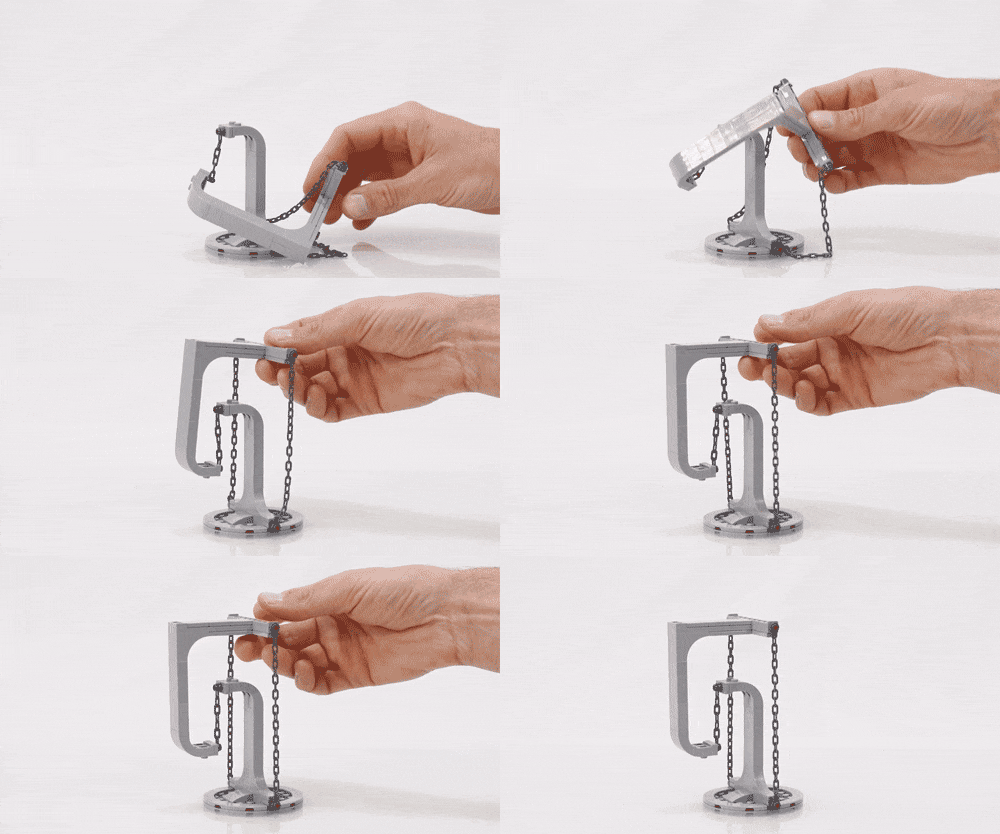
Pattern with Arabesque paths moving in a linear fashion induces rotational motion to a hexagonal device.

Emerson’s Secret
When Crayola‘s senior designer Emerson Moser retired in 1990—after 37 glorious years of loyal service—he finally confessed to a little secret: he was color vision deficient! Moser went on to produce a record 1.4 billion crayons during his career…
While any type of color vision deficiency (color blindness) could make crayon production difficult, complete color vision deficiency, where someone can only see in shades of gray, is extremely rare. About 99% of color vision deficiency involves just the inability to distinguish between some pairs of complementary colors.
So, if you’re wondering about your own color vision, feel free to take the test on my website.

TangraMagic Puzzle

TangraMagic, a new manipulative puzzle for classrooms or just for fun..

The visual art of concealing
In my book “Hidden Picture Puzzles“, I treat of hidden things in plain sight.
“Steganography” is the art and science of hiding a secret message within a larger one, in such a way that no one suspects its presence. The old Swiss banknotes offer some interesting examples of steganography. In the picture below you can see the back of a Swiss ten-franc bill. The small part surrounded by the blue square contains a microtext, if we strongly enlarge it we may read a short bio of the Swiss architect Le Corbusier both in German and in Romansch:
Le Corbusier hat als Architekt Urbanist maler und Theoretiker Bahnbrechende und Visionäre Anwendungen für den Wohn- und Städtebau verwirklicht…
Numbers In Nature
Diaethria phlogea, the “89’98 butterfly”, is a species of butterfly of the Nymphalidae family. It is found in Colombia, South America. The markings on its wing can resemble a painted number: an 89, a 98 or even an 88.