Illusive Pietà

Uncovering the subtle visual tricks Michelangelo wove into his masterpiece.

We’re not very good at judging the true size and positioning of objects just by looking. Take Michelangelo’s Pietà—it hides some subtle, conceptual “illusions”:

  • If they were standing, the Virgin Mary would actually be much taller than Christ, which may be surprising.
  • Her knees are slightly off-center, forming a kind of base or pedestal that supports Christ’s body.
  • And while logically the Virgin should look older, her face is almost childlike, creating a striking contrast with the mature, somber face of her son.

Michelangelo himself explained this choice:
“The mother had to be young—young enough to appear forever a virgin. Meanwhile, her son, who took on our human nature, must, in the stripping away of death, be a man like any other.”

Art is full of illusions designed to meet the visual expectations of viewers—and sometimes to correct what might seem off or unnatural to the eye. Because reality, at times, doesn’t always feel quite real or right to those who look at it.

And one last curious detail: Pietà is the only work Michelangelo ever signed. Stung by whispers that another sculptor had made it, he returned one night and boldly carved his name across Mary’s sash— “MICHAELA[N]GELVS BONAROTVS FLORENT[INVS] FACIEBAT” (Michelangelo Buonarroti, the Florentine, made this). A rare flash of pride from an artist who usually let his work speak for itself.)

Pietà by Michelangelo

The First Hero’s Quest for Immortality

The Epic of Gilgamesh is the oldest known long-form poem in history—predating the Bible, The Iliad, and even the Mahābhārata. Often hailed as the first great work of world literature, this ancient Babylonian epic tells the story of a mighty hero, king of Uruk, who embarks on a quest for immortality. Its timeless themes—love, friendship, grief, the fear of death—still speak to us with surprising clarity.

Originally transmitted orally, the poem was later inscribed in cuneiform on clay tablets. The version we know today was written in Akkadian, the lingua franca of the Babylonian Empire, over four thousand years ago. For centuries, the text was lost to history—until its rediscovery in fragmented form during the nineteenth century sparked renewed interest.

The tale begins with Gilgamesh, a powerful yet restless king, and Enkidu, a wild man created by the gods to challenge him. After a dramatic contest of strength, the two become inseparable companions. They journey to the sacred Cedar Forest, where they slay its divine guardian, Humbaba. When Gilgamesh rejects the goddess Ishtar, she unleashes the Bull of Heaven. The two heroes kill the beast—an act that angers the gods, who punish them by taking Enkidu’s life.

Stricken by grief, Gilgamesh sets out on a perilous journey in search of eternal life. He ultimately meets Utnapishtim, a flood survivor granted immortality by the gods. From him, Gilgamesh learns a harsh truth: death is man’s destiny; immortality belongs only to the divine.

More than a heroic saga, The Epic of Gilgamesh established the prototype for later epic heroes—from Heracles to Odysseus—and continues to inspire writers and artists today. Its enduring influence stretches across millennia and cultures.

In Forests, Robert Pogue Harrison draws on The Epic of Gilgamesh to explore the symbolic power of forests in the Western imagination. Gilgamesh’s felling of the sacred cedars and slaying of Humbaba reflects humanity’s first mythic confrontation with nature—marking the forest not as sanctuary, but as territory to be mastered. For Harrison, this moment signals the dawn of civilization’s long, uneasy relationship with the wild.

To truly grasp the spirit of the ancient world, I encourage you to read The Aeneid by Virgil, Homer’s Iliad and Odyssey, as well as the timeless Mahābhārata and The Epic of Gilgamesh. These foundational texts continue to illuminate the hopes, fears, and questions that have shaped human thought across the ages.

Gilgamesh

A Hidden Time Machine

We all carry within us a time machine—hidden in plain sight, right in the middle of our face. It may sound unlikely, but the NOSE is the only sensory organ capable of transporting us into the past without our even realizing it.

Our sense of smell activates memories like no other. A single scent can unlock a precise moment from childhood or early adulthood: the fragrance of oranges at Christmastime, melting snow during your first school field trip in winter, the scent of your sweetheart’s sweater the day you met, your grandmother’s simmering tomato sauce during Sunday lunches, the waxed floor of your grandparents’ house, school glue in primary class, the sunscreen of beachside summers, old book ink in the town library, the leather of your first satchel, or the aroma of fresh coffee at dawn when everyone else was still asleep…

The nose is a powerful trigger for nostalgia because the olfactory bulb, where smells are processed, is directly connected to the limbic system—the brain’s emotional and memory center. This close link allows smells to summon vivid memories, often with startling clarity, and sometimes, with them, an unexpected flood of emotions.

Each smell opens a door to a suspended instant—fragile, vivid. It’s an inward journey to a hidden past, a place buried deep, that suddenly bursts forth like a firework of nostalgia.

Each of us holds a palette of scents capable of bringing us back—suddenly, vividly—to a time that’s gone. Mine carries rustic, earthy tones: my maternal grandparents were farmers, and I spent much of my early childhood with them in the mountains of Irpinia.

I remember the sticky perfume of freshly harvested tobacco leaves, the white film of yeast clinging to wine grapes, the wild asparagus gathered by riverbanks, the unmistakable sweet scent of the ceuze—what we called mulberries in dialect—and the zenzifero, a local mint that gave ricotta ravioli its delicate fragrance…

I doubt I’ll ever stumble across those long-lost smells again—or perhaps they’re just dormant, waiting. But if they do return, that would be the most beautiful time travel I could ever hope for.

And you? What scents carry you away to other times, other worlds?

smell memory, nose

Smelling the Color 9: When Numbers Take Shape and Color

In English, the expression to smell the color 9 describes something completely impossible…

And yet, some people have the unusual ability to mentally visualize colors or spatial patterns when thinking about units of time—or more broadly, numbers. This phenomenon, known as synesthesia (from the Greek syn, “together”, and aisthēsis, “sensation”), occurs when stimulation of one sense involuntarily triggers sensations in another. It’s not a figure of speech—these perceptions feel very real to those who experience them.

The first documented case in medical literature appeared in 1710. Dr. John Thomas Woolhouse (1650–1734), an ophthalmologist to King James II of England, reported a blind young man who claimed he could perceive colors induced by sounds.

Neuroscientist Vilayanur S. Ramachandran and his team at the University of California, San Diego, observed that the most common form of synesthesia links “graphemes“—letters or numbers—to specific colors. Since my work bridges art and mathematics, I’ll focus here on number-based synesthesia.

People who experience synesthesia in its pure form are relatively few. However, many report strikingly similar associations between numbers and colors or spatial layouts, suggesting these perceptions aren’t just products of imagination or attention-seeking. For example, number–form synesthesia may result from cross-activation between brain regions in the parietal lobe that handle numerical and spatial processing. In contrast, number–color synesthesia likely stems from an overabundance of connections between adjacent areas that interfere with each other when triggered (see fig. 1 below).

brain synesthesia

Figures 2 and 3 illustrate common synesthetic patterns—either as color associations (fig. 2) or spatial arrangements (fig. 3, based on observations by Sir Francis Galton). Statistically, people often associate the digits 0 or 1—and sometimes 8 or 9—with black or white. Yellow, red, and blue are typically linked to smaller digits like 2, 3, or 4, while brown, purple, and gray tend to be tied to larger ones like 6, 7, or 8. Curiously, it’s not the idea of the number but the visual form of the digit that seems to trigger the sensation. For instance, when the number 5 is shown as the Roman numeral V, many synesthetes report no color at all.

color number synesthesia

And you—do you see numbers in color or arranged in space? Feel free to share your synesthetic experiences with me.

The Woman Who Painted the Future—Then Hid It

Hilma af Klint portrait

In 1906, Hilma af Klint, a Swedish artist and trained painter, began creating a groundbreaking body of abstract work—years before Kandinsky, Mondrian, or Malevich touched the genre.

Guided by her deep interest in spirituality, geometry, and nature, she produced hundreds of paintings that seemed to belong not to her time, but to the future. Vivid colors, spirals, symbols, and complex structures filled her canvases, forming a visual language meant to communicate the unseen.

Yet she kept these works largely hidden. Convinced the world wasn’t ready, Hilma left instructions that they not be shown until at least 20 years after her death.

She died in 1944. Her abstract paintings—more than 1,200 of them—remained in storage until the 1960s and were only brought to wider attention decades later. It wasn’t until the 2010s, with major exhibitions, that her place as a pioneer of abstract art was finally recognized.

Hilma af Klint didn’t just anticipate the future—she painted it, quietly, with visionary clarity.

Hilma af Klint painting 1

Julio Le Parc – Nihil novi sub sole…

Although I’ve been working in the field of Op Art since the mid-1980s, it’s important to recognize that the movement itself has a deeper history. It began to take shape in the 1960s, led by pioneering figures such as Victor Vasarely and Bridget Riley.

However, the artists who truly captivate me—the ones who expanded the language of perception—are often the outsiders. One such figure is Julio Le Parc (b. September 23, 1928), an Argentine-born artist whose practice bridges Op Art and kinetic art. Le Parc studied at the School of Fine Arts in Argentina and went on to co-found the Groupe de Recherche d’Art Visuel (GRAV). His work, honored with numerous awards, holds a prominent place in Latin American modernism.

Le Parc’s recurring themes—color, light, and movement—have always resonated with me. During the ’60s and ’70s, he explored light not just as a visual element but as a living, dynamic material. Yet by the late ’70s, his presence in the art world had faded; his output became sporadic, and for decades his work slipped quietly out of the international spotlight.

 Fortunately, recent years have witnessed a renewed appreciation of his explorations in light and movement, bringing his contributions once again to the attention of a wider public.

Artist’s Website: http://www.julioleparc.org

Book: Catalog of the artist’s first solo exhibition, Paris, November–December 1966. Text in French by Frank Popper.

Trama – A Strategy Game with an Artistic Twist

trama boardgame 2

Back in the ’90s, my board game Trama made waves for its fresh take on strategy and design. Imagine the logic of chess, but with a twist: neutral pieces that both players can use. The board—plexiglass with screen-printed art—echoes the feel of an Op Art piece, while the Galalith tokens add tactile charm.

There are several design variants, with boards featuring different color schemes and patterns. Some versions include holes or extruded circular reliefs to securely hold marbles instead of tokens—offering a fresh, sensory-rich experience.

· Curious? The full rulebook (in French) is 👉 here.
· More about 👉 Trama.

If you’re a manufacturer interested in bringing Trama back to the table, feel free to reach out.

trama news

Misdirection → Illusion → Aha! Moment…

How misdirection, illusion, and wonder shape my creative process.

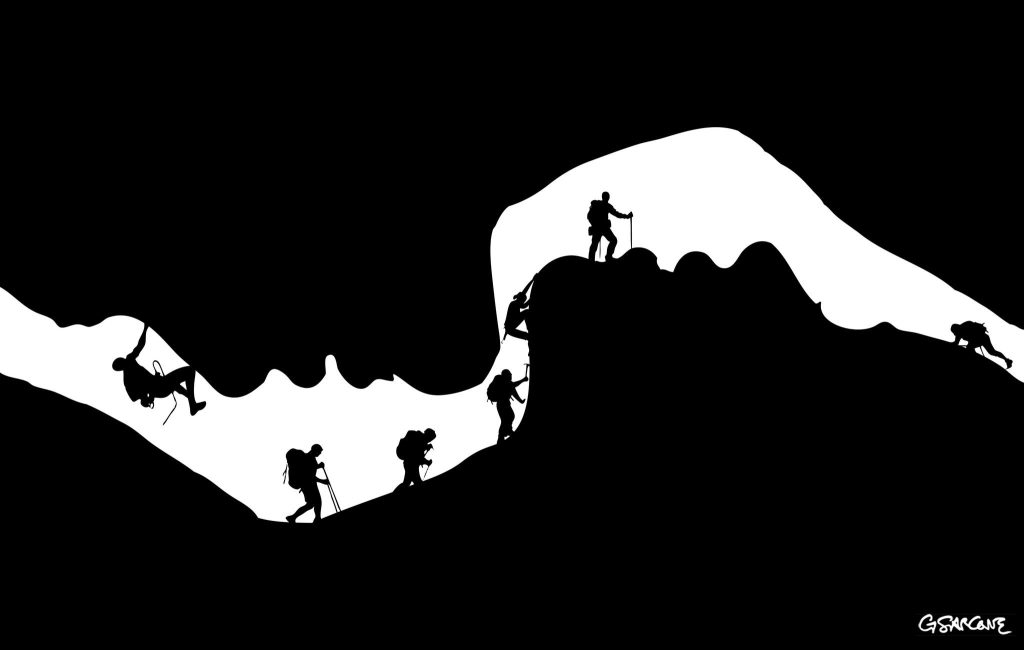
The path from misdirection to revelation is at the heart of how illusion and wonder spark insight. Misdirection steers our attention—often subtly—away from what truly matters. It disrupts our expectations, creating a gap between what we see and what is. Within that gap lies the illusion: a crafted discrepancy, a visual or cognitive sleight-of-hand that unsettles our perception.

But the magic doesn’t end there. When the illusion is cracked—when the mind shifts, recalibrates, and sees—the famous Aha! moment erupts. That flash of understanding isn’t just delightful; it’s deeply educational. It rewires how we interpret the world.

This sequence—misdirection, illusion, revelation—mirrors the creative process itself. It shows how confusion, when carefully designed, can be a gateway to clarity. In the right hands, illusion is not deception—it’s a tool to awaken curiosity, stretch perception, and provoke insight. Wonder, in this sense, becomes a powerful cognitive catalyst.

That’s why my art and, I believe, my writing, revolve around this sense of wonder—arguably the most direct and playful route to that pleasurable, often conflicting moment of insight: the sudden discovery of something previously unknown.

Reality Map… or a Carefully (Un)folded Illusion We Mistake for the Real?

The diagram offers just one interpretation among many: a visual way to suggest that every element in a hierarchy contains its own mini-hierarchy, and so on—an endless, anastomosed structure of nested systems. The names may shift, but the core idea stays the same. It’s our knowledge that draws the lines and defines the extent of this vast, branching tree.

Today, we think we’ve mapped the boundaries where the infinitely large and the infinitely small end. Yet with each scientific advance, those borders are pushed ever further.

But some philosophical questions arise: is our reality fractal in nature? Not necessarily. It may be that each entity, each element within this hierarchical branching structure, is fundamentally different from the others. And more than that—borrowing and reworking an idea from Aristotle—the whole is not merely the sum of its parts; it is something else entirely… and, in a way, the reverse is also true.

Yes, the branches may indeed extend infinitely, forming a structure that resembles a bridge stretching endlessly, anchored to no shore—a true paradox. Strange, perhaps. Stranger still: although our reality may not be fractal in the strict sense, we might consider it holographic in nature. From any single, distinct element, it is possible to reconstruct a part—or even the whole—of what surrounds it.

This phenomenon has a name in Latin: pars pro toto—a part that reflects the whole. In this sense, everything is contained within each of us, even in our differences.

I’ll end with a thought: if we perceive an ordered world amid the chaos of complexity, it is likely due to our remarkable ability to intuit patterns and to organize what we call reality according to the logics we ourselves invent. That, perhaps, is the most beautiful illusion of all.

reality map

Hands-On Wonders: A Mathemagical Collection

Ever wondered what happens when math puts on a magician’s hat? These books are the distilled magic of my hands-on math workshops across Europe — from Paris to Palermo, Geneva to Ghent — where paper folded, minds twisted, and logic sparkled in English, French, and Italian!

Impossible Folding Puzzles

1) “Impossible Folding Puzzles and Other Mathematical Paradoxes” — a playful dive into mind-bending problems where nothing is quite what it seems. Can a puzzle have no solution… or too many? Dare to fold your brain.

Still available on Amazon.

2) “Pliages, découpages et magie : Manuel de prestidi-géométrie” — where math meets illusion to spark curiosity and creativity.
Perfect for teachers, students, and curious minds: touch, fold, cut… and let the magic unfold!
Available on Amazon.

2) “Pliages, découpages et magie : Manuel de prestidi-géométrie” — un livre où maths et illusion se rencontrent pour éveiller curiosité et créativité.
Pour enseignants, élèves et esprits joueurs : touchez, pliez, découpez… la magie opère!
Dispo sur Amazon.

Pliage decoupages

3) “MateMagica” —  They say there’s enough carbon in the human body to make 900 pencils… but just one is all you need for these clever puzzles!
Fun, surprising, and thought-provoking — because, as Martin Gardner put it, “Mathematics is just the solution of a puzzle.”
Now on Amazon.

3) “MateMagica” —  Si dice che nel corpo umano ci sia abbastanza carbonio per 900 matite… ma per questi rompicapi ne basta una!
Sorprendenti, divertenti e stimolanti — perché, come diceva Martin Gardner, “la matematica è nient’altro che la soluzione di un rompicapo.”
Disponibile su Amazon.

I write and illustrate my own books in five languages: English, French, Italian, German, and Spanish.
If you’re a publisher or literary agent seeking original, high-quality educational content that blends creativity with clarity, I’d be pleased to explore potential collaborations.