
Lions had already appeared in Roman arenas, where they were set loose to devour Christians. Hannibal famously dragged elephants across the Alps. Yet, strangely enough, very few artists left us reliable images of these exotic beasts from the time.
So, centuries later, European artists faced a minor problem: how do you draw an animal you have never seen?
Simple. You copy someone who also never saw it.
This was the medieval version of the telephone game. A lion might be described in a manuscript, copied from an older drawing, or reported by a traveler as “a huge cat with a mane.” Each artist then copied, misunderstood, embellished, and passed the result on. After enough generations, the lion could acquire a human face, bizarre feet, and the general appearance of a creature that had escaped from someone’s nightmare.
The same problem survived well into the Renaissance. Take Albrecht Dürer’s famous 1515 rhinoceros. Dürer had never seen a rhinoceros. He worked from a written description and a sketch made after a real Indian rhino arrived in Portugal. He added armor-like plates that the animal did not actually have.Yet his rhinoceros became so influential that Europeans kept copying Dürer’s imaginary details for centuries.
There is something wonderfully philosophical about this: we rarely inherit reality itself. We inherit other people’s descriptions of it—and then confidently mistake the copies for the truth.
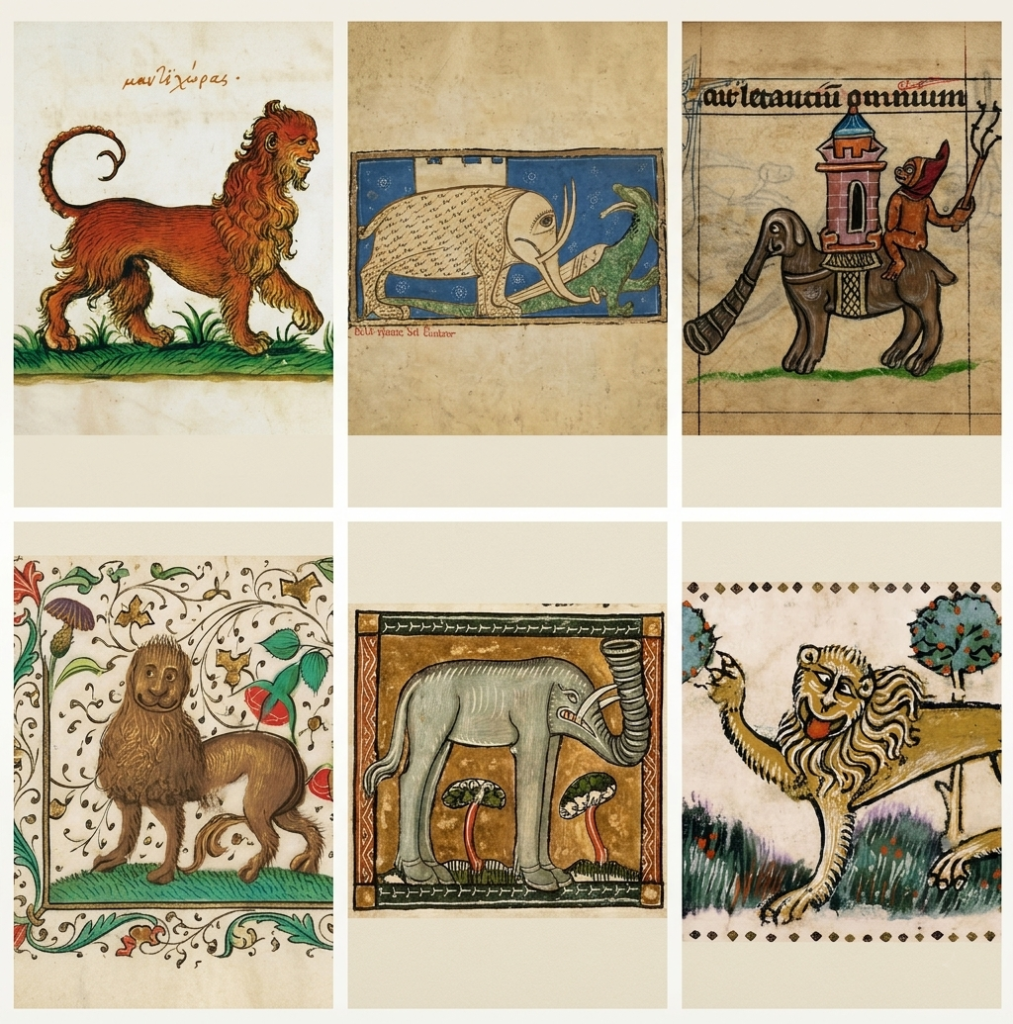
Details and Attributions for Each Picture
Top Row (Left to Right)
1. Top-Left (Manticore / μαντιχώρας)
Author / Artist: Unknown Medieval/Renaissance Illuminator (Greek manuscript tradition)
Date: Unknown (c. 16th Century / Early Modern Era)
Source / Context: Greek bestiary depicting the legendary Manticore with a lion’s body, human head, and scorpion-like tail.
2. Top-Middle (Elephant and Dragon / “De La Nature Del Olifaunt”)
Author / Artist: Unknown French Illuminator
Date: Unknown (c. 13th–14th Century)
Source / Context: Old French bestiary manuscript (Bestiaire) detailing the natural history and allegorical nature of the elephant and its rival, the dragon.
3. Top-Right (Monkey Riding an Elephant / Text: “aut letanias omnium”)
Author / Artist: Unknown Medieval Illuminator
Date: Unknown (c. 13th–14th Century)
Source / Context: Medieval manuscript marginalia / Book of Hours depicting a caped monkey riding a castle-bearing elephant (Howdah).
Bottom Row (Left to Right)
4. Bottom-Left (Smiling Lion in Floral Border)
Author / Artist: Unknown European Illuminator / Miniature Artist
Date: Unknown (c. 15th Century)
Source / Context: Illuminated manuscript page with ornate floral acanthus border work showing a stylized lion.
5. Bottom-Middle (Trumpet-Trunked Elephant with Trees in Framed Border)
Author / Artist: Unknown English or Northern European Illuminator
Date: Unknown (c. 13th Century)
Source / Context: Latin Bestiary miniature showing a stylized medieval elephant with trumpet-like trunk and tusks.
6. Bottom-Right (Paw-Raising Lion under Fruit Trees)
Author / Artist: Unknown Medieval Illuminator
Date: Unknown (c. 13th–14th Century)
Source / Context: Medieval Bestiary illustration depicting a lion gesturing toward fruit trees.
