This is one of my oldest illusions I created in the 90s. In the picture you may see ghostlike dark radial beams. This illusion is a variant of the Herman’s scintillating grid illusion. I designed this illusion just by turning 45 degrees the Herman grid and then by applying a polar transformation.
Salvador Dalí : Sept corps nus et un crâne, 1951 (Human skull consisting of seven naked women).
Often symbols of MORTALITY (or some romantic notion of immortality – as the belief that a spiritual part of a person survives death) and POWER, skulls have been employed in human rituals and art since the dawn of humanity: from the ancient animal skulls in Paleolithic burial sites, to the curlicued cattle skulls that haunt Georgia O’Keeffe’s canvasses. Skulls cannot be assumed to be only a mere symbol of death, they are also used in initiation rituals as a symbol of REBIRTH, symbolizing the ‘sephirah daath’ (סְפִירָה – sephirah, “enumeration” in Hebrew) on the cabalistic tree of life, the gateway to a higher awareness only achievable through spiritual death and rebirth.
Most of us are familiar with magenta — it’s a kind of purplish-red that exists between blue and red on color wheels (color wheels don’t accurately represent the physics of photons, but they represent the philosophical reality: color is a human construct that helps us interpret wavelengths to better understand our world).
The odd thing about color vision is that magenta (or pink) color is not in the spectrum of colors, meaning it cannot be generated by a single wavelength of light. Our brains interpret the color sensation of magenta/pink as ‘absence’ of green.
Take a look at this photo — it almost looks like a “transparent” or “camouflaged” knife! I snapped it years ago at a magician’s party. The trick here is all about specular reflections. It’s a simple illusion, but surprisingly effective. When you place a knife blade between the tines of a fork, it reflects nearby objects, making the blade seem almost invisible.
Image taken from my book “Optical Illusions: An Eye-Popping Extravaganza of Visual Tricks“, available from Amazon.Continue Reading →
For over 10 years, I’ve had the pleasure of collaborating with Focus, an Italian monthly popular science magazine published in Milan.
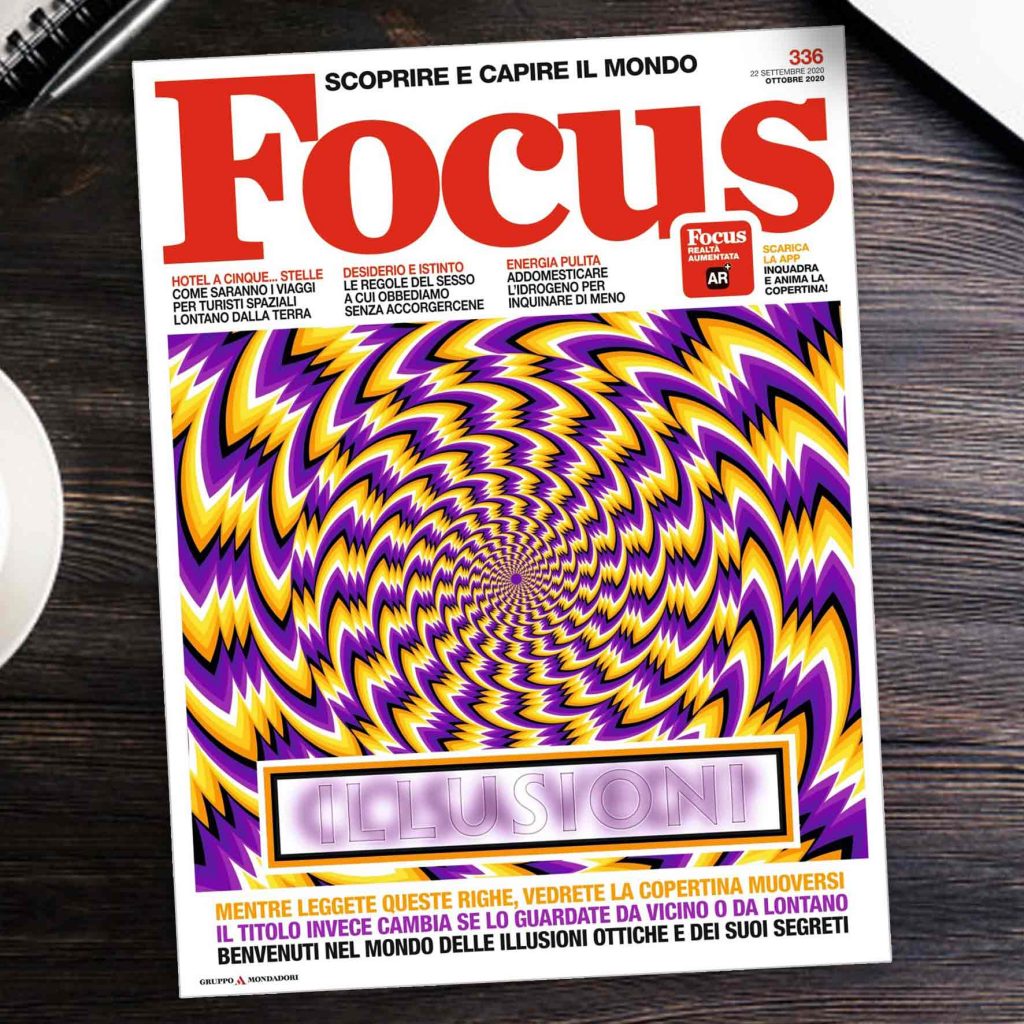
In October 2020, Focus released issue #336, which featured my article and optical illusions. This special edition included a 10-page dossier on visual perception, showcasing over 13 original illusions I created, complete with explanations.
The cover of this issue also featured a unique effect I designed for Focus. As you read the main title, the cover image moves, and, intriguingly, the title changes depending on your perspective—read closely, and it says ILLUSIONI; look from a distance, and it transforms into COSA VEDI?