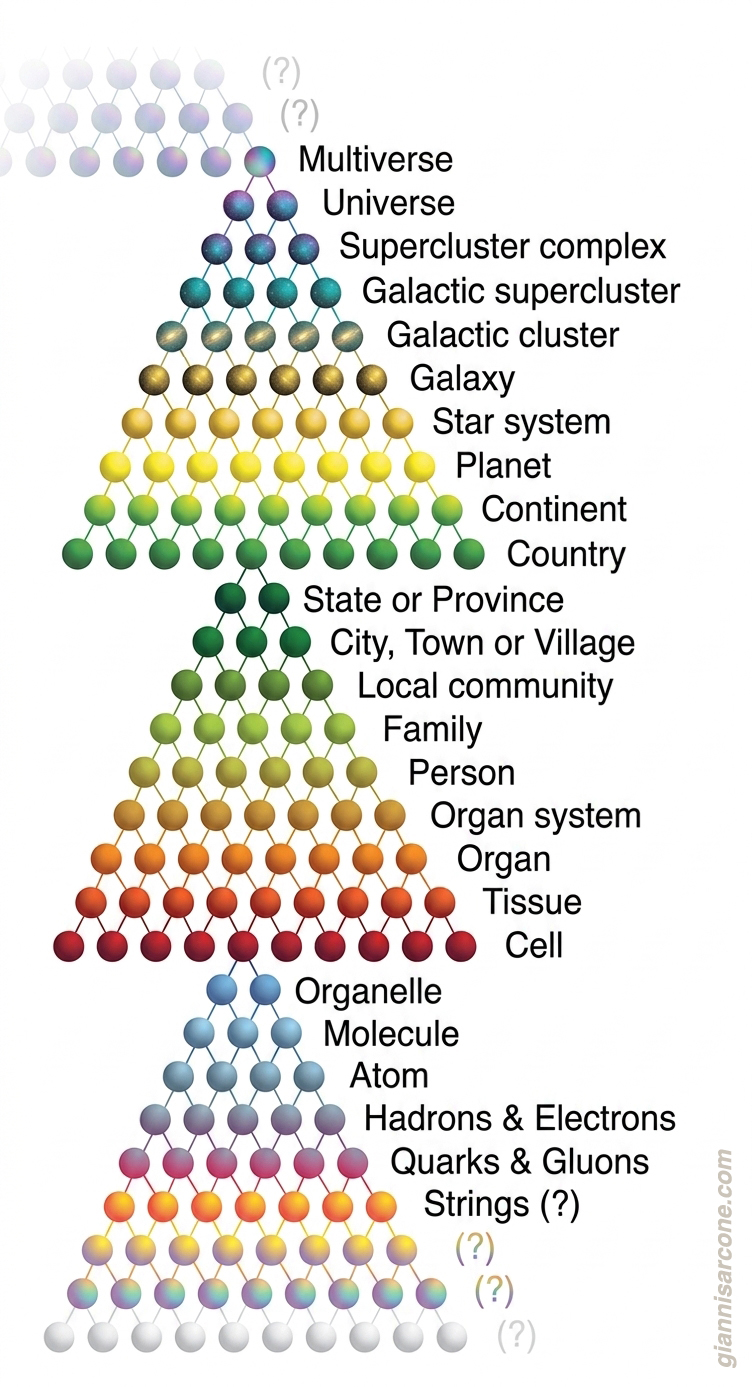
Stardust

Here’s the recipe to make an average-sized human: 15 kg of carbon, 4 kg of nitrogen, 1 kg of calcium, half a kg of phosphorus, 200 g of sodium, 150 g of potassium, 150 g of chlorine, a few grams of about 15 other elements (some exotic, like selenium, lithium, and vanadium in trace amounts), and four 10-liter buckets of water.

The 40 liters of water can be made by combining 5 kg of hydrogen and 35 kg of oxygen. Commercial cost? Just a few euros.
The hydrogen and a pinch of lithium come from the Big Bang, about 15 billion years ago. The other ingredients are more recent; they required billions of years of cosmic evolution, with stars being born, shining, dying, and reforming in nebulae from stellar collapse.
The 15 kg of carbon was formed in a star’s final stages by combining three helium atoms. The 35 kg of oxygen came from the fusion of carbon and helium in extremely hot stars. Iron is the ash of spent stars, and calcium, phosphorus, sulfur, chlorine, sodium, and nitrogen also come from these stellar forges.
Traces of even heavier elements reach us from supernovae. In short, we are born from the stars.

A Reflection on Conspiracy Theories

The Tinfoil Hat Prank
Conspiracy theories have become a widespread phenomenon, as common in Russia as they are in the West. A recent incident in Russia’s Voronezh region exemplifies this trend, where teachers fell for a prank by Belarusian artist Vladislav Bokhan, who sent a fake memo instructing educators to wear tinfoil hats to shield themselves from NATO satellites. Photos of these teachers, wearing their homemade “protection,” quickly went viral, sparking both laughter and concern.

A Deeper Look at the Prank
Bokhan’s prank was more than a joke—it was a satire on the extremes some beliefs can reach. Pretending to be a government official, he gave detailed instructions for crafting what he called “Helmets of the Fatherland.” Some teachers, taking the memo seriously, followed the directions, highlighting how easily misinformation can find a foothold.

The Public Reacts
As these images spread online, reactions poured in. While many laughed, others were alarmed by the sight of educators buying into such an absurd directive. The prank underscores the ease with which misinformation can affect even those responsible for educating future generations.

A Widespread Phenomenon
Notably, this isn’t just a Russian issue—conspiracy theories thrive in the West too, where ideas about microchips in COVID vaccines, flat-earth theories, and chemtrails reveal a growing distrust of science and authority. Anti-Western sentiments, once rooted in ideologies like communism and fascism, have fueled a skepticism that now feeds conspiracy theories across Western societies. This event serves as a reminder of how, in an age marked by skepticism and division, certain narratives can take hold in surprising ways.

Suggestive Minimalism

Draw me a human with just two short, symmetrical curved lines…

In 2012, Lebanese artist Huguette Caland took part in the group show Le corps découvert at the ‘Institut du Monde Arabe’ in Paris. One of her works, Self Portrait (1973)—a petal-pink field humorously cracked by a darker pink, revealing an up-close rear view of a classical nude—was featured on the catalog cover. She also presented whimsical, playful line drawings of breasts, lashes, eyes, lips, noses—noses?—as though lifted from a secret, sensual notebook of an untroubled Shel Silverstein. A sign in the hall restricted entry to those over eighteen… Who knows why, for such innocent visual plays?

Illusive Concentric Circles

My op art piece Trinacria (1997) features three black-and-white zig-zagging shapes spiraling together to create the illusion of interwoven concentric circles. These jagged, repeating patterns add a sense of depth to the piece and produce a subtle rotating effect that seems to shift as you follow each line with your eyes.

Prints and canvases of Trinacria are available in my online gallery.

Below, an animated version enhances the effect. By focusing on the center, viewers can observe virtual circles appearing to move inward or outward, adding to the piece’s dynamic sense of rotation and depth.

Perspective Optical Illusions: The art of circling the square

When bending the sides of a square structure forward, each edge forming a sine wave shape, the structure reveals a circle when viewed from the reverse angle. This illusion plays with perspective, specifically utilizing an effect known as “anamorphosis“.

Anamorphosis refers to a artistic technique that uses perspective to create distorted images that can only be viewed correctly from a specific angle.

Layering Up: A Creative Look at AI

Ever wondered how Convolutional Neural Networks (CNNs) process images? Imagine putting a photo through a pasta machine… TWICE! This creative experiment, inspired by artist Kensuke Koike, demonstrates how CNNs break down data into smaller, layered features, just like the pasta machine creates four clear images from a single input.

© Kensuke Koike

The Impossible Absence

In this naturalistic painting, there is no human being. And yet… Even when a painting appears to be empty of human presence, there is the inescapable human presence of the one who painted it.
Your gaze on the painting merges with the artist’s gaze. You see, through the emotions and the eyes of the one who spent hours studying this landscape. Art is a gift, it’s a “present”—the word is well chosen.
The artist becomes disembodied, transcending the physical, to offer you a front-row seat on the stage of his creation, where you’re invited to immerse yourself in his illusory representation of the world.

Painting by Guo Xi

Two Mind-Bending Aquariums

At first glance, they seem to be the same, but take a closer look… Can you spot what’s wrong?

I’ve always been fascinated by impossible figures, which psychologists call “undecidable figures”, meaning visual representations that challenge our perception and understanding of reality. Since the late 1980s, I’ve continued to explore this field and create new illusions, producing a series of drawings that play with the third dimension, manipulating perspectives and proportions to create original visual effects.

My work draws inspiration from two masters of optical art and impossible objects: Josef Albers and Oscar Reutersvärd. Their innovations and creations have always inspired and motivated me to continue my research in this field.

The Red Wine Color Illusion

Does the color of wine change when poured into a glass?
Although it may appear darker, the red shade remains the same. This visual trick is a result of the Munker-White illusion—where our brain perceives colors differently depending on their surrounding context.

If you’re fascinated by puzzles like this, reach out to my syndication agent to feature them in your publication.

This op art piece is also available as prints and canvases in my online gallery.