In 1997, I reimagined Leonardo da Vinci’s Mona Lisa through a system of 142 color beads, each precisely positioned at the nodes of an invisible two-dimensional triangular grid. Up close, the pattern appears abstract, yet from a distance, the arrangement resolves into the familiar features of the portrait, inviting viewers to recognize the image through perception and suggestion.
Our unconscious biases and stereotypes can influence our brain’s visual systems, leading us to perceive things and people in ways that align with these stereotypes.
Seeing nude women? Before assuming it’s pornography, reconsider… It’s fascinating how our minds are conditioned and stereotyped: in the first image, we instantly envision women in Adam and Eve attire, whereas the second presents a different reality.
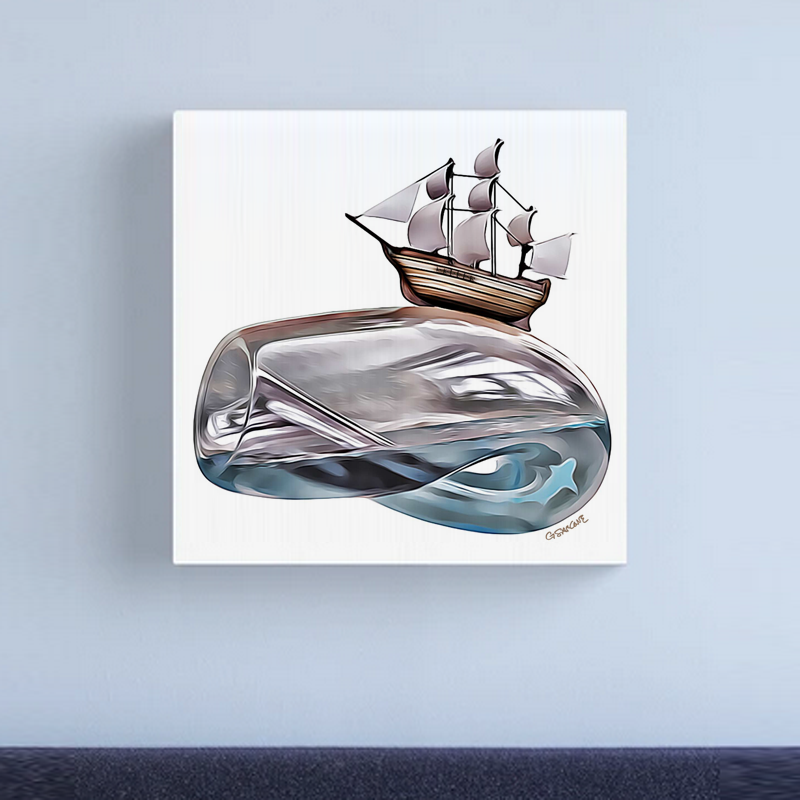
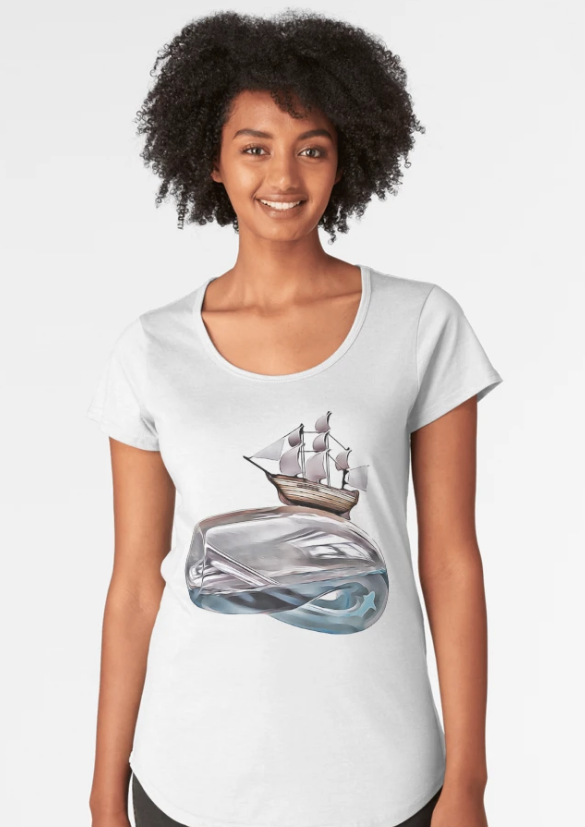
Embarking on a journey in a Klein bottle? Absolutely. A Klein bottle is a mind-bending non-orientable surface, defying the usual inside-outside norms. Technically, the ship’s navigating the interior…
Presenting “The Master of Numbers,” my acclaimed artwork. This photomosaic portrait, assembled from 288 random number-themed photos, creates a captivating optical illusion, revealing the image of a great physicist from a distance.
Currently showcased in numerous Museum of Illusions globally, posters and prints of this optical art can be found on my online store.
Are you seeing spirals? Look again, they’re actually concentric circles! This unique variation of the “Fraser spiral” plays tricks on your eyes by blending a regular line pattern (representing the circle’s circumference) with misaligned elements (the spheres with varying brightness).
Would you like to learn how to create this mesmerizing illusion? Follow my simple visual tutorial. If you have any ideas to further enhance this project, please don’t hesitate to reach out.
With this work, I aim to push geometry to its limits, transcending the confines of color. My goal is to showcase the creative potential of simple concentric squares as a medium for experimentation and the discovery of new op art patterns. By delving into this exploration, I strive to unveil captivating illusions of color and mesmerizing motion.
Draw a large and a small square with thick lines and center them (Fig. A). Next, blend the inner and outer squares in six steps to create a set of concentric squares. Reproduce the set to form a larger square pattern, as shown in Fig. B.
In these minimalist op art works, I explore geometry as metaphor, using the hexagon as a building block for cubes and other regular solids. The forms appear stable and believable, yet they are impossible. Their contradiction isn’t obvious at first; it reveals itself only when the eye slows down and follows the structure closely. By merging incompatible viewpoints and softening the boundary between inside and outside, the drawings turn logic against itself. The more ordinary the form looks, the stronger the effect—these objects are meant less to trick the eye than to unsettle the mind and challenge our sense of space.
The two drawings displayed above and below combine paired tribars to form an impossible isometric cube, where form and illusion lock into a single structure.
Here, the “volume” turns itself inside out, quietly echoing the logic of a Klein bottle and unsettling the usual distinction between interior and exterior.
I am currently in the process of writing an informative book titled “Mastering Optical & Geometric Art: A Journey to Captivating Creations.” With a length of 136 pages, this book serves as an engaging guide to creating visually striking optical art and intricate 2D and 3D patterns. If you are interested in exploring further, I invite you to connect with me on Amazon.
Do our eyes truly act as the gateway to the world, as poets suggest? Not quite. We see the world through tiny pupils that act as spy holes. Our brain is like a creative ‘camera obscura‘, constantly comparing differences between images received by each eye and individual elements within each image. This makes our eyes highly sensitive to contrasts in brightness, sharpness, and depth. Sometimes, our brain tries to correct what we see.
Try this experiment: Look at the blurry face below next to the sharp one for 20-30 seconds (staring at the fixation star between them), then quickly shift your gaze to the same scene further below. You’ll notice that the previously clear face now appears blurry while the previously blurry face appears clearer. This illusion, called contrast adaptation or contrast gain control, occurs because prolonged exposure to blurry images affects our visual acuity and sensitivity to contrast.
As an artist, I enjoy including subliminal messages or figures in my work. My paintings, photographs and collages play on the foreground and background relationship of our visual perception and represent common or iconic faces the viewer has to rediscover.
In this magical bookmark of my creation, a portrait of M. L. King appears when held over a blank page or up to a light. From his famous words, we are reminded that, “Darkness cannot drive out darkness; only light can do that.” A neat gift available from Art of Play.
While in this one below, a portrait of Gandhi appears when held over a blank page or up to a light — a subtle reminder to read with intention and “Be the change you wish to see in the world.” Still available from my partner Art of Play.
Explore My World of Art, Books, and Creative Concepts