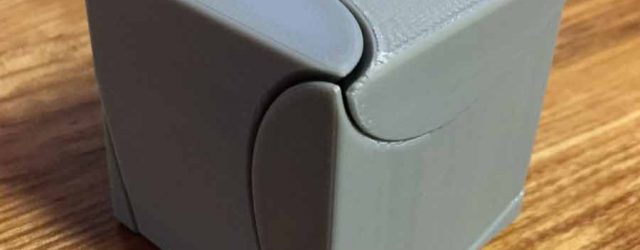
I really love puzzle with less pieces as possible and with a contemporary design… This neat three-piece puzzle has been invented by Robert Reid and designed by puzzle-master Oskar van Deventer. The fit of the puzzle is perfect, though assembly can be really challenging.
An op art sculpture and/or a fidget puzzle to play with over and over!
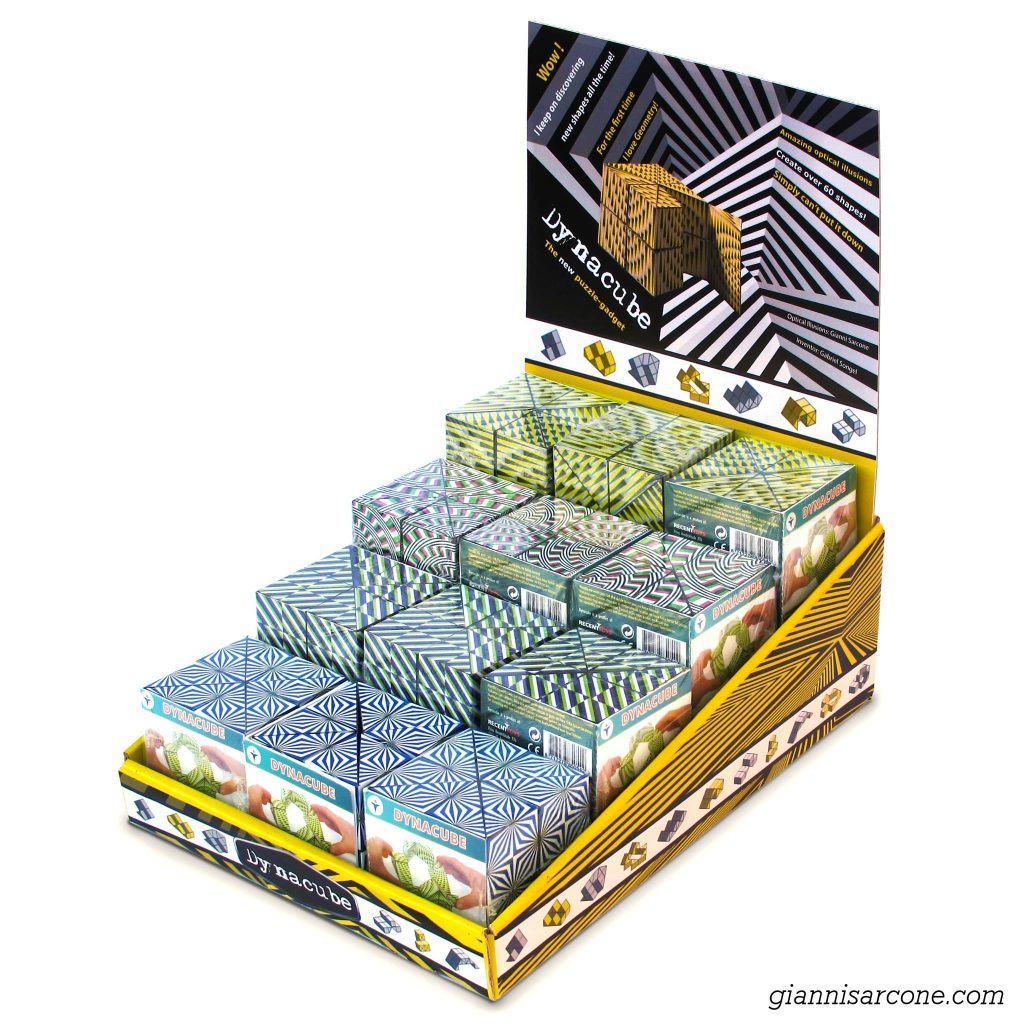
“Dynacube” is a new line of 3D puzzles featuring my optical art. It isn’t just a puzzle but also a living piece of art. This 3D game is available in 4 distinct styles from Recent Toys: http://www.recenttoys.com/project/dynacube/
Dynacube is a fun game for kids and adults alike to practice their logical thinking and motor skills.
As you surely know, the “BEST ILLUSION OF THE YEAR CONTEST” is a yearly competition under the patronage of Scientific American, organized by the Neural Correlate Company (New York, USA).
Müller-Lyer’s illusion proves that a segment can visually appear longer or shorter depending on the sense of the arrow heads at its ends. In what consists my variant? As shown in the animation, the red dot in the middle of the line is equidistant from the other two red dots, although the ends of the line visually appear to alternately stretch and shrink like a rubber band!
The radial version of the illusion is even more impressive:
The perceptual increasing and decreasing of the segments occurs in a very short time. Thus, I suppose it is more a physiological phenomenon, rather than a psychological bias. Our attention seems to be attracted by the receptive field WITHIN the V-shaped arrow heads, causing an illusory inward or outward shift of the ends of the line.
I am working on a new two-dimensional variant of the Müller-Lyer illusion… You may be surprised to know that the Müller-Lyer illusion isn’t only linear: it involves plane geometry too! In fig. A shown below, the ends of the blue and red collinear segments, arranged in a radial fashion around a central point, delimit two perfectly concentric circles. However, for most observers, they seem instead to define a large ovoid that circumscribes another one, slightly eccentric (Fig. B). This comes from the fact that the red segments seem to stretch towards the lower part of the figure, while the blue segments seem to stretch towards the upper part of the same. As you can see, in this variant comes also into play the “neon color spreading” effect. In fact, a bluish inner oval-like shape appears within the black arrow heads (Fig. A), though the background is uniformly white.
Sometimes, man lets himself go to this abstracted ‘diversion’, which involves assembling or arranging pieces, counters or any small familiar object. This compulsive behavior is evidence of a geometrical sense, which is natural and irrepressible. This is the same behavior, which drives some birds instinctively when they collect and group shells, glittering or colored objects to lavishly decorate their bowers. So, assembling and arranging objects is not only a cerebral activity but, indeed, a primitive geometric urge. Continue Reading →
Did you know that Fibonacci had a golden retriever who inspired his spiral aptly called “Golden Spiral”? (Hey, I am joking!)
The Fibonacci spiral is frequently regarded as an approximation to the “golden spiral”, which is a logarithmic spiral whose growth factor is ø, the golden ratio.
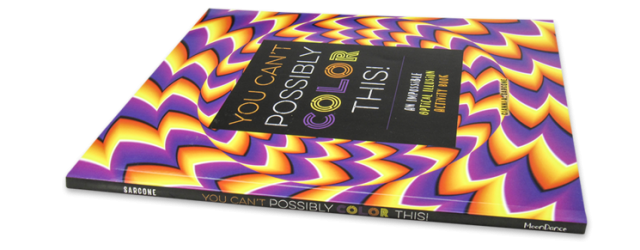
No mere coloring book, You Can’t Possibly Color This! is an eye-spinning experience that will inspire and astound. That’s because you’ll be coloring in optical illusions — things that can only exist on the page. With a just a few tips, you’ll be coloring in things that will bulge, expand, and even rotate. Other objects will leave you confused as you try to figure out the “trick,” while mandalas, complex patterns, and labyrinths will mesmerize you. Also included are fun activities for drawing and creating your own optical illusions.
“Why do the digits look like they do?” to answer this recurrent question one may find on the web many strange and diverse theories on the origin of the shapes of our modern, Hindu-Arabic numerals. Unfortunately, most if not all of those theories are patently false! One that went viral claims: “Our present method of writing figures is based on an early Arabic geometric design (see below) where each digit contains its own number of corners or angles, for instance the digit 1 contains one angle, the digit 3 has three angles, the digit 7 has seven angles and so on.” It’s not an exaggeration to say that it’s just plain nonsense!
Let us leave aside these abstruse theories, as there are a whole range of serious and documented books on the origin of numbers, including Georges Ifrah’s excellent book “Universal History of Numbers“.
However, there is nothing preventing us from finding or inventing original and / or fun typographic methods to create numbers, like the one illustrated below, which requires only two stylized numerals: a 4 and a 8.