“Unspirals” is a series of silkscreen-print projects (still in progress). These colorful geometric op art works appear to rotate and move. They are great promotional supports for companies and products.


“Unspirals” is a series of silkscreen-print projects (still in progress). These colorful geometric op art works appear to rotate and move. They are great promotional supports for companies and products.
An optical illusion I created years ago for the Gewerbemuseum of Winterthur, Switzerland. The orange halo around the contour of the eye doesn’t exist, it’s a construct of your brain.

This illusive effect is related to the “neon color spreading” phenomenon.
Look carefully at the saw-tooth wave patterns on this picture. Is the background of the picture uniformly gray or are there different shades of gray?

Brightness constancy makes some vertical strips look darker, when in fact the gray background is all the same shade of gray.
This op art work is available as prints and canvases from my official online Gallery.
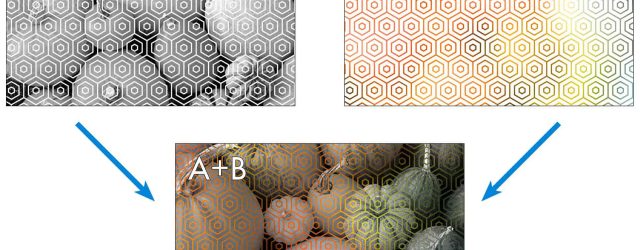
This is an old technique that uses the “color assimilation” effect to colorize pictures. This perceptual effect, also known by scientists as the Von Bezold spreading effect, occurs when our visual system transfers perceived colors to their adjacent areas.
Is the first photo of a variety of pumpkins in color?

A math-magic article I wrote for the German magazine Zeit Wissen: with the 13 triangular and square pieces (fig. 1) it is possible to form two large squares shown in fig. 2. Though the second large square has an extra piece the dimensions of the squares seem to be the same! Can you explain why this is possible?

Here’s a wooden version of the puzzle I designed in the late 1990s. Each set of pieces is made in a different color, giving the puzzle a clean, elegant look while making its deceptive geometry even more striking.
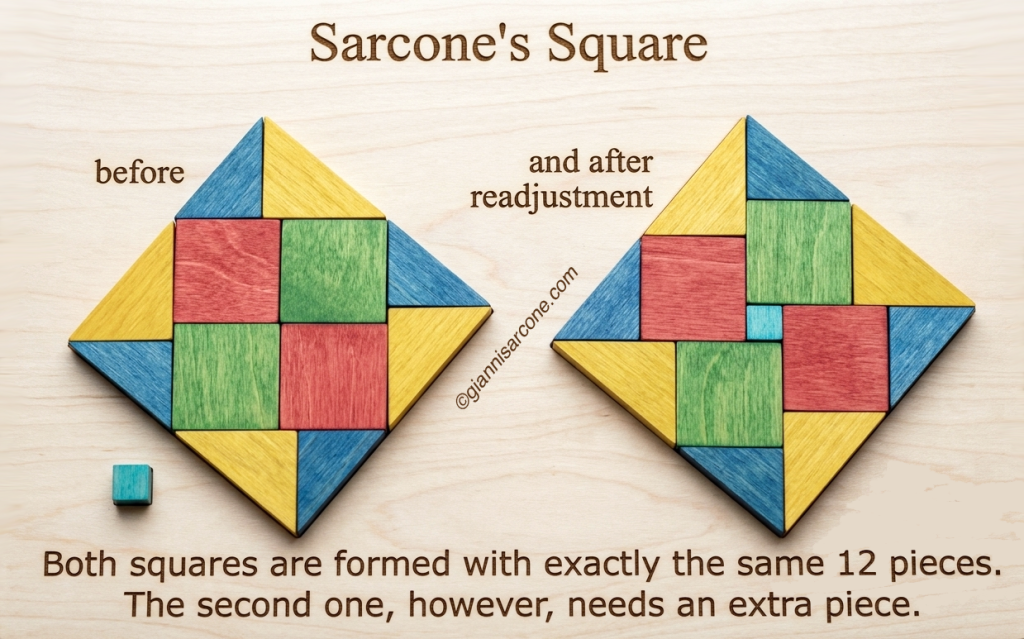
I am looking for a game manufacturer able to produce and distribute this incredible puzzle. You can contact me through my website.
☞ Further reading: explore the complete Vanishing Piece Puzzle project on my Behance profile.
This is one of my earliest color optical illusions. There is no yellow or green in the diamond shapes, just vertical black lines! (If you don’t believe it, use a eyedropper tool to check it.) This intriguing visual effect is mainly due to “simultaneous color contrast induction“.

“Deep Blue”, the yellowish rays you see in this picture are a construct of your brain. My op art work is available as prints from Saatchi Art gallery.

This is one of my oldest illusions I created in the 90s. In the picture you may see ghostlike dark radial beams. This illusion is a variant of the Herman’s scintillating grid illusion. I designed this illusion just by turning 45 degrees the Herman grid and then by applying a polar transformation.

Curiously enough, the cubes don’t move only the background color changes…

Here is my tutorial to create an amazing autokinetic animation.
Here are two projects involving the geometrical-constructive art of Piet Mondrian, one of my preferred artists, the golden ratio and ϕ. For this purpose, I used the same color palette favored by Mondrian: yellow, red, blue, black and gray.
In the first project, I used squares, that are proportional to each other by the golden ratio or ϕ, to prove the Pythagorean theorem as shown in the Zhoubi Suanjing (or Chou Pei Suan Ching – 周髀算經), one of the oldest Chinese mathematical texts (circa b.c. 200).
