Magic Tic-Tac-Toe

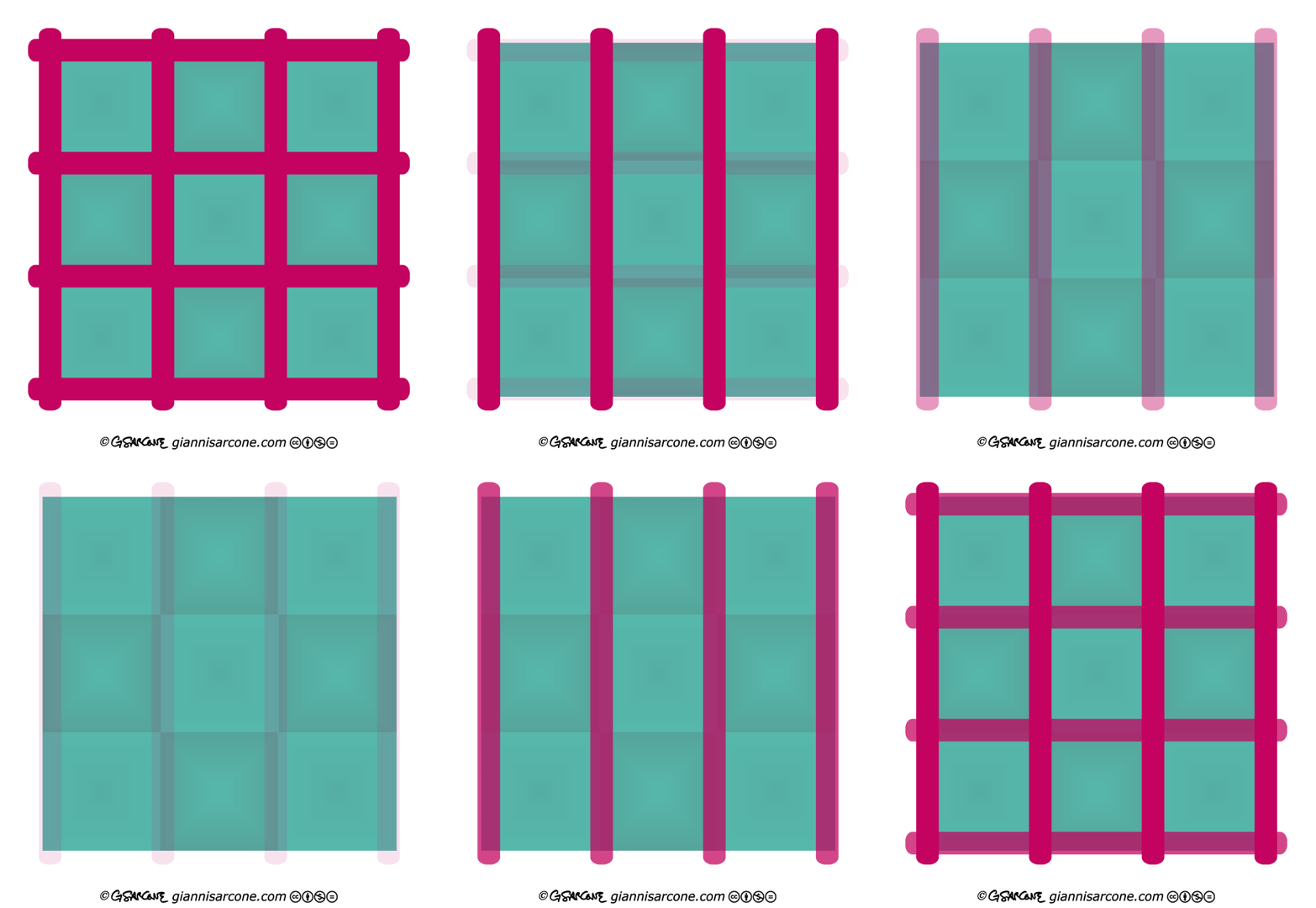
Our visual system can interpret colors and shades in surprising ways. This 3×3 Tic-Tac-Toe grid, for example, showcases how easily our perception of brightness can be fooled.
Do you notice anything unusual in the grid below?

Show / Hide the Trick

The looping animation below brings the illusion to life, revealing the trick in action. That large green square behind the grid isn’t actually uniform—it’s made up of alternating dark and light green squares.

Our visual system works like a “comparative computer”. In fact, we never see colors in isolation, as the appearance of any color is affected by the colors surrounding it. So, under certain conditions, colors that are identical may appear different, while colors that are different may look the same. In our visual system there is a mechanism that enhances the contrast of the outline of an object relative to its background: it is called “lateral inhibition”.
Thus, even small differences in brightness between adjacent zones, or objects, are deliberately increased by our visual system and the brain to better distinguish them. But something strange happens when the brightness boundaries of the color zones are concealed: the cues the brain needs to trigger the lateral inhibition no longer exist and consequently we become blind to variations in color brightness, as shown in the animated gif.

Recognitions
My optical illusion “Magic Tic-Tac-Toe” has been chosen to be among the top 10 finalists for the “2019 Best Illusion of the Year Contest

“Illusion d’Optique” Magic Playing Cards

For Art, Math and Magic Lovers!

Order now your exclusive “Illusion d’Optique” playing card deck designed by illusion Master Gianni A. Sarcone!

Packaging printed with optical ink and placed in a protective transparent plastic case.

54 eye-popping optical illusions to play and to experiment with!

Continue Reading

Fantastic Optical Illusions

Cover Fantastic Optical Illusions

“Everything we see hides another thing;
we always want to see what is hidden by what we see.”

– René Magritte

My book “Fantastic Optical Illusions” (ISBN: 178739235X) features all the best and most interesting illusion types: ambiguous and impossible figures, hidden objects, color and brightness effects, length, size and shape misperceptions, illusory moving patterns and image paradoxes.
This best-selling book has been first printed in 2004, since then I have made important updates on the latest discoveries in the world of perception, to be sure the book will continue to amaze both the young and the adult reader.
Available from Amazon UK and Amazon USA.

Continue Reading

Is seeing believing? This book will prove the contrary

I really enjoy communicate the mysteries behind the science of perception in a simple and clear manner with the use of instructive images.

We live in a “reallusive” world… Illusions are not totally unreal, because we feel them as they were real. Reality is also a kind of ‘illusion’. The outside world is mediated through our sense organs: vision, hearing, taste, touch and smell. All what we perceive and feel are just REPRESENTATIONS of reality, not the reality itself.

Children have a different way of looking at the world. So, writing and illustrating optical illusion books for kids is not an easy task, because they are less fooled by visual illusions than adults. This is due to the fact that brain’s capacity to consider the CONTEXT of visual scenes, and not just focus on SINGLE PARTS of scenes, develops very slowly.

My new work “Optical Illusions” will make you question: “is seeing believing?”… The brain is an amazing thing, but it doesn’t always get things right when it comes to sight. My book is here to explain why, with astounding images, baffling puzzles, and simple reveals.

Continue Reading

PERCEPTION OF BRIGHTNESS

In the example below, in the left column, you can see two apples—one green, one red—appearing as a single solid color with a black cross over them. Now, if we remove the thick black lines, each apple clearly appears divided into four quarters of different shades—even though they are exactly the same in both columns, with and without the black cross.

Here’s a trickier version: with the black grid in place, the large green square appears uniform. Take the grid away, and it turns into a full-on checkerboard…

shade contrast 2

This occurs because in our visual system there is a mechanism that enhances the contrast of the outline of an object relative to its background: it is called ‘lateral inhibition’. Thus, even small differences in brightness between adjacent zones or objects are deliberately increased by the brain to better distinguish them. So, when the brightness boundaries of the color zones are concealed, the cues the brain needs to trigger the lateral inhibition mechanism no longer exist and consequently we become “blind” to variations in color brightness. The illustrations above have been taken from my book “Drawing Optical Illusions” who was translated in many languages. The book is still available from Amazon.

Drawing optical illusions

This eye-catching, colorful book is designed to inspire those artists interested in optical illusions and as an invaluable reference tool for people who to wish to create them. In clear, easy steps, this book shows people how to design a range of original and classic optical illusions and even how to create their own personalized illusions.

Optical Illusions, An Eye-Popping Extravaganza of Visual Tricks

Reality is merely an illusion,
albeit a very persistent one.
— Albert Einstein

Everything you “see” depends strongly on the context and attention you give to it. The mind and the world you experience are inseparable, as it is your 3-pound brain that make the world meaningful. Seeing isn’t some kind of direct perception of reality. Actually, our bairns are cnostanlty itnerperting, correcting, and giving srtuctrue to the viusal ipnut form our eeys. If this were not the case, you would not see any colors (consider that all the beautiful colors you see don’t really exist), and you would probably see the world upside-down! Moreover, you would notice in your visual field a very large dot, called the “blind spot,” where the optical nerve enters the eye.

A Zen master said once: “If you pour water into a cup, water becomes the cup; if you fill a bottle with water, it becomes the bottle!” Likewise, the context shapes the appearance of the world surrounding you. Your brains work by comparing information and stimuli: contrasting colors, shapes, depth in a dynamic changing environment … that’s why perception is relative and not absolute. Continue Reading

Dynamic Müller-Lyer Illusion

Prize illusion sarcone

I am very proud that my “Dynamic Müller-Lyer Illusion” won the third prize as best illusion of the year 2017!

As you surely know, the “BEST ILLUSION OF THE YEAR CONTEST” is a yearly competition under the patronage of Scientific American, organized by the Neural Correlate Company (New York, USA).

Müller-Lyer’s illusion proves that a segment can visually appear longer or shorter depending on the sense of the arrow heads at its ends. In what consists my variant? As shown in the animation, the red dot in the middle of the line is equidistant from the other two red dots, although the ends of the line visually appear to alternately stretch and shrink like a rubber band!

The radial version of the illusion is even more impressive:

The perceptual increasing and decreasing of the segments occurs in a very short time. Thus, I suppose it is more a physiological phenomenon, rather than a psychological bias. Our attention seems to be attracted by the receptive field WITHIN the V-shaped arrow heads, causing an illusory inward or outward shift of the ends of the line.

Continue Reading

THE FIRST GREATEST ILLUSION

The very first illusion is to believe that there is one, unique world of perception. The mind and the world we experience are inseparable, as it is the mind that makes the world meaningful. Our mind IS our world. Despite the fact that our mental construct of what is perceived is distinct from the objective reality, our mind accepts it as real.

Every organism, man as well as animal, lives in its own subjective spatiotemporal world that semiotic philosophers call ‘Umwelt’ (from the German Umwelt, ‘surrounding world’, or ‘life-world’). According to the biologist Jakob J. von Uexküll, organisms and their life-world shape each other in a functional loop (see fig. below): interactions between the subject and the outer world, mediated through the sense and effect organs, determine the world framework of the subject. Thus, a particular stimulus which has a perceptive cue or meaning to the subject induces always a purposeful reaction.

feedback loop of information

Continue Reading

Bidimensional Müller-Lyer Illusion

I am working on a new two-dimensional variant of the Müller-Lyer illusion… You may be surprised to know that the Müller-Lyer illusion isn’t only linear: it involves plane geometry too! In fig. A shown below, the ends of the blue and red collinear segments, arranged in a radial fashion around a central point, delimit two perfectly concentric circles. However, for most observers, they seem instead to define a large ovoid that circumscribes another one, slightly eccentric (Fig. B). This comes from the fact that the red segments seem to stretch towards the lower part of the figure, while the blue segments seem to stretch towards the upper part of the same. As you can see, in this variant comes also into play the “neon color spreading” effect. In fact, a bluish inner oval-like shape appears within the black arrow heads (Fig. A), though the background is uniformly white.
Müller-lyer oval

Continue Reading

Man Can Never Be Clean

microbes

The human body plays host to trillions of microorganisms. So many, in fact, that they outnumber our cells 10 to 1! Fortunately many of these microbes are vital to human health.

Using a cell-culture dish filled with a nutrient broth commonly used in labs, Tasha Sturm, a microbiology tech at Cabrillo College in California, gently stamped her 8-year-old’s hand on the plate. She then incubated the petri dish at body temperature and 2 days later, the bacteria and yeast that were transferred to the dish had built a blooming colony (see featured photo above). Continue Reading