An optical illusion I created years ago for the Gewerbemuseum of Winterthur, Switzerland. The orange halo around the contour of the eye doesn’t exist, it’s a construct of your brain.
Geometric shapes are not limited only to the figurative aspect, they can also play active roles, for instance, serving in microelectronics to build operational printed circuits such as: small inductors (magnified, fig. a below), resistors (fig. b) and capacitors (fig. c). (image taken from my book “Almanach du Mathématicien en Herbe“)
Obviously not… The closest thing to a “perpetual motion machine” is the Beverly clock whose mechanism is driven by variations in atmospheric pressure, and by daily temperature variations.
This is one of my earliest color optical illusions. There is no yellow or green in the diamond shapes, just vertical black lines! (If you don’t believe it, use a eyedropper tool to check it.) This intriguing visual effect is mainly due to “simultaneouscolor contrast induction“.
Salvador Dalí : Sept corps nus et un crâne, 1951 (Human skull consisting of seven naked women).
Often symbols of MORTALITY (or some romantic notion of immortality – as the belief that a spiritual part of a person survives death) and POWER, skulls have been employed in human rituals and art since the dawn of humanity: from the ancient animal skulls in Paleolithic burial sites, to the curlicued cattle skulls that haunt Georgia O’Keeffe’s canvasses. Skulls cannot be assumed to be only a mere symbol of death, they are also used in initiation rituals as a symbol of REBIRTH, symbolizing the ‘sephirah daath’ (סְפִירָה – sephirah, “enumeration” in Hebrew) on the cabalistic tree of life, the gateway to a higher awareness only achievable through spiritual death and rebirth.
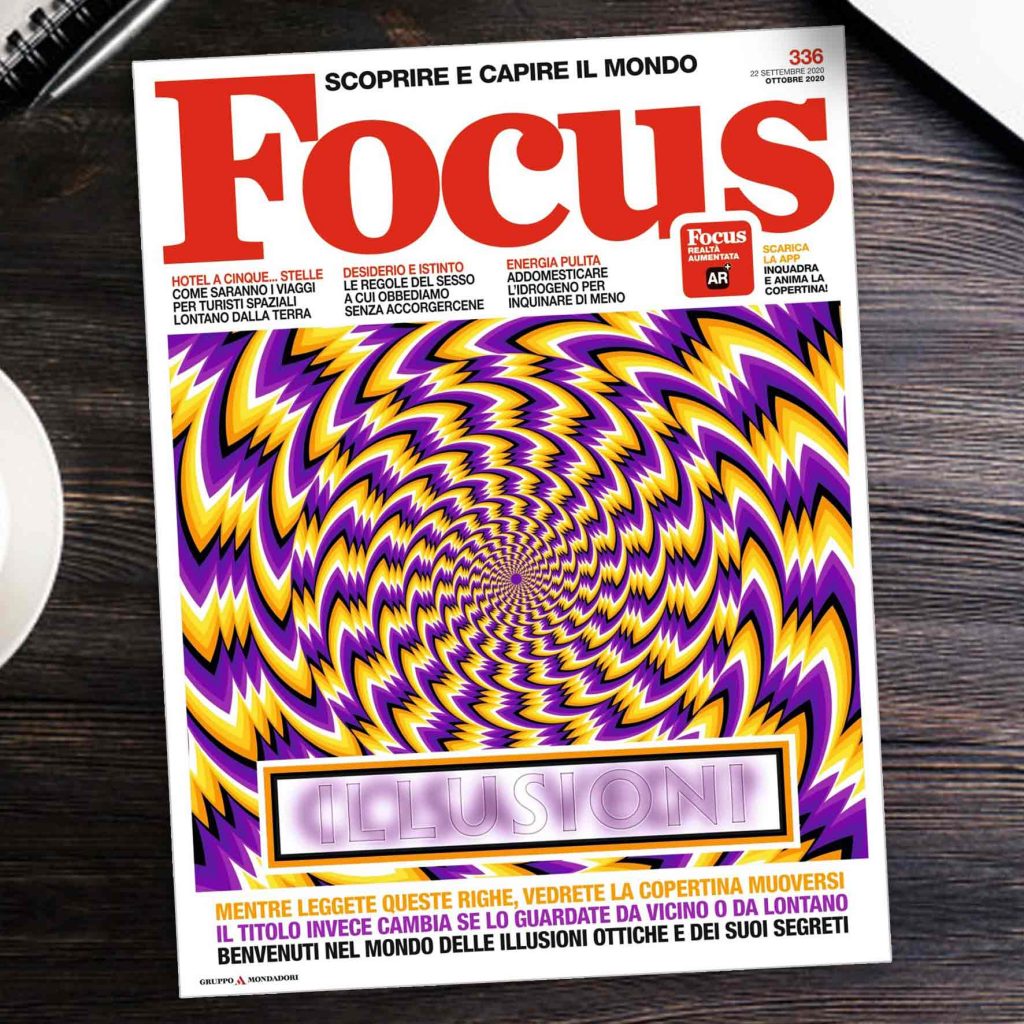
For over 10 years, I’ve had the pleasure of collaborating with Focus, an Italian monthly popular science magazine published in Milan.
In October 2020, Focus released issue #336, which featured my article and optical illusions. This special edition included a 10-page dossier on visual perception, showcasing over 13 original illusions I created, complete with explanations.
The cover of this issue also featured a unique effect I designed for Focus. As you read the main title, the cover image moves, and, intriguingly, the title changes depending on your perspective—read closely, and it says ILLUSIONI; look from a distance, and it transforms into COSA VEDI?
Here is a neat optical illusion project I was commissioned by “Art of Play“. From one perspective, the grooves in the metal die-cut bookmark seem to be an abstract design but place the pattern against a solid background and a familiar figure pops into view!