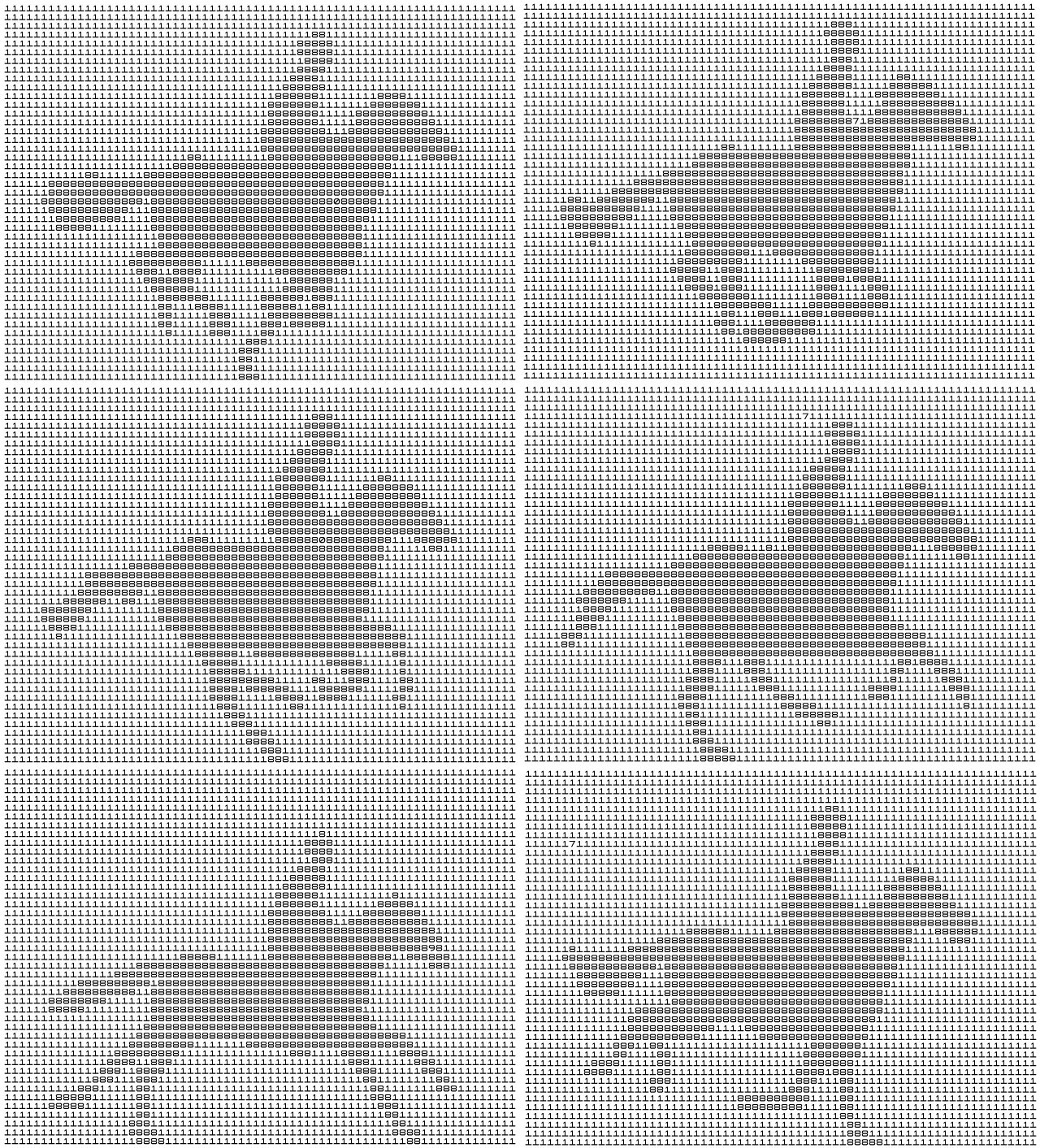
Every frame in this GIF is a 3,100-digit prime number:
Together, they recreate the world’s first motion picture: Eadweard Muybridge’s iconic 1878 “Galloping Horse.”
How it works: Each frame is converted into a grid of 1s and 8s, then slightly tweaked until the math clicks and a prime number is born. Fast primality tests spot the candidates, and rigorous checks confirm them.
The result? An animated piece of history, built entirely out of pure mathematics.
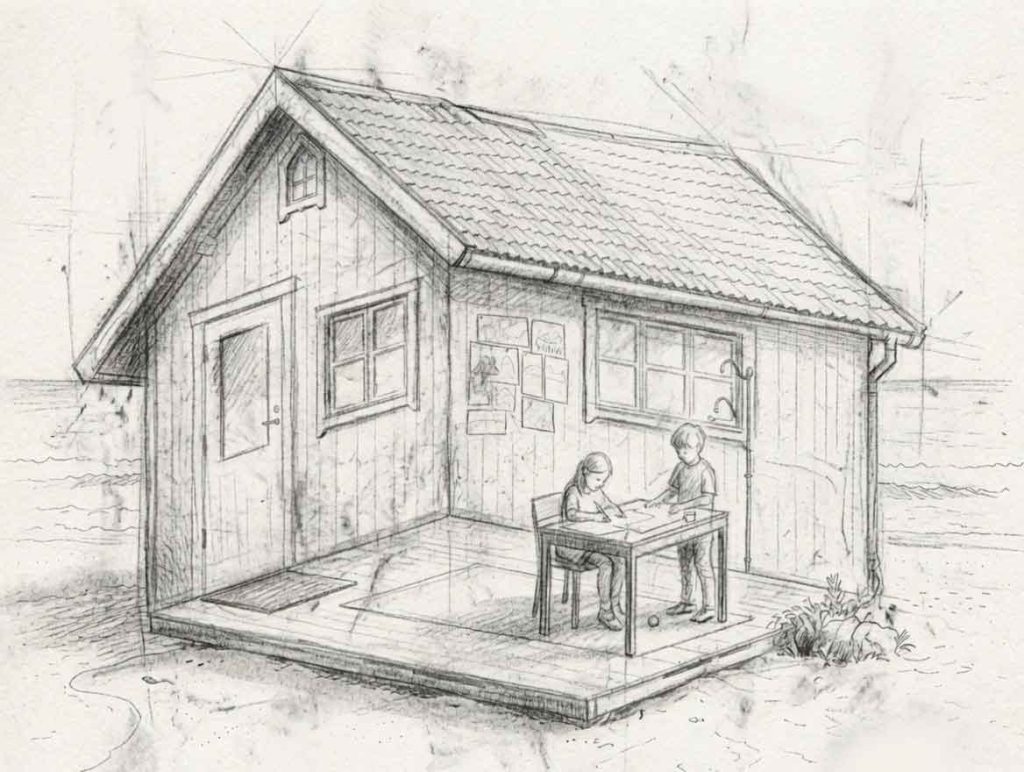
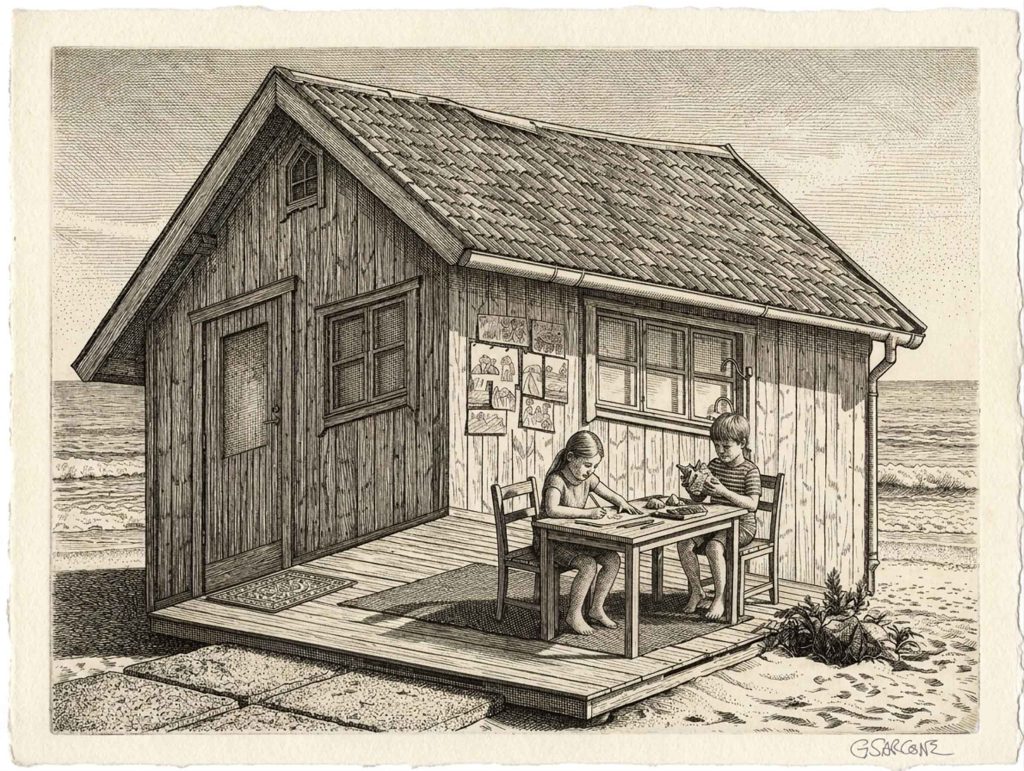
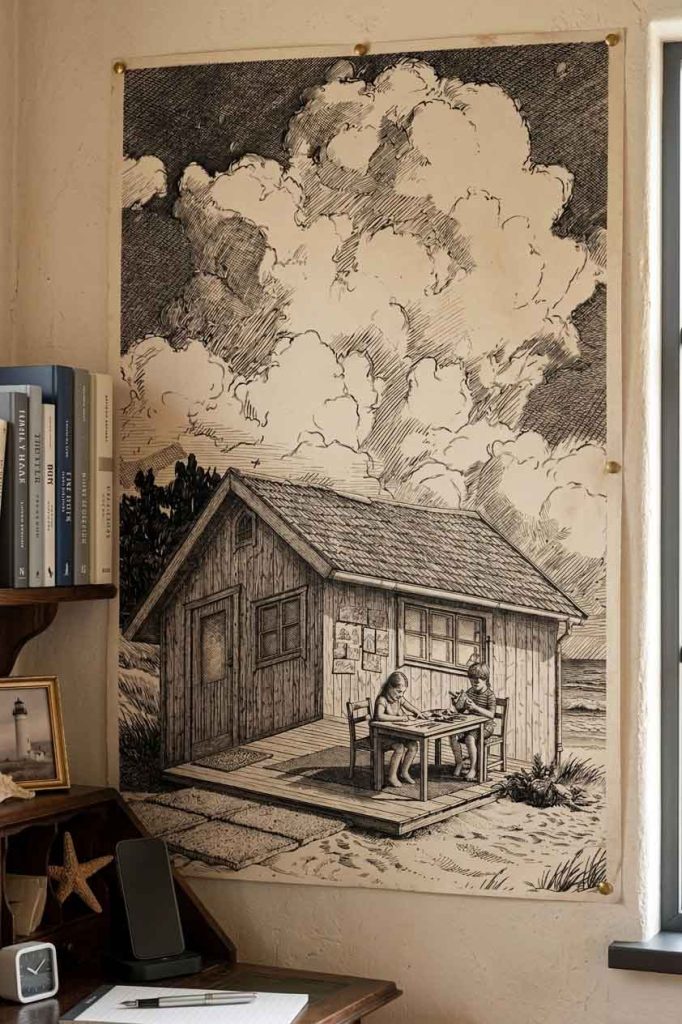
With summer just around the corner, I find myself drifting back to the shores of time, to this delightfully impossible little structure perched on the beach.
A drawing concept created for a children’s coloring book on optical illusions. Over the years, I’ve explored this theme through many curious and playful variations.
Are the kids engaging in creative activities inside the cabin or outside it?
The roof insists we’re looking at the exterior, while the floor pulls us firmly indoors. Both readings feel correct, yet they cancel each other out. So, there’s no clean resolution here—just a quiet visual paradox.
Curious to see more of my optical illusion book concepts, impossible worlds, and mind-bending creations? Take a stroll through my author page.
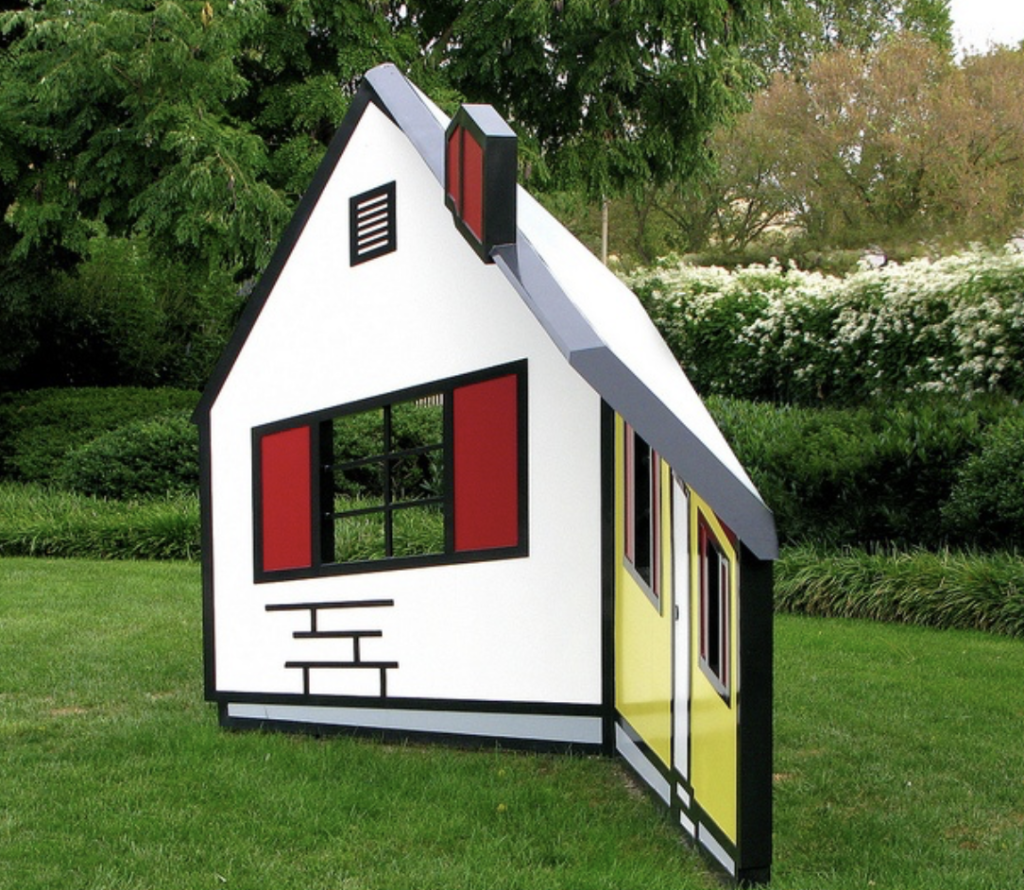
The idea itself is far from new and has inspired countless artists, architects, and photographers. It even exists in three dimensions. A notable example is Roy Lichtenstein‘s House I (1996), an ingenious sculpture that appears to be a solid house but is actually a concave construction made of angled steel planes. As viewers move around it, the structure seems to rotate and reshape itself, turning perception into part of the artwork.
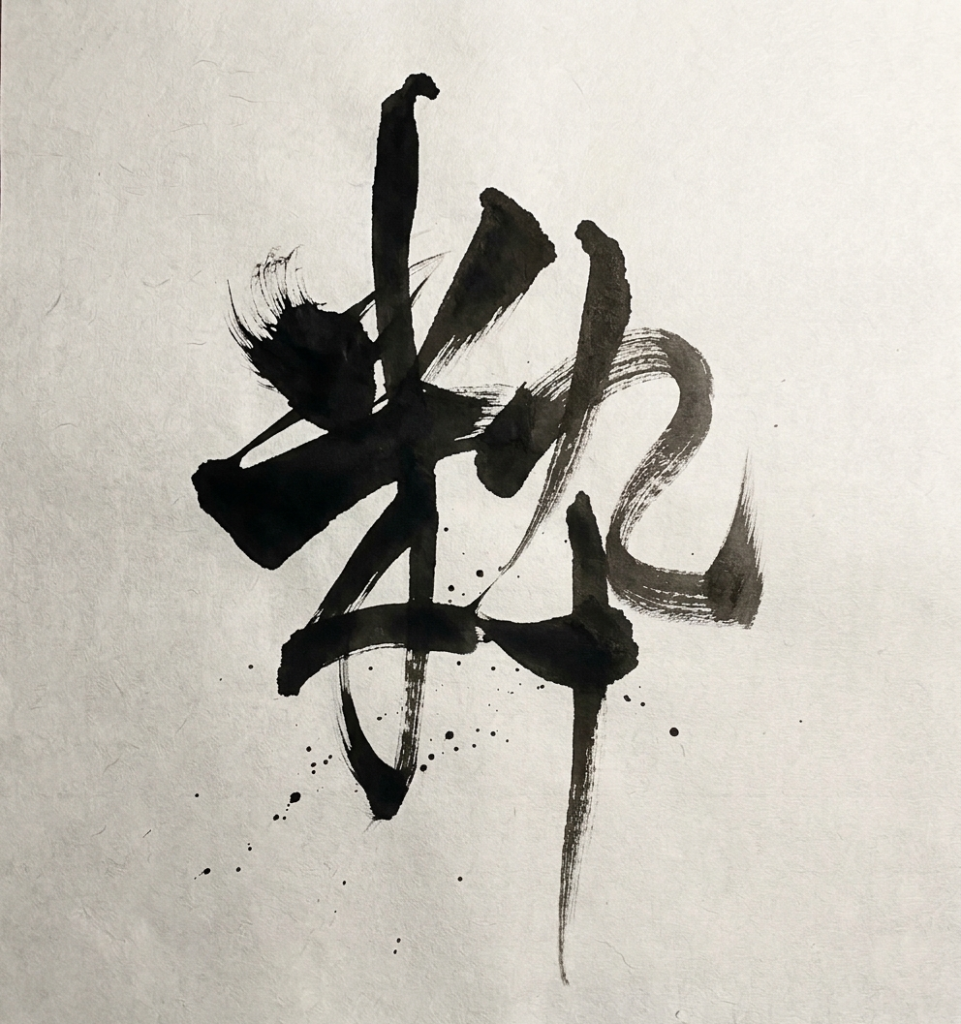
Edo, under the Tokugawa shogunate. Merchants wealthy enough to unsettle the hierarchy, yet still ranked below the samurai. Power without status—watched closely, dressed carefully.
Sumptuary laws did the rest: no gold, no loud silk, no bright declarations. Only browns, greys, indigo. A forced muting of visibility.
Constraint rarely suppresses imagination. It concentrates it.
From this narrow register emerged a refined spectrum known as Shijuhattcha Hyakunezumi (四十八茶百鼠)—“48 browns, 100 greys.” Not literal numbers, but a cultural way of naming excess within restraint: an almost infinite sensitivity to difference inside what first appears uniform.
Fashion became a coded language. Subtle shifts in tone, legible only to trained eyes. Outside, discipline. Inside, excess held in reserve. A lining of rare fabric. A color hidden against the skin. A private flash revealed only when a sleeve turns in the wind.
This is iki: elegance that refuses emphasis. Presence without display. A form of refinement that collapses the moment it is named.
Its opposite is yabo (野暮): excess, insistence, the compulsion to be seen. Not morality—measure. Or the lack of it.
Today, the direction has inverted. Visibility has become currency. Those who do not perform disappear; those who do not declare are not counted. What was once failure has become strategy.
And yet the counter-move remains simple.
Lower the volume. Leave gaps. Let meaning breathe in what is not shown.
Inside plants and living beings, there are remnants of ancient independent beings that once lived on their own, long before becoming part of the cellular world we know today. Known in biology as “organelles,” these are the living proof of ‘endosymbiotic theory’. They survive not as ghosts, but as symbiotic, working structures—still active, still essential, still carrying their own ancient logic.
From the host cell, these once-independent bacteria receive what any free organism would constantly struggle to secure: a stable, protected environment. No predators. No sudden shifts in conditions. A controlled internal world with steady access to water, nutrients, and chemical balance. In short, they are sheltered inside a living system that maintains their continuity.
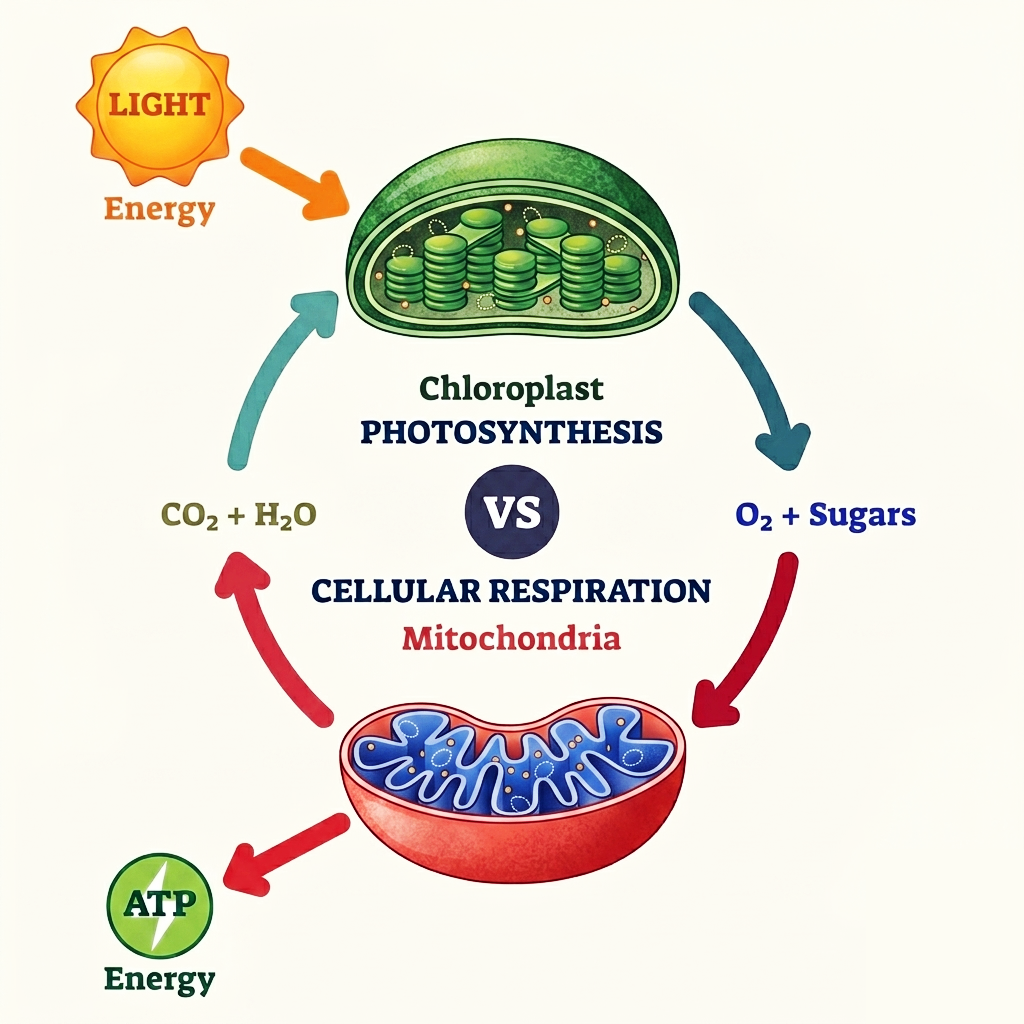
Chloroplasts are the light catchers. You can think of them as tiny green alchemists, turning sunlight and water into stored energy, like weaving daylight into sugar. They belong to plants and algae, quietly building the foundation of almost every food chain on Earth.
Mitochondria are the fire keepers. They don’t create energy from light, but unlock it from what we consume, breaking down fuel to release usable power for the cell. Without them, nothing in the body moves, thinks, or repairs itself.
There is also a quieter detail: mitochondria are inherited almost exclusively from the mother. They pass from mother to child through the egg, like an intimate biological thread, while paternal mitochondria are usually removed after fertilization. Every cell therefore carries a subtle maternal imprint within its energy system.
In simplified terms, chloroplasts harness sunlight and water to generate sugars, storing energy in chemical form, while mitochondria release that stored energy for the cell by breaking down those molecules. One captures energy from light; the other unlocks it from organic matter—together sustaining the energetic cycle of complex life.
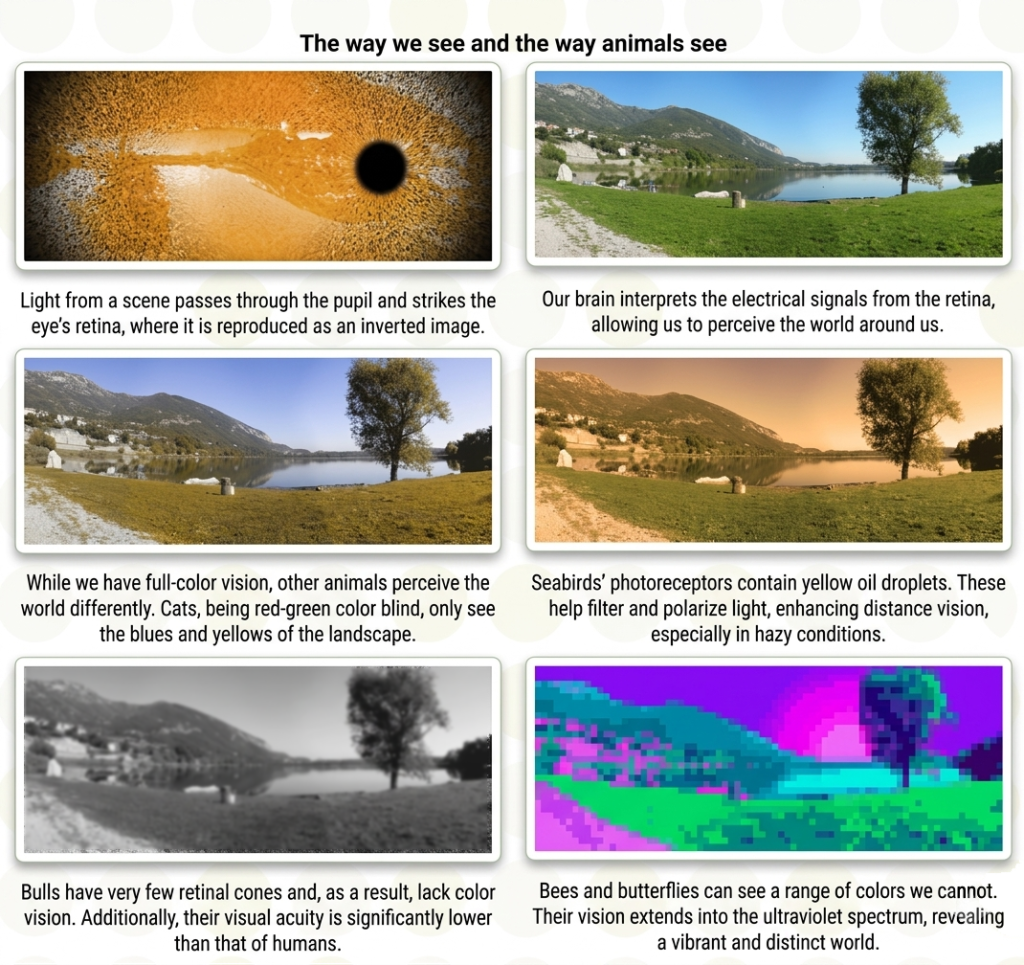
Deep in the retina, an ancient memory persists. Our visual cells rely on “opsins“—light-sensitive molecules inherited from unicellular organisms that existed long before animals. For over a billion years, life has refined this simple act: catching light. In the sea, the same logic still plays out. Some oysters host algae on their mantle; they feed them, and in return these light-sensitive cells signal the presence of light. A quiet watch system—almost an eye, spread across a surface. In certain algae, like Chlamydomonas reinhardtii, a tiny eyespot—the stigma—is enough to steer the organism toward light. Not an eye, but already a direction, a choice. Our rods and cones extend that first invention: a long lineage of light detectors, slowly shaped over time, linking our vision today to the faint glimmers of the earliest oceans.
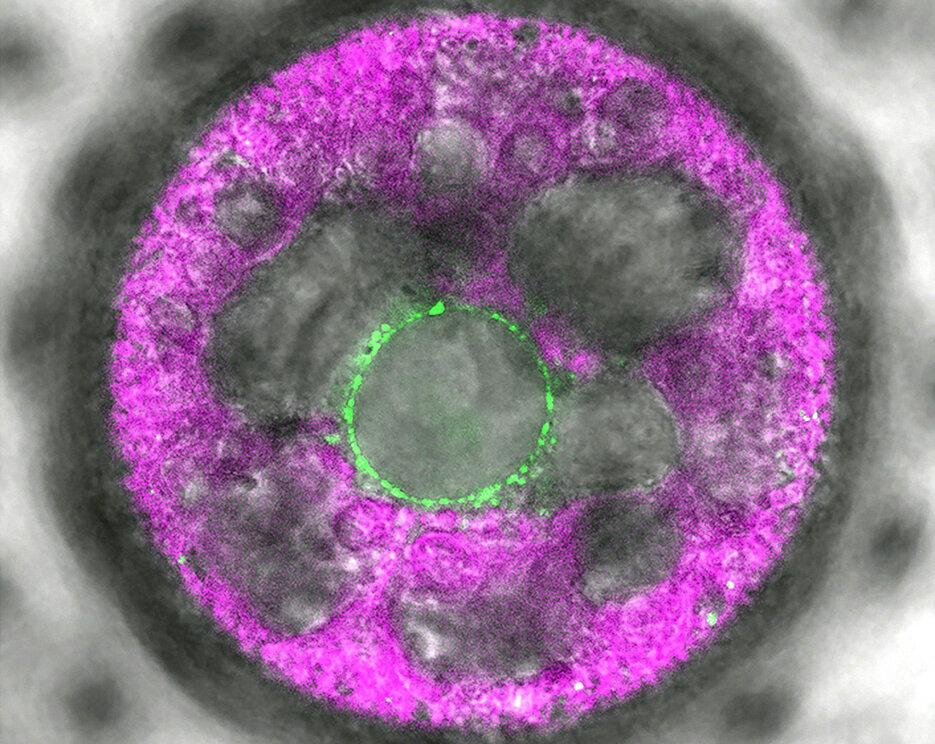
In the tiny alga Volvox, a newly found light sensor glows green, showing where it sits around the cell’s center. (Image: Eva Laura von der Heyde / University of Bielefeld)
Color is energy—an electromagnetic phenomenon shaped by how light is reflected from objects. What we call vision is not innate. It is largely learned, built through a slow and demanding process. We tend to take it for granted, yet someone born blind who later gains sight must spend years learning how to organize and interpret what now enters the eyes.
Seeing is neither simple nor passive. When we look at a landscape, color information reaches the visual cortex in roughly 30 milliseconds (in the occipital lobe, V1). Only a fraction later—around 70 milliseconds—shape, depth, and motion begin to emerge. In these brief intervals, the brain filters, compares, and reconstructs fragments of data, assembling them into a coherent image. What we perceive is not a direct recording of reality but a refined interpretation—an internal best guess shaped for meaning and action.
I’ve long been intrigued by the way people with partial or total visual loss engage with the world. Any serious reflection on perception or optical illusion eventually meets its counterpoint. Understanding how they “see” without sight reveals the real weight of vision itself—and how inseparably it works with the other senses, each one calibrating the rest.
When we see, move, speak, and feel at once, what actually binds sight to touch or hearing? The truth is, we notice far less than we assume. We attend only to what matters in the moment. Without the constant support of the other senses, perception would collapse into confusion, because they operate quietly in the background, guiding everyday behavior.
A striking example comes from research on inattentional blindness. In a well-known 1999 experiment by Daniel Simons and Christopher Chabris, participants watched a video and counted basketball passes between two teams. Nearly 40 percent failed to notice a person in a gorilla suit walking through the scene, pausing, even dancing, before exiting. The demonstration is disarming in its simplicity: we do not see what we do not attend to—even when it stands directly in front of us.
It’s not uncommon to read, on a snack package, the phrase “with chocolate taste,” often printed in bold uppercase. The wording plays a subtle trick on the mind. Most people assume the product must contain chocolate. Yet a flavor is not a substance. More often than not, what we bite into carries only the impression—an illusion—of chocolate.
The same applies to color. Our brain is just as easily misled. Colors behave like flavors: they may smell—pardon… look—like a particular hue, but they are subjective sensations rather than fixed properties of the outside world. They shift with context, changing according to their surroundings. More striking still, identical colors can appear different under certain conditions, while different colors may look the same. This phenomenon is known as color induction.
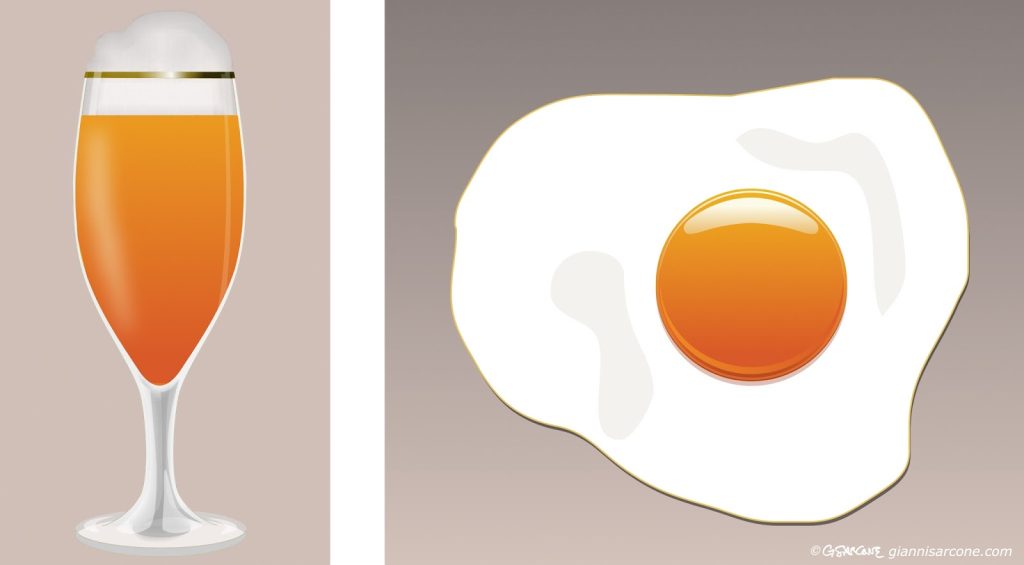
Even texture plays a role. It can alter how we perceive a color’s intensity and tone. Take beer and an egg yolk: they may share the same orange hue and gradation. Yet the brain reads them differently. The glass and the liquid are perceived as translucent, so their color seems lighter, duller, more diluted. The yolk, by contrast, appears opaque, with a richer, more glossy, more solid color.
In this picture, the beer and the egg share exactly the same orange gradation.
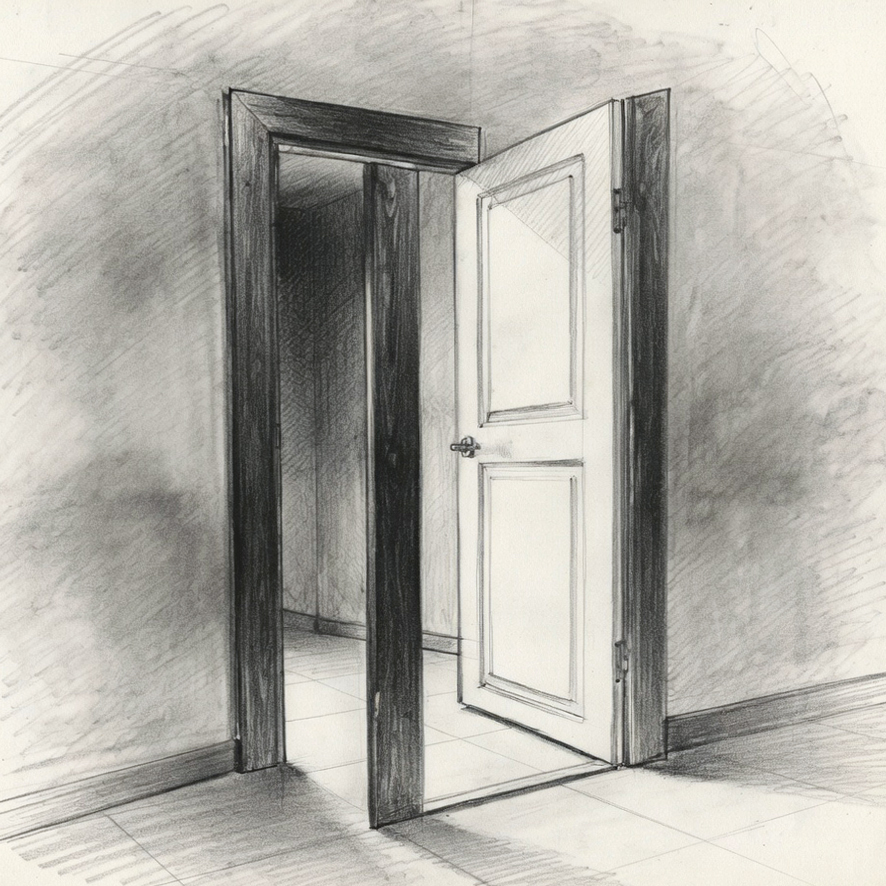
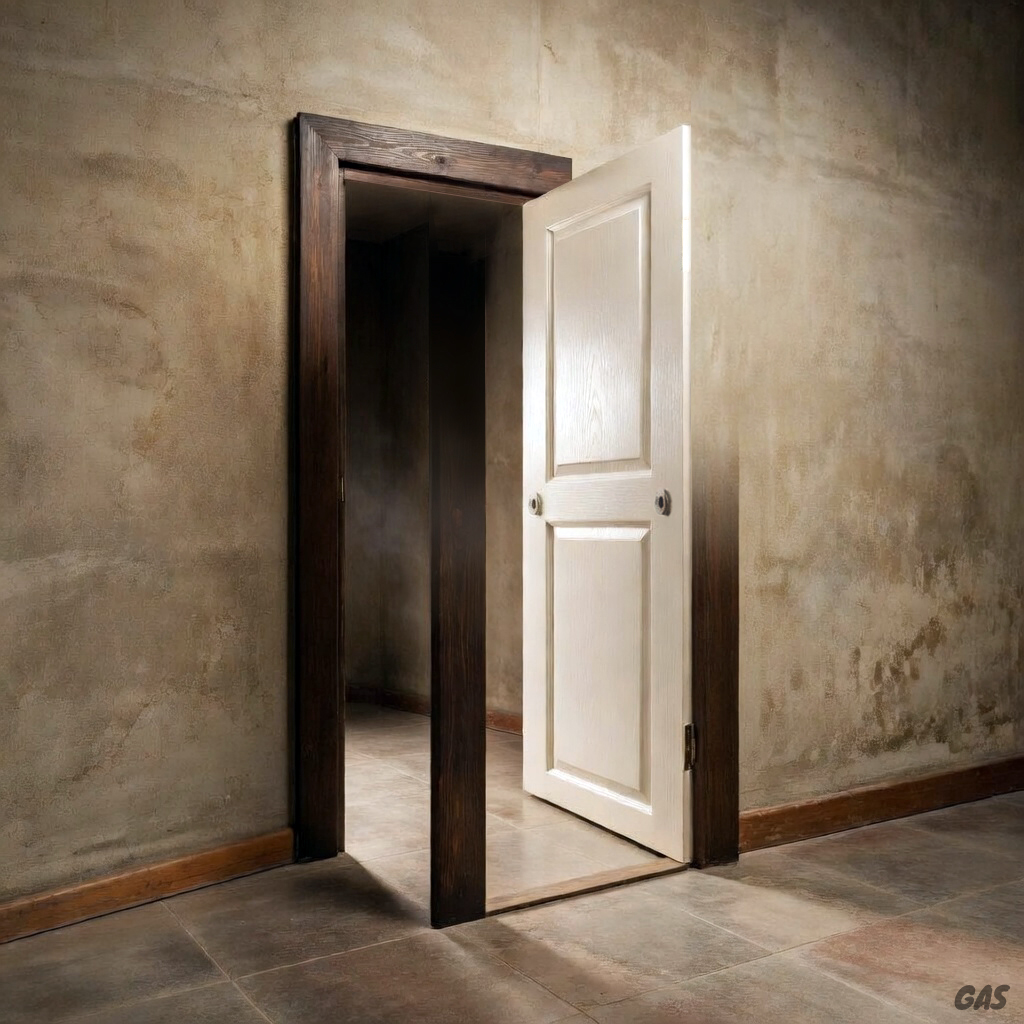
I’ve always been drawn to impossible objects—those forms that slip between logic and illusion, never fully settling into one or the other.
This piece grew out of an old idea I felt compelled to revisit, almost as if reopening a long-forgotten door. A binary door, in fact—one that leads to two distinct worlds. Depending on how you look at it, it shifts, tilts, and reveals something else.
It starts with pencil on paper. A loose, intuitive phase where the form finds its way. From there, I move into FreeHand MS—an old tool I’ve never quite let go of. It still gives me a certain precision and feel I can’t replace. Finally, I refine the piece in Photoshop, adjusting, balancing, pushing it toward that delicate point where everything holds together.
There’s still work to be done. Something remains unresolved—but maybe that tension is part of what keeps it alive.
“The Master of Numbers” is an Op Art photomosaic portrait of the renowned physicist, created from a collection of photographs of numbers. Each detail contributes to a visual exploration of mathematics, perception, and pattern. The project took me two years to complete, photographing numbers in the most unusual places and objects, and bringing them together into a single portrait.
And a little secret: tucked inside the mosaic is a tiny portrait of me and my wife—a fun, hidden signature and a personal touch.
Limited edition posters and prints are available through my online gallery.
First, observe the alignment of the red circles as they move in a straight vertical path, up and down. Then keep your gaze on one of the three Xs in the middle. What do you notice?
The red circles seem to drift away from their true physical trajectories, as if they were following the curves of the static lines. This perceptual shift is known as the “Mainz-Linez Illusion“.
When you keep your gaze on the central X, the moving dots shift into peripheral vision, where spatial resolution is limited and detail is reduced. The visual system compensates by interpolating missing information based on contextual cues and prior experience. As a result, the dots become perceptually “bound” to the nearby curved lines, as if threaded on them, and their straight vertical motion is misread as oscillating.
The Mainz-Linez phenomenon reflects a broader principle: peripheral vision is largely constructive. Under certain conditions, this predictive filling-in can also distort motion judgments in real-world tasks—such as driving—where events in the periphery may be misperceived.
Explore My World of Art, Books, and Creative Concepts