When Orient Meets Occident: The Buddhist and Christian Parables

The Buddhist parable of the man hanging from a cliff and the Christian legend of “Barlaam and Josaphat” both explore human vulnerability, the impermanence of life, and fleeting pleasures. Despite different contexts, they share profound philosophical insights.

The Buddhist Parable

A man chased by tigers falls off a cliff, clinging to a fragile root. Facing death above and below, he notices a ripe strawberry. Ignoring danger, he tastes it, savoring the present moment. The strawberry symbolizes mindfulness and the beauty of the present despite life’s dangers.

The Christian Legend

In the medieval Christian story, a man chased by a unicorn falls into a pit, holding onto a branch. A dragon waits below, while two mice—one black, one white, symbolizing night and day—gnaw at the root. Drawn by the sweetness of honey dripping nearby, he forgets the danger beneath. The honey represents worldly pleasures that distract from spiritual awareness.

Key Similarities

– Life’s Fragility: Both stories depict imminent danger, emphasizing life’s precariousness and impermanence.

– Fleeting Pleasures: The strawberry and honey symbolize temporary sensory pleasures.

– Impermanence: The mice in the Christian tale echo the passing of time, a theme also present in the Buddhist view.

Key Differences

– Buddhist Perspective: Focuses on mindfulness and present awareness.

– Christian Perspective: Warns against worldly distractions from spiritual truth.

Both parables emphasize life’s fragility and the tension between danger and fleeting pleasures. They offer timeless reflections on mindfulness and the importance of spiritual awareness.

But how is art connected to these stories? Both explore how perception shapes our experience of life. What we focus on—whether a ripe berry, a drop of honey, or a striking pattern—can define our reality, revealing beauty or reflecting deeper truths.

These parables also show the importance of context. In the East, strawberries symbolize sweetness, while in the West—especially during medieval times—it was honey. The sources of fear also differ: in the East, tigers have long been feared, and this legacy endures today. In the West, storytellers created mythical creatures to inspire fear, since real animals like bears and wolves, though dangerous, typically keep their distance from humans, making them seem less threatening than imagined monsters.

Through the Eyes of Insects

The compound eye is nothing like the human eye, but we often misunderstand how insects see the world. In horror movies, their vision is depicted as a chaotic kaleidoscope. In reality, it’s much more refined—like viewing the world through a crystal-clear glass paperweight. 

What’s even more fascinating? Some insects have vibrant color patterns on their compound eyes that serve a purpose! These patterns act as filters, enhancing contrast to help them spot objects against colorful backgrounds or shielding their eyes from certain wavelengths of light.

Take the Deer Fly and Horse Fly, for example—both flaunt these functional designs. But the Green Lacewing (Chrysopidae) takes the crown for the wildest look. Its compound eyes create a diffraction pattern resembling a sheriff’s star, formed by the countless six-sided “ommatidia” that make up its eye structure.

The Wonders of Compound Eyes

Insect compound eyes are made up of thousands of tiny units called ‘ommatidia’, each acting like a mini-eye. This gives insects a near-panoramic view, perfect for spotting motion and environmental changes. Dragonflies, for example, have around 30,000 ommatidia per eye, making them masters of motion detection.

While human eyes, with their single lens and dense photoreceptors, excel at detail and depth, they lack the wide-field motion awareness of compound eyes. Insects also outshine us in speed, detecting rapid movements crucial for survival.

Many insects see ultraviolet light—something humans can’t. This unique vision aids in finding food, communication, and mating. Compound eyes are a brilliant mix of structure and function!

Hypnotic Disc

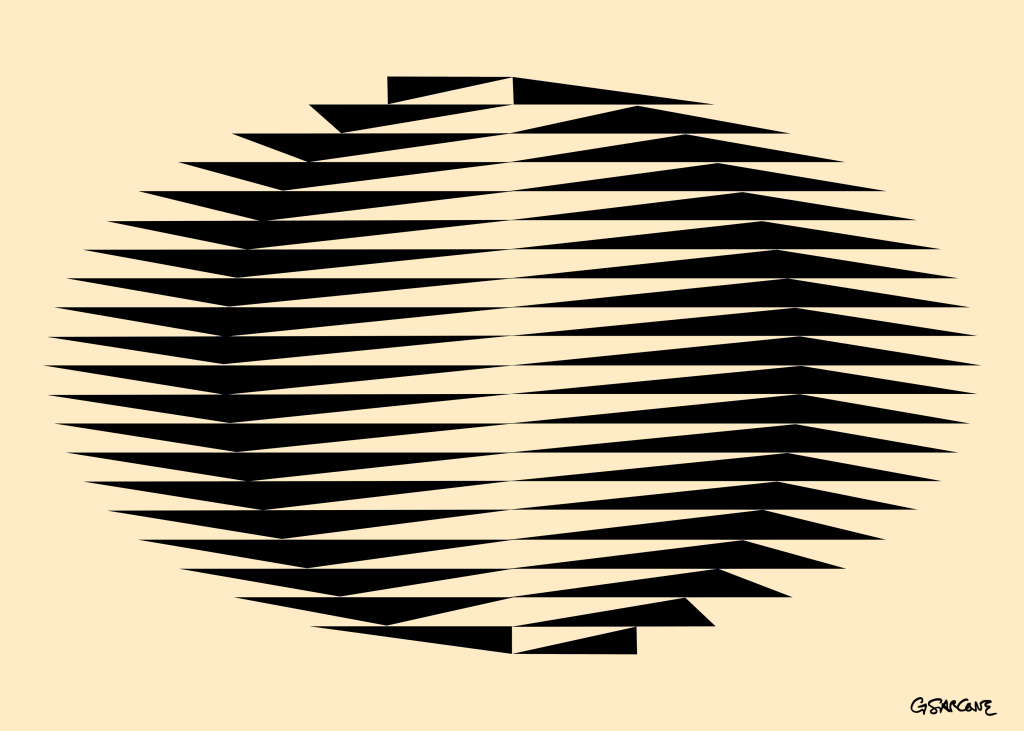
Take a moment to focus on the circular pattern. How many spirals do you see? The surprising answer is none. There are no spirals here—just alternating black and yellow discs, slightly off-center and layered to create a striking illusion of swirling depth and motion.

© G. Sarcone, 1990

I began crafting pieces like this in the early ’90s, drawing inspiration from Duchamp’s Rotoreliefs. I was captivated by how simple rotation could deceive the eye, inviting the viewer into a world of optical illusions. It’s a unique experience—seeing motion and depth in something entirely flat, both puzzling and mesmerizing.

This op art pattern comes to life across various mediums and transforms into artistic expressions on different objects. In my online gallery, you’ll find art prints and everyday items featuring this work, all available for purchase.

The Enigmatic Caroline Rivière

Caroline Rivière, a French girl immortalized in Jean-Auguste-Dominique Ingres’ 1806 masterpiece “Portrait of Caroline Rivière”, remains a striking figure in art history. This iconic painting frequently graces book covers, thanks to its timeless and deeply evocative qualities. Caroline is depicted as a delicate young woman in a serene, contemplative pose, her gaze imbued with an air of mystery and quiet melancholy. Tragically, she passed away at just 15 years old, shortly after Ingres completed the portrait.


This poignant backstory heightens the emotional resonance of her image, symbolizing the fragility of youth and the transient nature of beauty. It’s this haunting combination of innocence and impermanence that makes the portrait so appealing to publishers and audiences alike. Whether adorning the covers of literary classics, historical novels, or introspective works, Caroline Rivière’s likeness evokes themes of nostalgia, identity, and human vulnerability, bridging the gap between art and storytelling. Her enduring presence on bookshelves speaks to the universal, timeless appeal of Ingres’ artistry.

Even Lady Gaga was moved by this iconic painting, as she posed for filmmaker Robert Wilson, who created a strikingly similar piece—a close video replica of Ingres’ portrait, reinterpreted in his own unique style, incorporating subtle movements and nuanced expressions that added a dynamic dimension to its timeless stillness.

The $66 Million Sausage: Art, Irony, and a Dash of Common Sense

After the world lost its mind over a duct-taped banana selling for over $6 million, I present to you: the duct-taped Italian sausage. Stylishly Italian, delightfully produit du terroir, and—let’s be honest—way more practical. I’m aiming for at least $66 million at auction because, unlike a banana that turns into compost in a week, a fermented sausage can outlive your art collection.

Sure, the banana sparked debates and grabbed international headlines since its debut at Art Basel Miami Beach in 2019. And hey, I’m all for a good debate—it keeps things interesting. But let’s be real: the world is full of rich fools willing to throw stupid money at stupid things just because everyone’s talking about them. So, here’s hoping my sausage can inspire the same level of ridiculous hype. Fingers crossed!

Genesis of G

The lowercase ‘g’ is one of the most distinctive letters in the Latin alphabet, showcasing a variety of shapes across different styles.

The Latin alphabet, created around 753 BC, originated from the Etruscan alphabet, itself derived from Greek. Its earliest known inscription is on the ‘Praeneste Fibula’, a 7th-century BC cloak pin, reading Manios med fhefhaked numasioi (Classical Latin: “Manius me fecit Numerio” or “Manius made me for Numerius”).

Since Etruscan lacked the voiced plosive G, the letter G was introduced around 230 BC by Spurius Carvilius Ruga as a modified version of C.

As the Roman Empire expanded, the Latin alphabet spread throughout Europe, leading to its adoption in many languages. Today, it serves as the foundation for numerous writing systems worldwide, illustrating its lasting impact on global communication.

Paradossal… Mente!

Sabato 21 dicembre ti aspettiamo alla Mostra delle Illusioni di Genova per “Paradossal…mente“, il laboratorio interattivo sulla percezione visiva che ho ideato e che guiderò personalmente. Non mancare!


I partecipanti saranno attivamente coinvolti in esperienze che mettono alla prova le percezioni: scopriranno illusioni ottiche inedite, creeranno giochi percettivi sconcertanti e indagheranno vari paradossi e misteri della mente e del sistema visivo. Ogni esperienza invita a riflettere su come il cervello può “ingannarci” o lasciarsi influenzare da ciò che lo circonda

Durata del laboratorio: 1 ora circaIl Materiale per il laboratorio creativo sarà fornito direttamente dalla Mostra delle Illusioni.

🔹APPUNTAMENTI:
🔸1 TURNO ORE 14:30
🔸2 TURNO ORE 15:30
🔸3 TURNO ORE 16:30

🔹QUOTA LABORATORIO:
ADULTO (18+): 20€
BAMBINO (8-17): 15€

🔹QUOTA LABORATORIO + MOSTRA:
ADULTO (18+): 30€
BAMBINO (8-17): 25€

🤩 Portate con voi la vostra curiosità…al resto ci pensiamo noi!

📍 Dove
Magazzini del Cotone – Modulo 1, Porto Antico di Genova
✅ Prenota al numero: 389-5540263 oppure scrivi a: mostragenova@lamostradelleillusioni.com

Mesmerizing Color-Changing Squid

Squids are basically the chameleons of the sea, and their secret weapon? Chromatophores—tiny skin cells that let them pull off some mind-blowing color changes. Whether it’s blending into a coral reef or throwing out some serious “back off” vibes, these little guys do it all. Right now, though, this squid seems to be saying: “Hey genius, put me back in the water before you turn me into calamari!”

Chromatophores of the Squid: How Do They Work?
Chromatophores are pigment-containing cells found in the skin of squids and other cephalopods. These cells expand and contract to display different colors, allowing the squid to blend into its surroundings, communicate with others, or signal threats. They play a vital role in the squid’s survival.

Stardust

Here’s the recipe to make an average-sized human: 15 kg of carbon, 4 kg of nitrogen, 1 kg of calcium, half a kg of phosphorus, 200 g of sodium, 150 g of potassium, 150 g of chlorine, a few grams of about 15 other elements (some exotic, like selenium, lithium, and vanadium in trace amounts), and four 10-liter buckets of water.

The 40 liters of water can be made by combining 5 kg of hydrogen and 35 kg of oxygen. Commercial cost? Just a few euros.
The hydrogen and a pinch of lithium come from the Big Bang, about 15 billion years ago. The other ingredients are more recent; they required billions of years of cosmic evolution, with stars being born, shining, dying, and reforming in nebulae from stellar collapse.
The 15 kg of carbon was formed in a star’s final stages by combining three helium atoms. The 35 kg of oxygen came from the fusion of carbon and helium in extremely hot stars. Iron is the ash of spent stars, and calcium, phosphorus, sulfur, chlorine, sodium, and nitrogen also come from these stellar forges.
Traces of even heavier elements reach us from supernovae. In short, we are born from the stars.