Do the light gray triangular shapes in the diagram below have the same hue and brightness?


Do the light gray triangular shapes in the diagram below have the same hue and brightness?
Look at the colored rings from a distance. Then decide which ones have YELLOW inner circles, and which ones have BLUE inner circles.

Most of us are familiar with magenta — it’s a kind of purplish-red that exists between blue and red on color wheels (color wheels don’t accurately represent the physics of photons, but they represent the philosophical reality: color is a human construct that helps us interpret wavelengths to better understand our world).
The odd thing about color vision is that magenta (or pink) color is not in the spectrum of colors, meaning it cannot be generated by a single wavelength of light. Our brains interpret the color sensation of magenta/pink as ‘absence’ of green.
Source: https://www.archimedes-lab.org/Gallery/new_optical_illusions/pages/10n-Pink_rose.html
Curiously enough, the cubes don’t move only the background color changes…

Here is my tutorial to create an amazing autokinetic animation.
Look at the picture from a certain distance and check which colors are in the patchwork. Image taken from my book “Fantastic Optical Illusions” available from Amazon US: https://www.amazon.com/dp/178739235X/?tag=archimelabpuz-20 and Amazon UK: https://www.amazon.co.uk/dp/178739235X/?tag=archimedeslab-21

Our visual system can interpret colors and shades in surprising ways. This 3×3 Tic-Tac-Toe grid, for example, showcases how easily our perception of brightness can be fooled.
Do you notice anything unusual in the grid below?

The looping animation below brings the illusion to life, revealing the trick in action. That large green square behind the grid isn’t actually uniform—it’s made up of alternating dark and light green squares. Our visual system works like a “comparative computer”. In fact, we never see colors in isolation, as the appearance of any color is affected by the colors surrounding it. So, under certain conditions, colors that are identical may appear different, while colors that are different may look the same. In our visual system there is a mechanism that enhances the contrast of the outline of an object relative to its background: it is called “lateral inhibition”.
Show / Hide the Trick
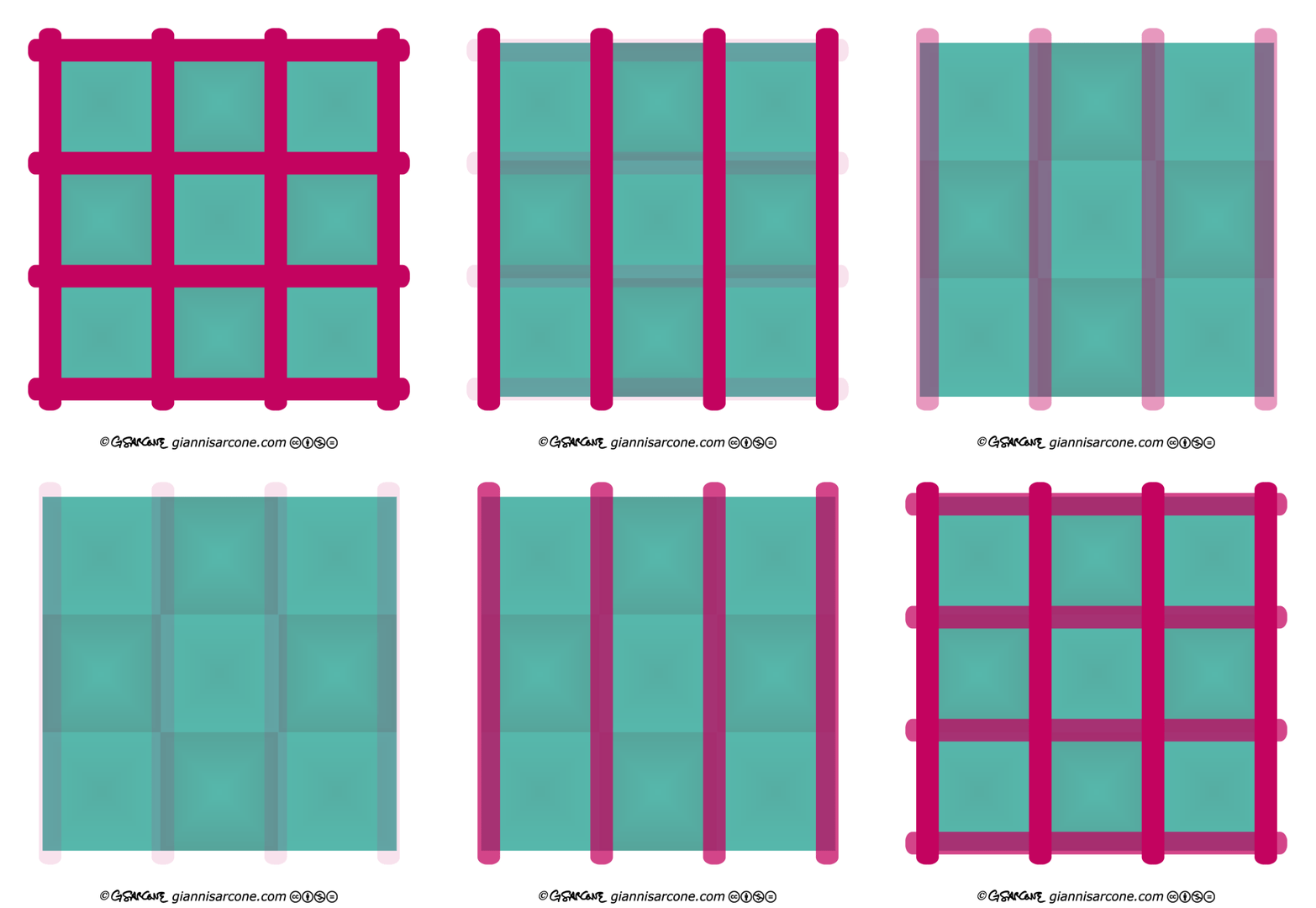
Thus, even small differences in brightness between adjacent zones, or objects, are deliberately increased by our visual system and the brain to better distinguish them. But something strange happens when the brightness boundaries of the color zones are concealed: the cues the brain needs to trigger the lateral inhibition no longer exist and consequently we become blind to variations in color brightness, as shown in the animated gif.
Recognitions
My optical illusion “Magic Tic-Tac-Toe” has been chosen to be among the top 10 finalists for the “2019 Best Illusion of the Year Contest”

Order now your exclusive “Illusion d’Optique” playing card deck designed by illusion Master Gianni A. Sarcone!
Packaging printed with optical ink and placed in a protective transparent plastic case.
54 eye-popping optical illusions to play and to experiment with!
Continue ReadingIn the example below, in the left column, you can see two apples—one green, one red—appearing as a single solid color with a black cross over them. Now, if we remove the thick black lines, each apple clearly appears divided into four quarters of different shades—even though they are exactly the same in both columns, with and without the black cross.

Here’s a trickier version: with the black grid in place, the large green square appears uniform. Take the grid away, and it turns into a full-on checkerboard…

This occurs because in our visual system there is a mechanism that enhances the contrast of the outline of an object relative to its background: it is called ‘lateral inhibition’. Thus, even small differences in brightness between adjacent zones or objects are deliberately increased by the brain to better distinguish them. So, when the brightness boundaries of the color zones are concealed, the cues the brain needs to trigger the lateral inhibition mechanism no longer exist and consequently we become “blind” to variations in color brightness. The illustrations above have been taken from my book “Drawing Optical Illusions” who was translated in many languages. The book is still available from Amazon.

This eye-catching, colorful book is designed to inspire those artists interested in optical illusions and as an invaluable reference tool for people who to wish to create them. In clear, easy steps, this book shows people how to design a range of original and classic optical illusions and even how to create their own personalized illusions.
Here are two projects involving the geometrical-constructive art of Piet Mondrian, one of my preferred artists, the golden ratio and ϕ. For this purpose, I used the same color palette favored by Mondrian: yellow, red, blue, black and gray.
In the first project, I used squares, that are proportional to each other by the golden ratio or ϕ, to prove the Pythagorean theorem as shown in the Zhoubi Suanjing (or Chou Pei Suan Ching – 周髀算經), one of the oldest Chinese mathematical texts (circa b.c. 200).
Kinechromatics (patent pending) is a method of my invention for animating static images through retinal persistence and controlled interactions between additive and subtractive color systems. It produces apparent motion by sequential color filtering across layered chromatic structures, rather than relying on conventional frame-by-frame animation.

The static image above is made of 3 layers having each a different subtractive primary color (magenta, yellow, or cyan) blended in ‘multiply mode’…
What happens if we alternately overlay this image with transparent colored acetate sheets, each carrying an additive primary color (red, green, and blue)?

Kinechromatics: red filter
When viewed through a red acetate sheet, the magenta and yellow components are largely absorbed, while the cyan layer remains visible, appearing black.

Kinechromatics: green filter
Through a green acetate sheet, the cyan and yellow components are suppressed, revealing the magenta layer in black.
Kinechromatics: blue filter
Through a blue acetate sheet, the magenta and cyan components are reduced, allowing the yellow layer to emerge but appear black due to its lack of transmission in the blue range.
The animated GIF below produces a continuous motion effect using only four elements: a static base image and three full-color layers blended in multiply mode.

Colored light can also replace acetate filters, creating a seamless optical animation. Stroboscopic illumination in primary colors has the added effect of merging perceptually into white light, making the transitions visually smooth. This approach can be particularly effective in museum or gallery installations, offering a direct demonstration of how color interaction is processed by human vision. The setup consists of a static image containing the Kinechromatics pattern, illuminated sequentially by red, green, and blue projection, as shown in the animation below.
For inquiries about exhibition or collaboration, feel free to contact me.

A second example, a simple animated dancing skeleton, demonstrates the same principle:

See also:
