Turning Gray Shades Into Colors With A Tinted Geometric Grid

explanation

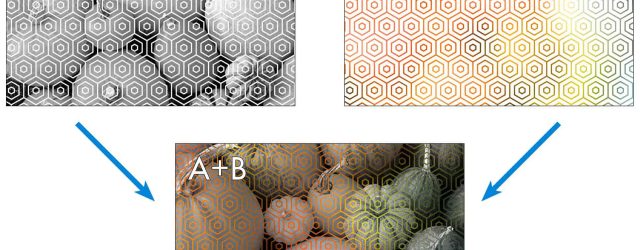
This is an old technique that uses the “color assimilation” effect to colorize pictures. This perceptual effect, also known by scientists as the Von Bezold spreading effect, occurs when our visual system transfers perceived colors to their adjacent areas.

Is the first photo of a variety of pumpkins in color?

colorized black and white pumpkins
Black and white photo overlaid with a geometrical tinted grid

Ghost Colors

This is one of my earliest color optical illusions. There is no yellow or green in the diamond shapes, just vertical black lines! (If you don’t believe it, use a eyedropper tool to check it.) This intriguing visual effect is mainly due to “simultaneous color contrast induction“.

Illusive colors
Ghost Squares / Black Diamonds (2002 – 2007)
Continue Reading

Is Magenta a Real Color?

Most of us are familiar with magenta — it’s a kind of purplish-red that exists between blue and red on color wheels (color wheels don’t accurately represent the physics of photons, but they represent the philosophical reality: color is a human construct that helps us interpret wavelengths to better understand our world).

The odd thing about color vision is that magenta (or pink) color is not in the spectrum of colors, meaning it cannot be generated by a single wavelength of light. Our brains interpret the color sensation of magenta/pink as ‘absence’ of green.

Source: https://www.archimedes-lab.org/Gallery/new_optical_illusions/pages/10n-Pink_rose.html

magenta

Magic Tic-Tac-Toe

Our visual system can interpret colors and shades in surprising ways. This 3×3 Tic-Tac-Toe grid, for example, showcases how easily our perception of brightness can be fooled.
Do you notice anything unusual in the grid below?

Show / Hide the Trick

The looping animation below brings the illusion to life, revealing the trick in action. That large green square behind the grid isn’t actually uniform—it’s made up of alternating dark and light green squares.

Our visual system works like a “comparative computer”. In fact, we never see colors in isolation, as the appearance of any color is affected by the colors surrounding it. So, under certain conditions, colors that are identical may appear different, while colors that are different may look the same. In our visual system there is a mechanism that enhances the contrast of the outline of an object relative to its background: it is called “lateral inhibition”.
Thus, even small differences in brightness between adjacent zones, or objects, are deliberately increased by our visual system and the brain to better distinguish them. But something strange happens when the brightness boundaries of the color zones are concealed: the cues the brain needs to trigger the lateral inhibition no longer exist and consequently we become blind to variations in color brightness, as shown in the animated gif.

Recognitions
My optical illusion “Magic Tic-Tac-Toe” has been chosen to be among the top 10 finalists for the “2019 Best Illusion of the Year Contest

“Illusion d’Optique” Magic Playing Cards

For Art, Math and Magic Lovers!

Order now your exclusive “Illusion d’Optique” playing card deck designed by illusion Master Gianni A. Sarcone!

Packaging printed with optical ink and placed in a protective transparent plastic case.

54 eye-popping optical illusions to play and to experiment with!

Continue Reading