“Everything we see hides another thing;
we always want to see what is hidden by what we see.” – René Magritte
My book “Fantastic Optical Illusions” (ISBN: 178739235X) features all the best and most interesting illusion types: ambiguous and impossible figures, hidden objects, color and brightness effects, length, size and shape misperceptions, illusory moving patterns and image paradoxes.
This best-selling book has been first printed in 2004, since then I have made important updates on the latest discoveries in the world of perception, to be sure the book will continue to amaze both the young and the adult reader. Available from Amazon UK and Amazon USA.
Some intriguing pieces of art by Athens-based street artist Achilles who utilizes a series of wall murals to produce a 3D composite anatomical rendering of a face. The artist often utilizes perspective in unusual ways, more examples of which you can find on his Facebook page.
The “Salar Jung Museum” is an art museum located at Dar-ul-Shifa, on the southern bank of the Musi River in the city of Hyderabad, Telangana, India. In this museum is exhibited a captivating double-figure wood sculpture built in the 19th century A.D. in France. It stands before a mirror and shows the facade of a nonchalant Mephistopheles and the image of a demure Margaretta in the mirror.
The wooden double statue of ‘Mephistopheles and Margaretta’ representing evil and good are characters from Goethe’s famous work ‘Dr.Faust’ (1808) and tells the story of love, heroism and tragedy.
I really enjoy communicate the mysteries behind the science of perception in a simple and clear manner with the use of instructive images.
We live in a “reallusive” world… Illusions are not totally unreal, because we feel them as they were real. Reality is also a kind of ‘illusion’. The outside world is mediated through our sense organs: vision, hearing, taste, touch and smell. All what we perceive and feel are just REPRESENTATIONS of reality, not the reality itself.
Children have a different way of looking at the world. So, writing and illustrating optical illusion books for kids is not an easy task, because they are less fooled by visual illusions than adults. This is due to the fact that brain’s capacity to consider the CONTEXT of visual scenes, and not just focus on SINGLE PARTS of scenes, develops very slowly.
My new work “Optical Illusions” will make you question: “is seeing believing?”… The brain is an amazing thing, but it doesn’t always get things right when it comes to sight. My book is here to explain why, with astounding images, baffling puzzles, and simple reveals.
In the example below, in the left column, you can see two apples—one green, one red—appearing as a single solid color with a black cross over them. Now, if we remove the thick black lines, each apple clearly appears divided into four quarters of different shades—even though they are exactly the same in both columns, with and without the black cross.
Here’s a trickier version: with the black grid in place, the large green square appears uniform. Take the grid away, and it turns into a full-on checkerboard…
This occurs because in our visual system there is a mechanism that enhances the contrast of the outline of an object relative to its background: it is called ‘lateral inhibition’. Thus, even small differences in brightness between adjacent zones or objects are deliberately increased by the brain to better distinguish them. So, when the brightness boundaries of the color zones are concealed, the cues the brain needs to trigger the lateral inhibition mechanism no longer exist and consequently we become “blind” to variations in color brightness. The illustrations above have been taken from my book “Drawing Optical Illusions” who was translated in many languages. The book is still available from Amazon.
This eye-catching, colorful book is designed to inspire those artists interested in optical illusions and as an invaluable reference tool for people who to wish to create them. In clear, easy steps, this book shows people how to design a range of original and classic optical illusions and even how to create their own personalized illusions.
“Reality is merely an illusion, albeit a very persistent one.”
— Albert Einstein
Everything you “see” depends strongly on the context and attention you give to it. The mind and the world you experience are inseparable, as it is your 3-pound brain that make the world meaningful. Seeing isn’t some kind of direct perception of reality. Actually, our bairns are cnostanlty itnerperting, correcting, and giving srtuctrue to the viusal ipnut form our eeys. If this were not the case, you would not see any colors (consider that all the beautiful colors you see don’t really exist), and you would probably see the world upside-down! Moreover, you would notice in your visual field a very large dot, called the “blind spot,” where the optical nerve enters the eye.
A Zen master said once: “If you pour water into a cup, water becomes the cup; if you fill a bottle with water, it becomes the bottle!” Likewise, the context shapes the appearance of the world surrounding you. Your brains work by comparing information and stimuli: contrasting colors, shapes, depth in a dynamic changing environment … that’s why perception is relative and not absolute. Continue Reading →
Here are two projects involving the geometrical-constructive art of Piet Mondrian, one of my preferred artists, the golden ratio and ϕ. For this purpose, I used the same color palette favored by Mondrian: yellow, red, blue, black and gray.
In the first project, I used squares, that are proportional to each other by the golden ratio or ϕ, to prove the Pythagorean theorem as shown in the Zhoubi Suanjing (or Chou Pei Suan Ching – 周髀算經), one of the oldest Chinese mathematical texts (circa b.c. 200).
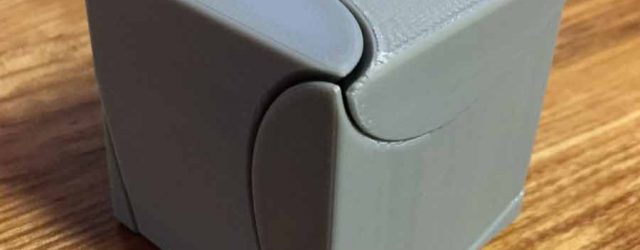
I really love puzzle with less pieces as possible and with a contemporary design… This neat three-piece puzzle has been invented by Robert Reid and designed by puzzle-master Oskar van Deventer. The fit of the puzzle is perfect, though assembly can be really challenging.
An op art sculpture and/or a fidget puzzle to play with over and over!
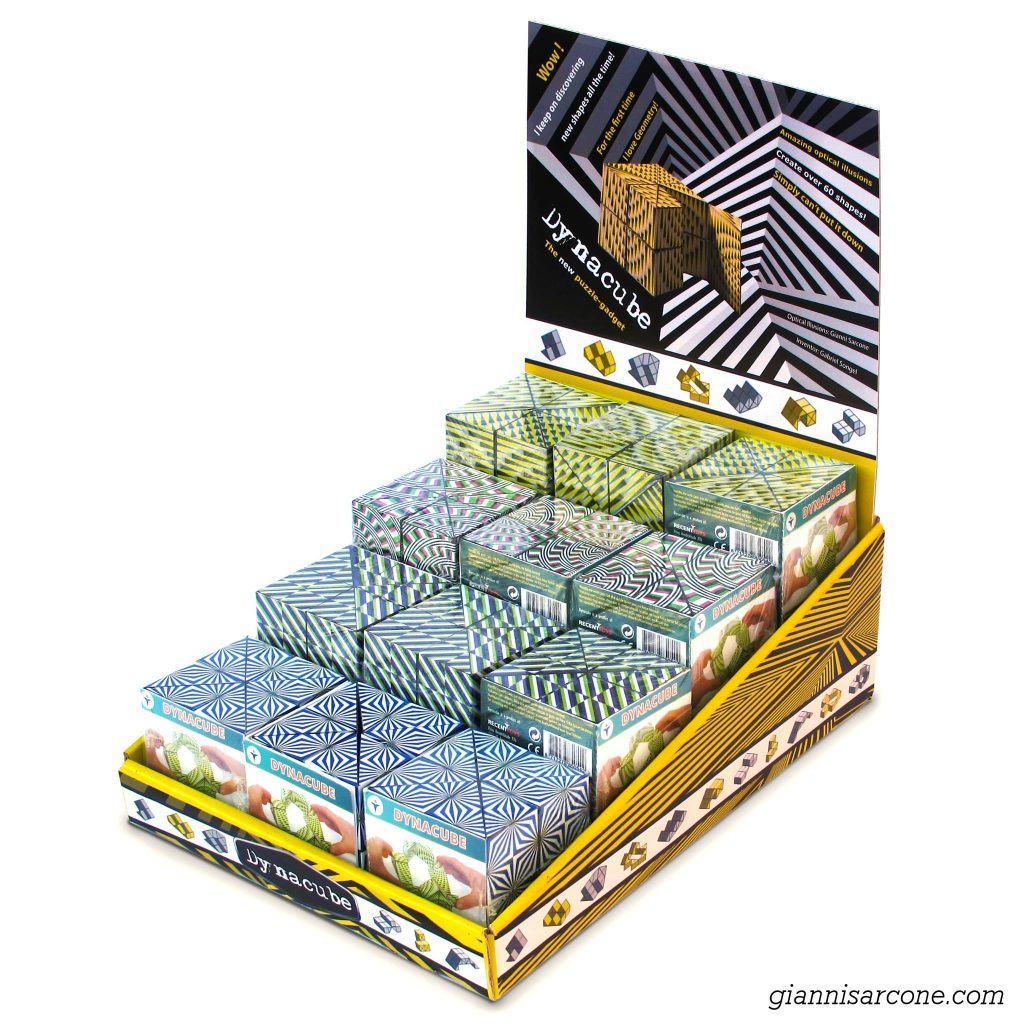
“Dynacube” is a new line of 3D puzzles featuring my optical art. It isn’t just a puzzle but also a living piece of art. This 3D game is available in 4 distinct styles from Recent Toys: http://www.recenttoys.com/project/dynacube/
Dynacube is a fun game for kids and adults alike to practice their logical thinking and motor skills.