Through the Eyes of Insects

The compound eye is nothing like the human eye, but we often misunderstand how insects see the world. In horror movies, their vision is depicted as a chaotic kaleidoscope. In reality, it’s much more refined—like viewing the world through a crystal-clear glass paperweight. 

What’s even more fascinating? Some insects have vibrant color patterns on their compound eyes that serve a purpose! These patterns act as filters, enhancing contrast to help them spot objects against colorful backgrounds or shielding their eyes from certain wavelengths of light.

Take the Deer Fly and Horse Fly, for example—both flaunt these functional designs. But the Green Lacewing (Chrysopidae) takes the crown for the wildest look. Its compound eyes create a diffraction pattern resembling a sheriff’s star, formed by the countless six-sided “ommatidia” that make up its eye structure.

The Wonders of Compound Eyes

Insect compound eyes are made up of thousands of tiny units called ‘ommatidia’, each acting like a mini-eye. This gives insects a near-panoramic view, perfect for spotting motion and environmental changes. Dragonflies, for example, have around 30,000 ommatidia per eye, making them masters of motion detection.

While human eyes, with their single lens and dense photoreceptors, excel at detail and depth, they lack the wide-field motion awareness of compound eyes. Insects also outshine us in speed, detecting rapid movements crucial for survival.

Many insects see ultraviolet light—something humans can’t. This unique vision aids in finding food, communication, and mating. Compound eyes are a brilliant mix of structure and function!

Gliding Patterns: The Anomalous Motion Illusion

Let your gaze wander across the image below. Do the shapes in the first and third rows seem to subtly shift leftward, while the second and fourth rows appear to glide rightward?

© Gianni A. Sarcone, Gliding Patterns, 1999

Now, let your gaze wander across the image below. Do the concentric circles appear to subtly counter-rotate?

© Gianni A. Sarcone, Counter-Rotating Circles, 1999

Why do these static images appear to move? This perceptual phenomenon, known as “anomalous motion” or “peripheral drift illusion”, results from the interplay of color contrast, luminance, and eye movements. It occurs due to a sawtooth luminance grating in the visual periphery, where a sequence of contrasting colors transitions from light to dark. The speed of the perceived motion is influenced by the frequency of microsaccadic eye movements.

In the 1990s, I began creating many of these fascinating images, experimenting with patterns and contrasts to bring this mesmerizing effect to life.

Fine art prints and merchandise of these mesmerizing pieces are available in my online gallery—a perfect addition to any space!

Mesmerizing Color-Changing Squid

Squids are basically the chameleons of the sea, and their secret weapon? Chromatophores—tiny skin cells that let them pull off some mind-blowing color changes. Whether it’s blending into a coral reef or throwing out some serious “back off” vibes, these little guys do it all. Right now, though, this squid seems to be saying: “Hey genius, put me back in the water before you turn me into calamari!”

Chromatophores of the Squid: How Do They Work?
Chromatophores are pigment-containing cells found in the skin of squids and other cephalopods. These cells expand and contract to display different colors, allowing the squid to blend into its surroundings, communicate with others, or signal threats. They play a vital role in the squid’s survival.

Stardust

Here’s the recipe to make an average-sized human: 15 kg of carbon, 4 kg of nitrogen, 1 kg of calcium, half a kg of phosphorus, 200 g of sodium, 150 g of potassium, 150 g of chlorine, a few grams of about 15 other elements (some exotic, like selenium, lithium, and vanadium in trace amounts), and four 10-liter buckets of water.

The 40 liters of water can be made by combining 5 kg of hydrogen and 35 kg of oxygen. Commercial cost? Just a few euros.
The hydrogen and a pinch of lithium come from the Big Bang, about 15 billion years ago. The other ingredients are more recent; they required billions of years of cosmic evolution, with stars being born, shining, dying, and reforming in nebulae from stellar collapse.
The 15 kg of carbon was formed in a star’s final stages by combining three helium atoms. The 35 kg of oxygen came from the fusion of carbon and helium in extremely hot stars. Iron is the ash of spent stars, and calcium, phosphorus, sulfur, chlorine, sodium, and nitrogen also come from these stellar forges.
Traces of even heavier elements reach us from supernovae. In short, we are born from the stars.

Perspective Optical Illusions: The art of circling the square

When bending the sides of a square structure forward, each edge forming a sine wave shape, the structure reveals a circle when viewed from the reverse angle. This illusion plays with perspective, specifically utilizing an effect known as “anamorphosis“.

Anamorphosis refers to a artistic technique that uses perspective to create distorted images that can only be viewed correctly from a specific angle.

Two Mind-Bending Aquariums

At first glance, they seem to be the same, but take a closer look… Can you spot what’s wrong?

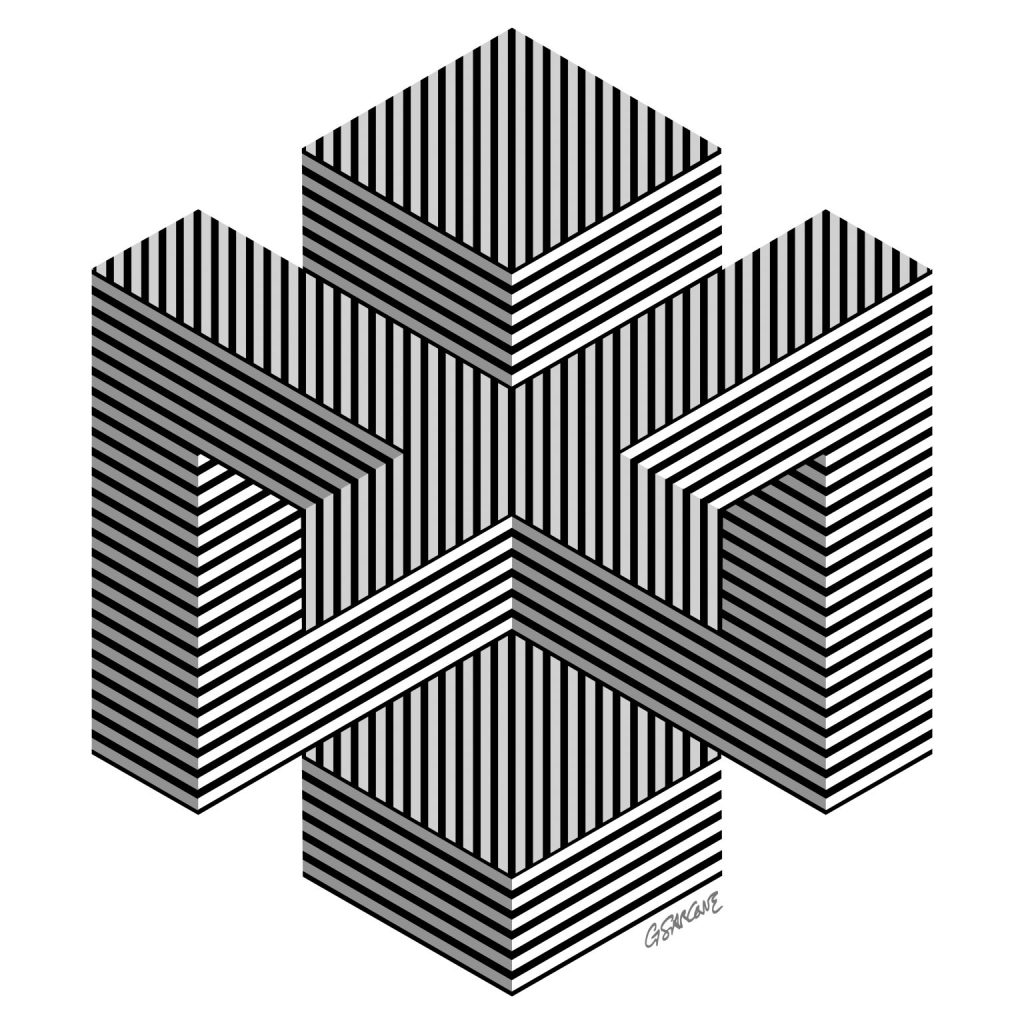
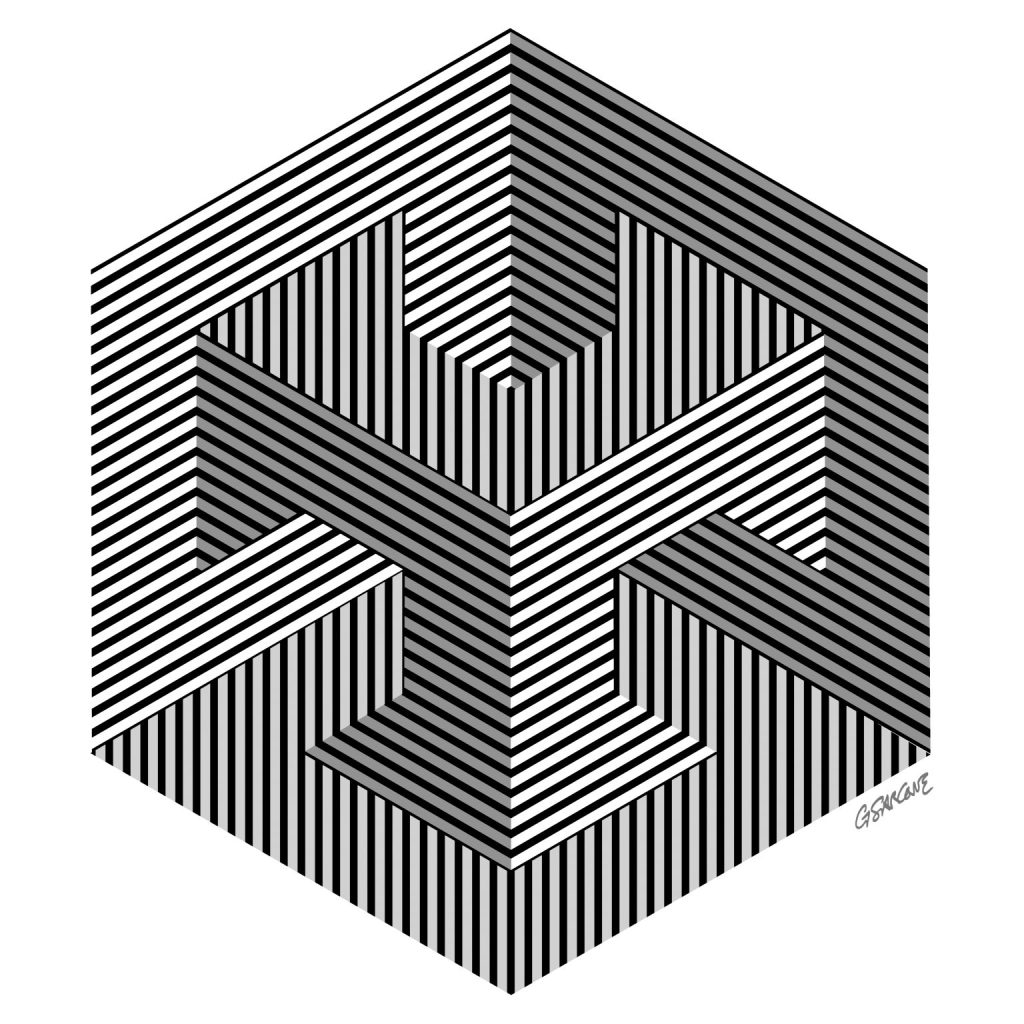
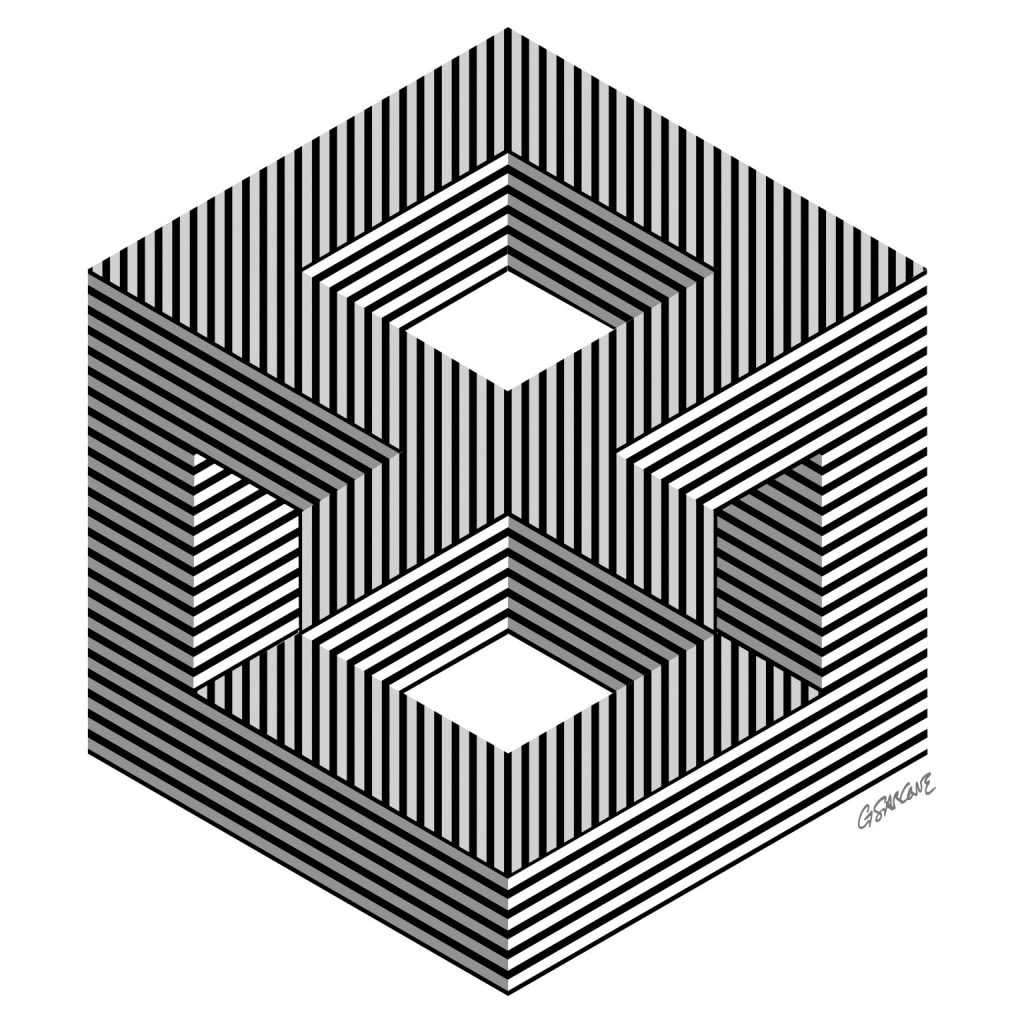
I’ve always been fascinated by impossible figures, which psychologists call “undecidable figures”, meaning visual representations that challenge our perception and understanding of reality. Since the late 1980s, I’ve continued to explore this field and create new illusions, producing a series of drawings that play with the third dimension, manipulating perspectives and proportions to create original visual effects.

My work draws inspiration from two masters of optical art and impossible objects: Josef Albers and Oscar Reutersvärd. Their innovations and creations have always inspired and motivated me to continue my research in this field.

The Red Wine Color Illusion

Does the color of wine change when poured into a glass?
Although it may appear darker, the red shade remains the same. This visual trick is a result of the Munker-White illusion—where our brain perceives colors differently depending on their surrounding context.

If you’re fascinated by puzzles like this, reach out to my syndication agent to feature them in your publication.

This op art piece is also available as prints and canvases in my online gallery.

Quando l’arte incontra la scienza: l’enigmatica Moona Lisa

Sono felice di condividere che la mia opera congiunta Moona Lisa, realizzata in collaborazione con l’astrofotografa Marcella Giulia Pace, è ora esposta presso il Dipartimento di Fisica e Astronomia dell’Università di Firenze. Potete scoprire di più su quest’opera qui: Moona Lisa – UniFi. Moona Lisa sarà inoltre parte della mostra permanente di Enlighting Mind, un’esposizione dedicata alla connessione tra arte e scienza.

Il prossimo 13 dicembre, Marcella terrà un seminario al dipartimento dal titolo preliminare “Moona Lisa e l’enigma della luna”, dove esplorerà il mistero e la bellezza della nostra opera attraverso la lente dell’astrofotografia.

Per chi fosse interessato ad acquistare l’opera sotto forma di stampa, potete farlo nella mia galleria online: Redbubble.

The Red Mesh Ruse

With Christmas around the corner, mandarins and oranges start popping up everywhere. In supermarkets, you’ll often find oranges wrapped in red mesh bags. But that choice isn’t just for looks—it’s a clever sales trick.

Why red mesh? It’s a simple way to make oranges seem more appealing to our eyes and brains, even if the fruit is a bit lackluster. Scientists have studied this phenomenon, which they call the “Confetti illusion.” Arriving fashionably late to the scene, they discovered the visual effect caused by the red mesh bag. They’ve given it the grand name “perceptual ripening of oranges,” but let’s be real—it’s just color assimilation doing the work.

Color assimilation is when different hues blend in our perception, changing how we see things. In this case, the red mesh combines with the actual color of the fruit (fig. A), making the oranges look brighter and more appealing (fig. B)—a little trick on the eyes.

Scientists recently confirmed what artists and salespeople have known for centuries: color assimilation can shape how we see things, especially in shopping. The illusion works because most people trust what they see without taking a closer look. But once out of the red mesh, the oranges often aren’t as shiny or ripe as they first appeared.

Curious to learn more about how color influences perception? Check out my color research and visual experiments on my Behance page.

The Importance of Dots

It is often the little things that are the basis of progress… So let me tell you a little story about the tiniest thing on earth: the dot.

Thousands of years ago, a man in his solitude scanned the night sky and saw all those dots shining like so many still fireflies, and, perhaps for fun, he decided to join them together to form shapes. This is how zodiac signs and astronomy were born.

Far away, in ancient India, the dot symbolized beauty and the eye of knowledge. But even more, the dot they called “shunya-bindu” (शून्यबिन्दु) represented what we nowadays know as zero. It was first a placeholder and then a fully fledged number, for when it is added to the right of the representation of any given digit, the value of the digit is multiplied by ten. This is how our current numbers and decimal numeration system were born.

While drawing or painting, visual artists of all times used to fix a dot – or more specifically a point in space – which was traditionally visualized from the tip of their thumb. Eventually, when this point receded so far away in space, it became known as a “vanishing point”. A vanishing point is where all converging lines of a landscape meet at the horizon. This is how perspective and geometry were born.

One day, medieval musicians were tired of having to rely solely on their memories to remember songs. So they started to use dots, named “puncti”, placed on or between four lines to represent the pitch and duration of a sound. This is how musical notation and programming were born.

In the modern era, at the beginning of the nineteenth century, dots were used in many other symbolic forms: bumps, holes, single tones, flashes of light… Do the terms Braille, Morse, punched card, or pixel sound familiar to you? This is how communication and coding were born.

This is how the humble dot, often overlooked, has served as a fundamental building block for countless advancements throughout history. Never underestimate the power of small things; within a dot was the whole universe.

Bridget Riley, White Discs 2, 1964, emulsion on board, 41 × 39 inches (104 × 99 cm) © Bridget Riley 2021. All rights reserved.

(The text above has been used as foreword for the book “The All-Round Activity Book” available from Amazon)