Explore a fascinating figure/ground effect in this op art piece, where 4 black illusive bangles appear to overlap with 4 white ones. The rotating patterns create a calming and hypnotic visual experience.
This design is now available as t-shirts and posters in my online gallery.
If you’re interested in creating your own op art, I also have a tutorial available on Behance.
I hope you enjoy this design, and I’d love to hear your thoughts on it!
Sono felice di condividere che la mia opera congiunta Moona Lisa, realizzata in collaborazione con l’astrofotografa Marcella Giulia Pace, è ora esposta presso il Dipartimento di Fisica e Astronomia dell’Università di Firenze. Potete scoprire di più su quest’opera qui: Moona Lisa – UniFi. Moona Lisa sarà inoltre parte della mostra permanente di Enlighting Mind, un’esposizione dedicata alla connessione tra arte e scienza.
Il prossimo 13 dicembre, Marcella terrà un seminario al dipartimento dal titolo preliminare “Moona Lisa e l’enigma della luna”, dove esplorerà il mistero e la bellezza della nostra opera attraverso la lente dell’astrofotografia.
Per chi fosse interessato ad acquistare l’opera sotto forma di stampa, potete farlo nella mia galleria online: Redbubble.
With Christmas around the corner, mandarins and oranges start popping up everywhere. In supermarkets, you’ll often find oranges wrapped in red mesh bags. But that choice isn’t just for looks—it’s a clever sales trick.
Why red mesh? It’s a simple way to make oranges seem more appealing to our eyes and brains, even if the fruit is a bit lackluster. Scientists have studied this phenomenon, which they call the “Confetti illusion.” Arriving fashionably late to the scene, they discovered the visual effect caused by the red mesh bag. They’ve given it the grand name “perceptual ripening of oranges,” but let’s be real—it’s just color assimilation doing the work.
Color assimilation is when different hues blend in our perception, changing how we see things. In this case, the red mesh combines with the actual color of the fruit (fig. A), making the oranges look brighter and more appealing (fig. B)—a little trick on the eyes.
Scientists recently confirmed what artists and salespeople have known for centuries: color assimilation can shape how we see things, especially in shopping. The illusion works because most people trust what they see without taking a closer look. But once out of the red mesh, the oranges often aren’t as shiny or ripe as they first appeared.
Curious to learn more about how color influences perception? Check out my color research and visual experiments on my Behance page.
Introducing my latest creation, Triangles of Beauty—a minimalist mosaic that blends geometric precision with visual intrigue. This op art piece showcases a striking arrangement of triangular shapes in sepia tones, merging rich shades of brown and beige. The triangle, a timeless symbol, embodies the balance of masculine and feminine energies, forming a harmonious third element that transcends duality. It represents strength, unity, and the divine—a visual echo of the trinity, where individual components unite into something greater.
Step back and let the patterns unfold to reveal the depth within this thought-provoking piece.
This thought-provoking op art piece is available in my online galleries:
We are all equal, but not in the way we usually think. Imagine that we are made up of Legos, with each Lego representing a distinct experience, cultural background, or genetic component. Our entirety forms a colorful construction that reveals how we share certain Legos—in varying degrees—with others, shaping who we are. Indeed, we are “non-uniform units“, and it is in this mosaic that we find our equality.
In 1997, I reimagined Leonardo da Vinci’s Mona Lisa through a system of 142 color beads, each precisely positioned at the nodes of an invisible two-dimensional triangular grid. Up close, the pattern appears abstract, yet from a distance, the arrangement resolves into the familiar features of the portrait, inviting viewers to recognize the image through perception and suggestion.
Our unconscious biases and stereotypes can influence our brain’s visual systems, leading us to perceive things and people in ways that align with these stereotypes.
Seeing nude women? Before assuming it’s pornography, reconsider… It’s fascinating how our minds are conditioned and stereotyped: in the first image, we instantly envision women in Adam and Eve attire, whereas the second presents a different reality.
It is often the little things that are the basis of progress… So let me tell you a little story about the tiniest thing on earth: the dot.
Thousands of years ago, a man in his solitude scanned the night sky and saw all those dots shining like so many still fireflies, and, perhaps for fun, he decided to join them together to form shapes. This is how zodiac signs and astronomy were born.
Far away, in ancient India, the dot symbolized beauty and the eye of knowledge. But even more, the dot they called “shunya-bindu” (शून्यबिन्दु) represented what we nowadays know as zero. It was first a placeholder and then a fully fledged number, for when it is added to the right of the representation of any given digit, the value of the digit is multiplied by ten. This is how our current numbers and decimal numeration system were born.
While drawing or painting, visual artists of all times used to fix a dot – or more specifically a point in space – which was traditionally visualized from the tip of their thumb. Eventually, when this point receded so far away in space, it became known as a “vanishing point”. A vanishing point is where all converging lines of a landscape meet at the horizon. This is how perspective and geometry were born.
One day, medieval musicians were tired of having to rely solely on their memories to remember songs. So they started to use dots, named “puncti”, placed on or between four lines to represent the pitch and duration of a sound. This is how musical notation and programming were born.
In the modern era, at the beginning of the nineteenth century, dots were used in many other symbolic forms: bumps, holes, single tones, flashes of light… Do the terms Braille, Morse, punched card, or pixel sound familiar to you? This is how communication and coding were born.
This is how the humble dot, often overlooked, has served as a fundamental building block for countless advancements throughout history. Never underestimate the power of small things; within a dot was the whole universe.
Creativity isn’t bound by meaning; its essence lies in the emotional resonance felt during creation and the impact on those who perceive it. Art is a personal journey, and its beauty lies not just in the product but in the unique connection forged between creator and audience.
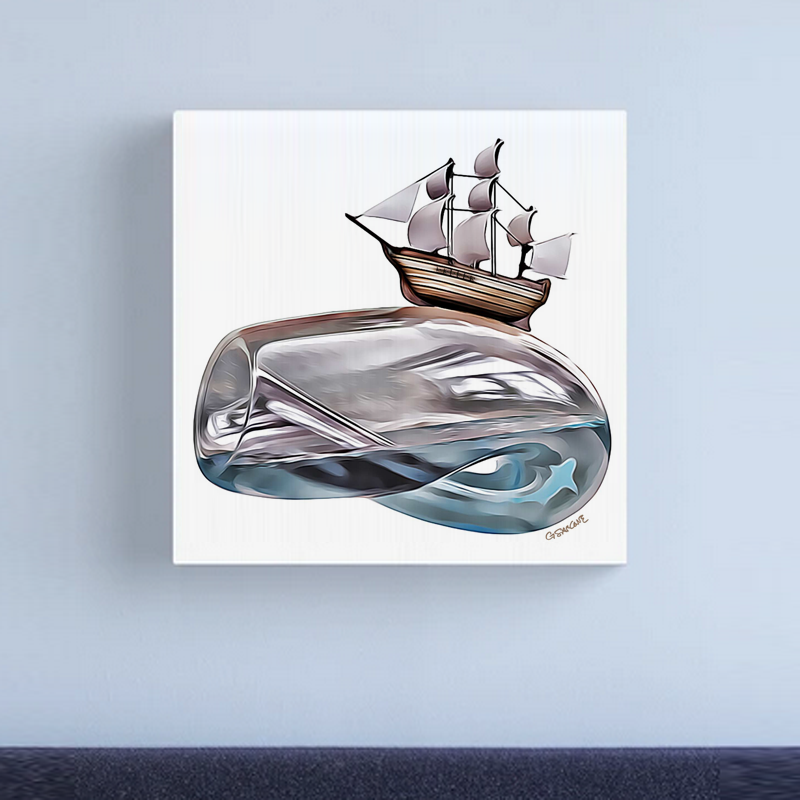
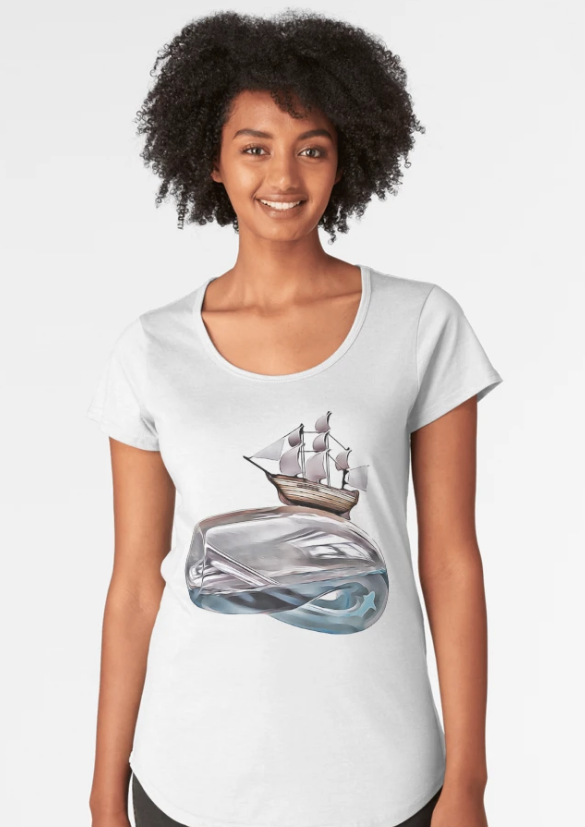
Embarking on a journey in a Klein bottle? Absolutely. A Klein bottle is a mind-bending non-orientable surface, defying the usual inside-outside norms. Technically, the ship’s navigating the interior…