As some of you know, I am fluent in four languages—French, Italian, German, and English—and switching from one language to another sometimes makes me notice things I would probably overlook otherwise. The same idea can take on a surprisingly different tone depending on the language in which it is expressed.
Language is rarely a simple tool for conveying information. It also reveals how societies frame responsibility, inconvenience, and social balance.
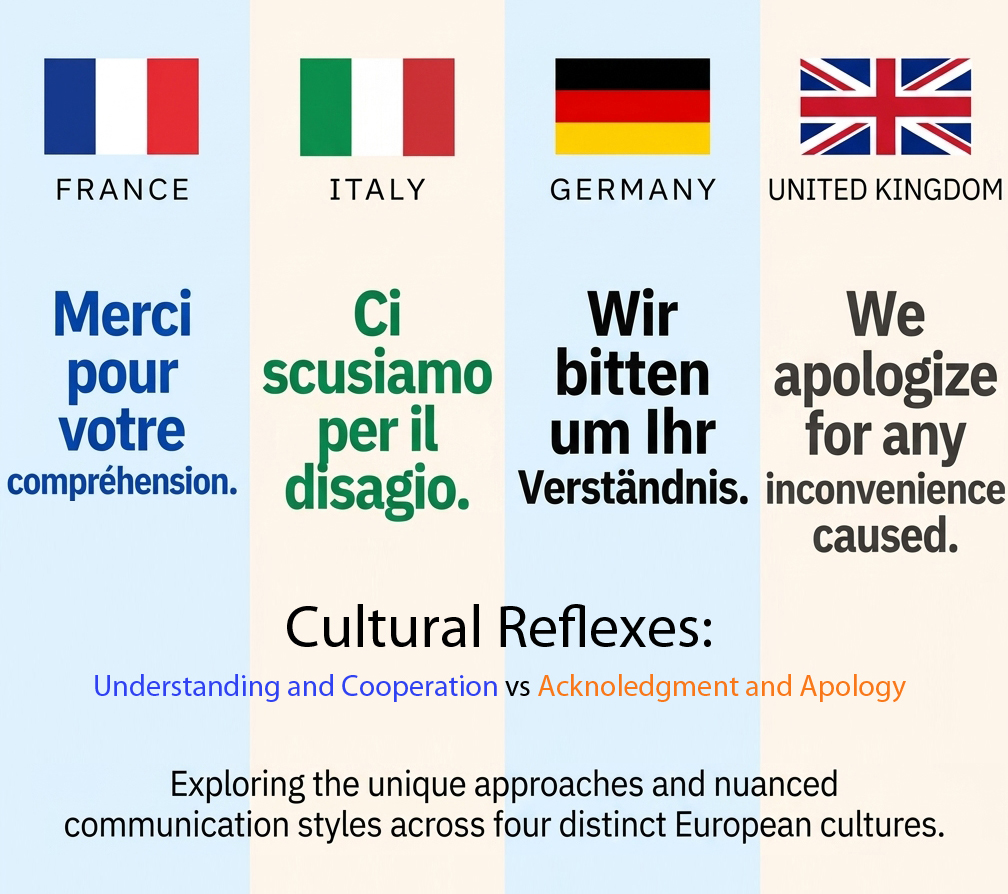
This image highlights a subtle linguistic difference in Western Europe. When routine friction occurs, some institutional formulas appeal to understanding, while others emphasize acknowledgment and apology.
The Linguistic Mechanics
- France & Germany — Cooperation and Understanding: The French “Merci pour votre compréhension” and German “Wir bitten um Ihr Verständnis” ask the listener to understand the circumstances. Rather than explicitly expressing regret, the institution frames the situation as something that calls for the public’s understanding and cooperation.
- Italy & the United Kingdom — Acknowledgment and Apology: Italy’s “Ci scusiamo per il disagio” and Britain’s “We apologize for any inconvenience caused” explicitly acknowledge the inconvenience experienced by the individual. In British English, apologies also serve as an everyday politeness strategy, often helping to reduce social friction even when there is little or no personal responsibility involved. Italian disagio similarly draws attention to the discomfort or inconvenience caused.
These are not rigid cultural rules. All four languages can use both strategies. What differs is the conventional framing favored in particular situations.
The Philosophical Tension
This small linguistic difference raises a larger question:
What restores balance when a routine disruption disturbs the social order?
One approach appeals to understanding: Please understand the circumstances.
The other acknowledges the disruption: We recognize the inconvenience and regret it.
Neither is necessarily more polite or more effective. They simply place the emphasis in different places—on shared understanding or on acknowledging the individual’s experience.
What looks like a routine automated notice on a train platform can therefore reveal something deeper about responsibility, politeness, individual agency, and public trust.