
The letter W ultimately derives from the letter V, but its history is more layered than a simple invention after the Norman Conquest.
In classical Latin, inherited from the Greek and Phoenician alphabet traditions (Fig 1), the letter V served a dual function: it represented both the vowel /u/ and the consonantal sound /v/. There was no distinct symbol for /w/. In contrast, Old English (Anglo-Saxon) already had a need for this sound and used a separate rune, “wynn” (ƿ, Fig. 2), to represent it.
After the Norman Conquest of England in 1066, scribal practices shifted toward continental Latin conventions. The rune wynn gradually fell out of use, and scribes began representing the /w/ sound by writing a doubled form of U (or V, since the two were not yet fully distinguished, Figs. 3-4). This “double u” convention eventually evolved graphically: two V-shaped characters were written side by side, then gradually joined.
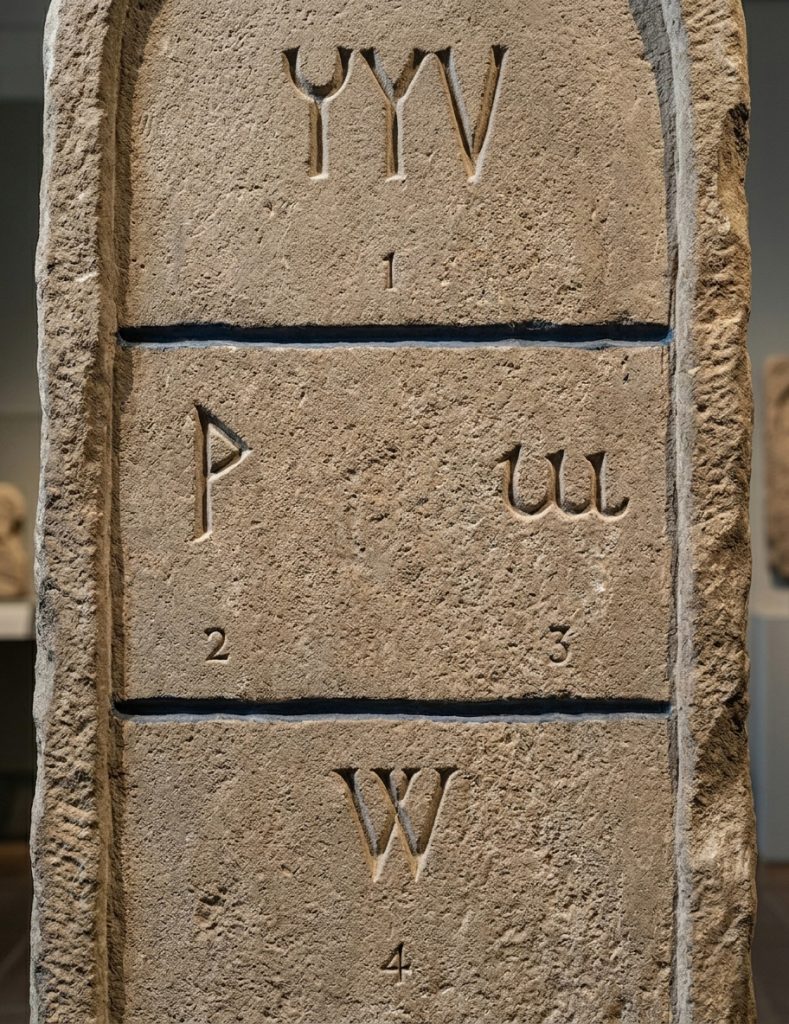
From this duplication comes the modern name “double U,” which preserves the historical origin even though the visual form is closer to two V’s than two U’s. The lowercase w developed directly from this doubled form, simplifying over time into a continuous script shape.
In short, W is not a direct Roman invention, but a medieval solution: a hybrid born from Latin writing habits adapting to a sound already present in Old English.