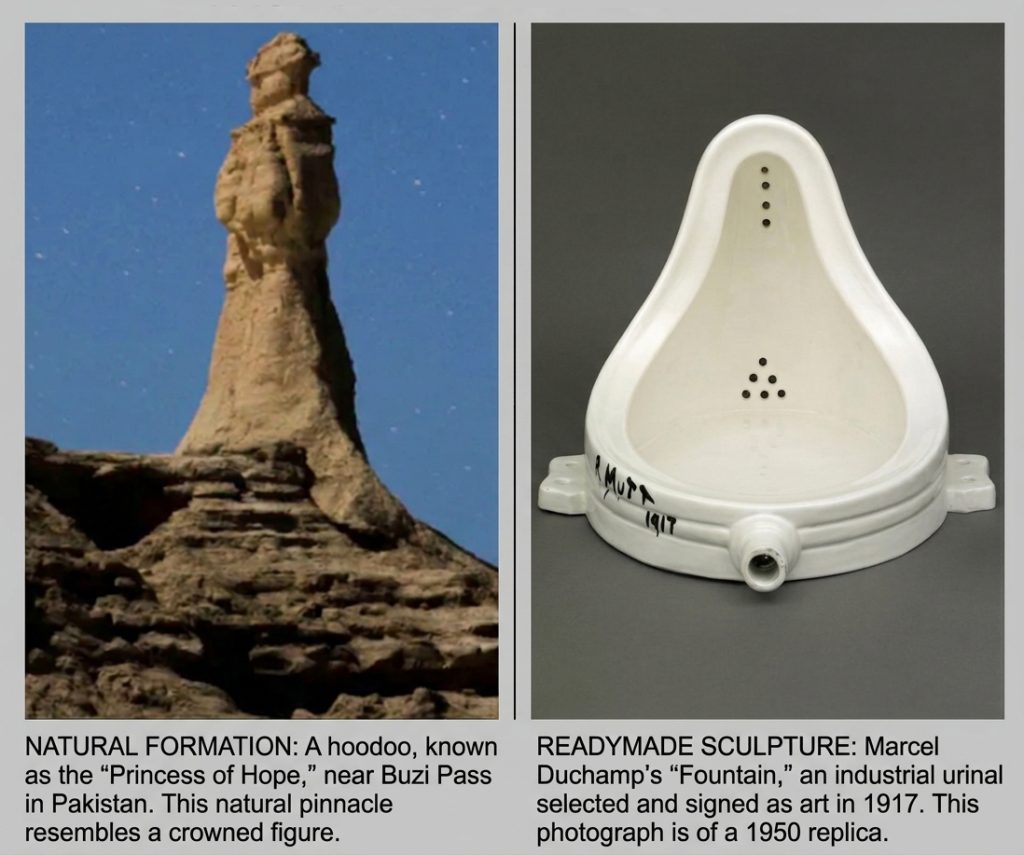
Art may not be exclusively a human affair. Nature has its own creative force and aesthetic power. Crystals, shells, clouds, and landscapes produce forms and patterns that we often find as fascinating as works made by artists.
Without disturbing Kant too much—and his somewhat dated distinction between natural and artistic beauty—where does art actually begin?
Nature: the original artist?
Nature creates without any apparent intention. It does not try to please us or express an idea, yet it can produce forms of extraordinary complexity and beauty.
- Spontaneous beauty: Crystals, landscapes, spirals, symmetries, and biological patterns can display structures we perceive as beautiful.
- Creation without a plan: Nature produces forms without an artist, a blueprint, or even an audience.
- Our first inspiration: From the beginning, humans have observed, imitated, and transformed natural forms into their own creations.
For Kant, this is precisely where the difference lies: a work of art involves intention and a concept of what it is supposed to be, whereas natural beauty can be appreciated without knowing any purpose behind what we see.
But is intention really necessary?
Does art require intention?
The idea that we must know what an artist intended in order to understand or judge a work has been questioned for a long time. In 1946, William Wimsatt and Monroe Beardsley famously called the attempt to use an author’s intention as the basis for interpretation the “intentional fallacy.”
And art can go even further.
It can be improvised, accidental, discovered rather than made. It can emerge from a chance encounter between an object and a particular way of looking at it.
Leonardo da Vinci already understood this. He suggested looking at stains and irregular patterns on old walls because they could trigger visions of landscapes, battles, figures, and strange compositions. Chance could become a generator of images.
In other words, the work is not always entirely in the object.
Sometimes, it appears in the eye of the beholder.
Take a stone polished by the sea. It might suddenly remind you of a sculpture by Henry Moore. Nobody sculpted it. Nobody intended it to represent anything. Yet your brain detects a form, gives it meaning, and perhaps even sees a sculpture.
So—is it art?
From found object to readymade
With Marcel Duchamp, things get even more complicated.
The readymade takes an existing object, removes it from its ordinary context, and presents it as art. Duchamp began exploring this idea as early as 1913 with Bicycle Wheel.
The object itself may have little or nothing to do with traditional ideas of beauty. What changes is the context, the choice, and the way we look at it.
Art therefore moves, at least in part, from something made by the artist to something that can be selected, discovered, and reframed by the artist.
And this makes the boundary between creating and discovering surprisingly thin.
A natural form can resemble a sculpture. A stain can become a landscape. An ordinary object can become a work of art. And sometimes a work becomes art only because someone recognizes it as such.
Perhaps the artist does not always create something from nothing.
Sometimes, the artist does something more subtle:
he reveals what everyone else was looking at but never saw.
So where, exactly, do we draw the line between art and non-art?
And ultimately, what makes something art: the object, the artist’s intention, or the eye of the beholder?