
Some intriguing pieces of art by Athens-based street artist Achilles who utilizes a series of wall murals to produce a 3D composite anatomical rendering of a face. The artist often utilizes perspective in unusual ways, more examples of which you can find on his Facebook page.
Ambiguous figures

Mephistopheles and Margaretta, a double statue
The “Salar Jung Museum” is an art museum located at Dar-ul-Shifa, on the southern bank of the Musi River in the city of Hyderabad, Telangana, India. In this museum is exhibited a captivating double-figure wood sculpture built in the 19th century A.D. in France. It stands before a mirror and shows the facade of a nonchalant Mephistopheles and the image of a demure Margaretta in the mirror.
The wooden double statue of ‘Mephistopheles and Margaretta’ representing evil and good are characters from Goethe’s famous work ‘Dr.Faust’ (1808) and tells the story of love, heroism and tragedy.

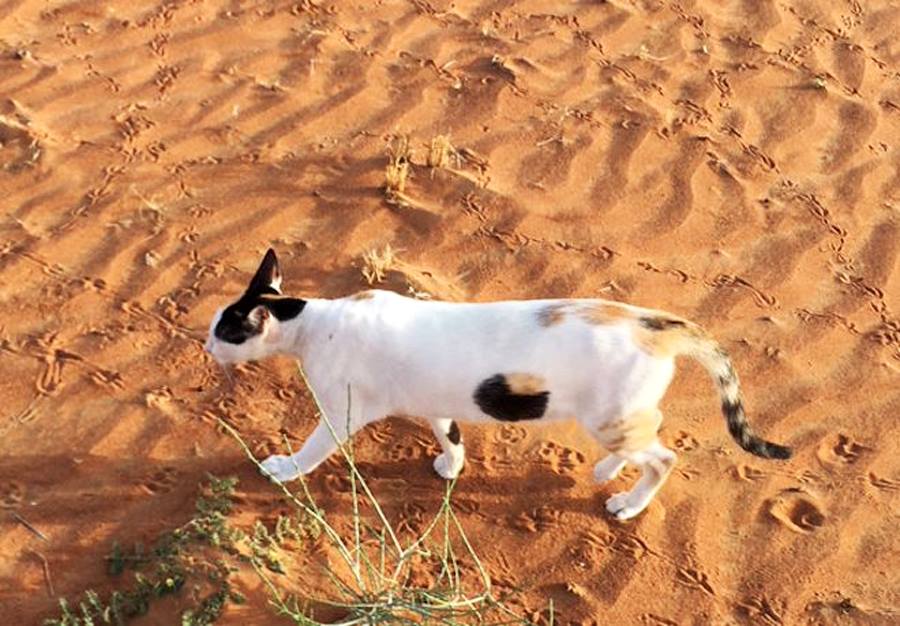
Real world illusion: the hollow cat
Because of his unique ginger and black coloring, this slim cat walking in the desert looks like to have a hole through his body!
Frankenstein’s Dream: Hybrid Picture

This intriguing image is taken from my book “Curiopticals“. Look at Frankenstein from a certain distance – approximately 2-3 meters, or 7-8 feet – and you will see what he is dreaming about. This type of illusion is known as a cryptic or hybrid optical illusion, and is produced by merging two subjects with different resolutions. The result is that one subject is hidden or suggested in the ‘host’ image. Continue Reading
Topsy-turvy Mural
Lithuanian-American artist Ray Bartkus painted during the Malonny art festival an intriguing mural on the side of a building in Marijampolė, Lithuania. It may seem abstract at first glance, but when reflected in the river near the structure, it all makes sense!


The Bullephant, an earliest bistable figure
Visual illusions where you experience two equally possible interchangeable states in perception are called “bistable illusions“. The Necker cube and the Rubin vase are ones of the most classic examples of a bistable figure. I have discovered that all over India, you may see many variants of an interesting bistable depiction, which represents a bull and an elephant with distinct bodies and only one head (painted or sculpted at least 850 years ago). If you look carefully at the whole picture, you may see how the body parts of both animals are skillfully overlapped. For instance, the trunk of the elephant is also the hump of the bull. The horns and ears of the bull have become the mouth or snout of the elephant. These are ones of the earliest documented “ambiguous figure” illusions…
