
Since humans learned to stand upright without wobbling too much, they also learned how to organize confrontation—and how to justify it, which sometimes requires more invention than the act itself.
The archers painted on the rock shelters of the Spanish Levant—particularly in the Castellón region, around sites such as Morella and the Cueva del Roure area—belong to a broad artistic tradition dated to the late Mesolithic and early Neolithic (roughly the 7th to 6th millennia BCE). They are among the earliest narrative images known in Europe. The scenes show hunting in motion, and in some cases have been read as episodes of intergroup conflict.
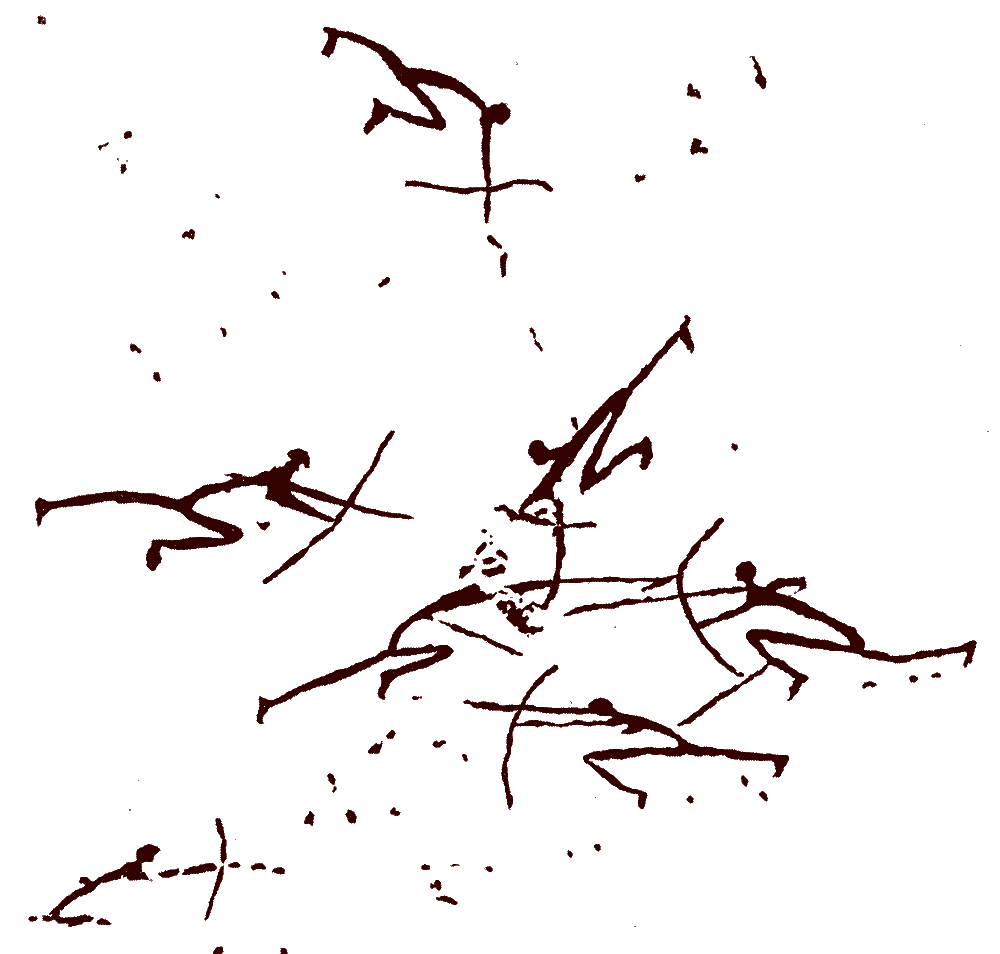
What is clear is not the confirmed presence of war, but the early shaping of its story. From very early on, humans did more than strike—they composed. They organized action into sequence, gave it form, and turned events into something legible. And perhaps that is where the deeper history of power begins: in the ability to convert chaos into composition.
So is war in our DNA?
No. DNA does not encode behavior. It defines capacities that are shaped by culture, history, and environment. Still, it leaves a clear paradox: we are built to cooperate, and we are built to exclude. Early humans lived in tight-knit groups, bound by cooperation, while competing with other groups for resources. That tension likely shaped both empathy and aggression.
The brain still carries traces of it. The amygdala rapidly classifies “us” and “them,” triggering threat responses, while the prefrontal cortex helps regulate and reinterpret them. Culture largely determines which patterns dominate. We see the same mechanism today in digital echo chambers, where similarity is continuously reinforced and difference flattened.
Organized warfare, as we recognize it today, appears relatively late in the archaeological record. Clear and recurring evidence becomes more visible around 14,000–10,000 years ago, and expands with the rise of sedentary and agricultural societies. Homo sapiens, however, has existed for roughly 300,000 years. Across most of that span, the evidence points more toward small-scale, episodic violence rather than sustained, systematized warfare.
War, in this sense, may be less an ancient biological destiny than a comparatively recent cultural development—built upon older cognitive and social instincts.
P.S. Early language systems such as Proto-Indo-European—the reconstructed ancestor behind many European and some South Asian languages—did not rely on a single abstract word for “war.” Conflict was instead described through specific acts like raiding, fighting bands, or disputes. The idea of “war” as a unified concept came much later, which is why Indo-European languages still reflect different, unrelated roots for it today.