“Every abstract idea has a concrete past.”
Have you ever wondered why we call the middle of something its center? The answer lies in a rather unexpected place: the sharp tip of a metal instrument.
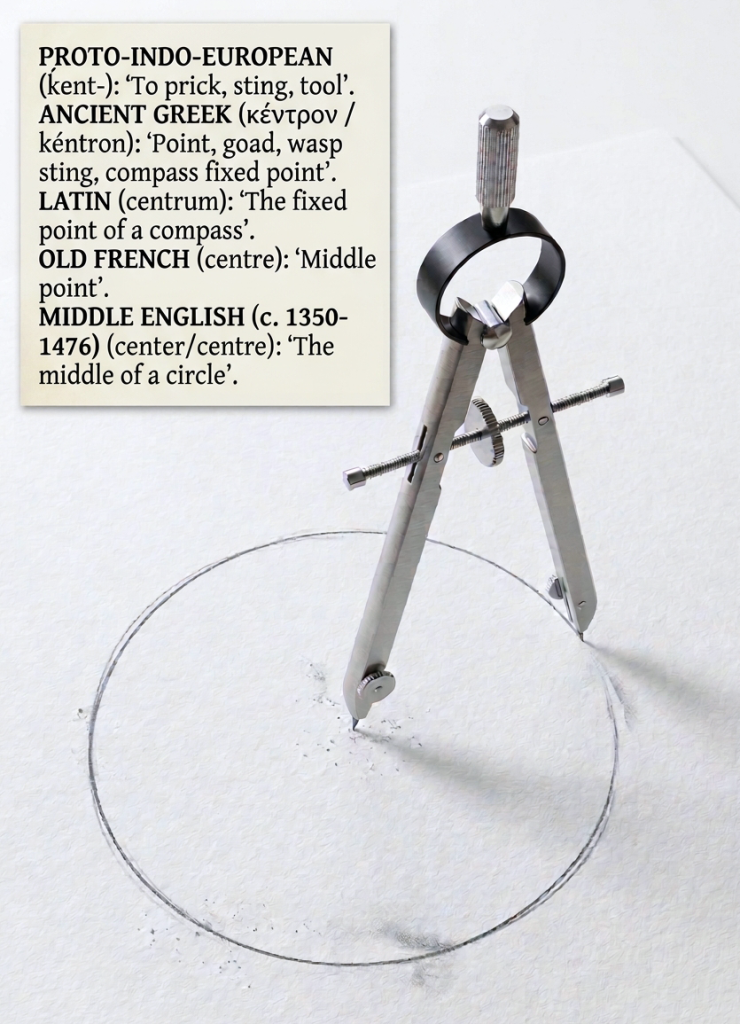
The word center (or centre, in British English) traveled through several languages before acquiring the meaning we know today. It entered English through Middle French centre, which came from the Latin centrum. But the story goes back even further, to the Ancient Greek word κέντρον (kéntron), meaning a sharp point, a spike, a goad, or even the sting of an insect.
In other words, the original meaning of center had very little to do with being in the middle of something. It was about pointing, piercing, and marking a precise spot.
The connection becomes clearer when we consider an instrument that has been used for centuries by mathematicians, architects, and draftsmen: the compass. When drawing a circle, one leg of the compass holds a sharp metal point firmly in place, while the other swings around it, tracing the circumference. That tiny, stationary point is the centrum — the fixed pivot around which the circle takes shape.
Since the sharp point of the compass determines the exact middle of the circle, the word gradually shifted from describing the point itself to describing the position it occupied.
By the late 14th century, centrum had come to mean the middle point of a circle. Then, by the late 16th century, its meaning had expanded further, referring to the middle, heart, or core of virtually anything.
From the sting of an insect to the point of a compass, from the geometry of a circle to the center of our world, the word had traveled a long way.
Well, this is how language often works: it begins with something tangible, something we can touch, see, or experience, and gradually transforms it into an image, an idea, or an abstraction. Even the most familiar words can conceal the memory of a physical world we no longer see behind them.