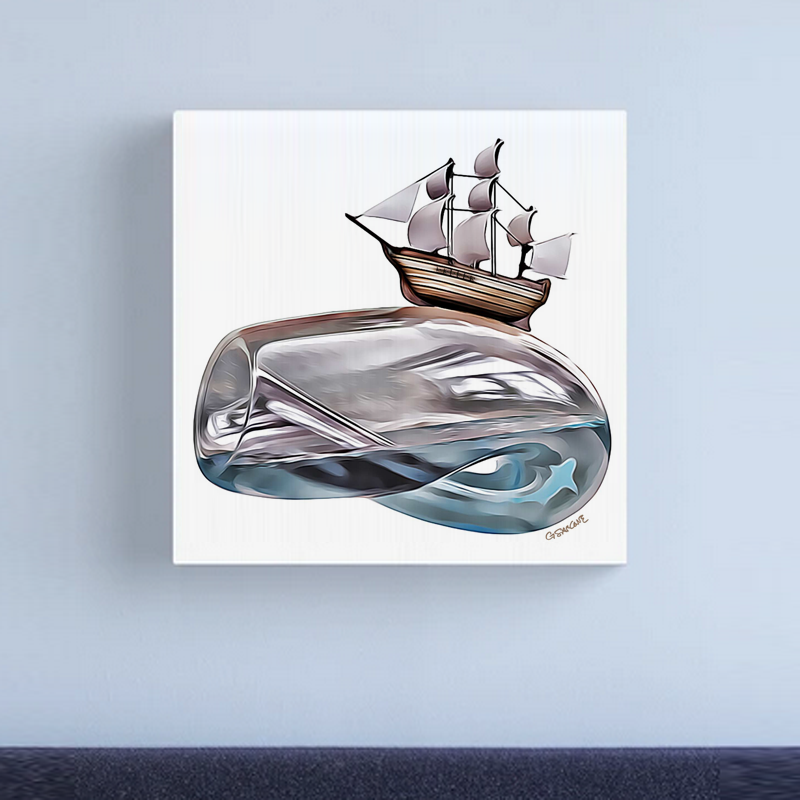
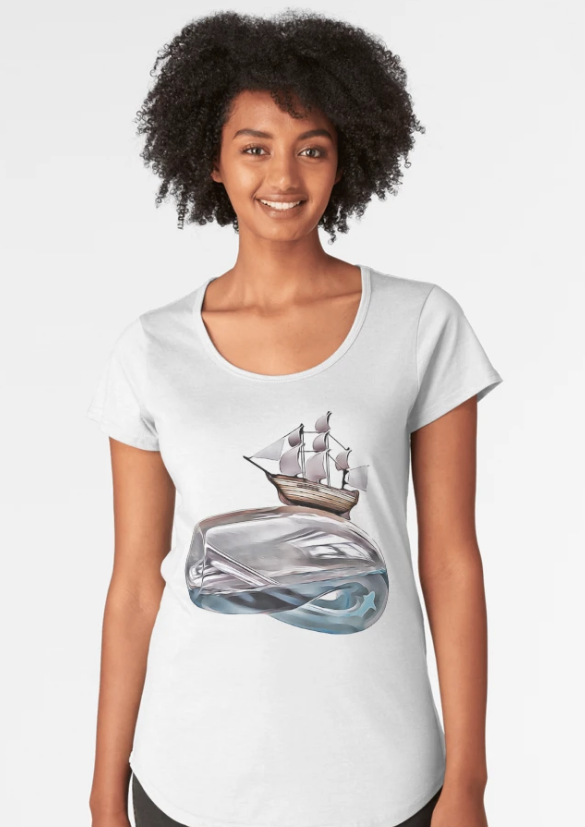
Embarking on a journey in a Klein bottle? Absolutely. A Klein bottle is a mind-bending non-orientable surface, defying the usual inside-outside norms. Technically, the ship’s navigating the interior…
In these minimalist op art works, I explore geometry as metaphor, using the hexagon as a building block for cubes and other regular solids. The forms appear stable and believable, yet they are impossible. Their contradiction isn’t obvious at first; it reveals itself only when the eye slows down and follows the structure closely. By merging incompatible viewpoints and softening the boundary between inside and outside, the drawings turn logic against itself. The more ordinary the form looks, the stronger the effect—these objects are meant less to trick the eye than to unsettle the mind and challenge our sense of space.
The two drawings displayed above and below combine paired tribars to form an impossible isometric cube, where form and illusion lock into a single structure.
Here, the “volume” turns itself inside out, quietly echoing the logic of a Klein bottle and unsettling the usual distinction between interior and exterior.
I am currently in the process of writing an informative book titled “Mastering Optical & Geometric Art: A Journey to Captivating Creations.” With a length of 136 pages, this book serves as an engaging guide to creating visually striking optical art and intricate 2D and 3D patterns. If you are interested in exploring further, I invite you to connect with me on Amazon.
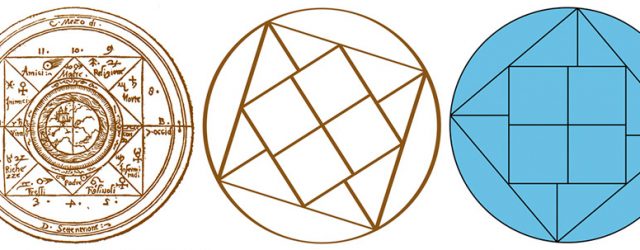
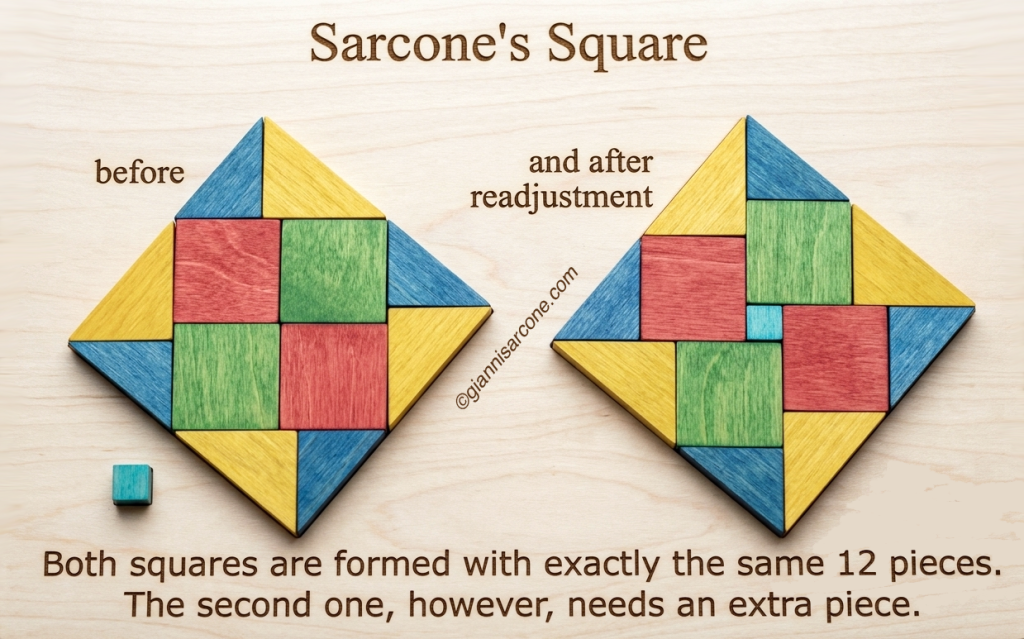
Inspired from the astrological tables, here is a new puzzle of my creation designed according to the ‘Golden Number Rules’, which is reflected in the proportion of each single piece of the game. Thanks to the balanced dimensions of its pieces, this puzzle acquires some intriguing magical properties!
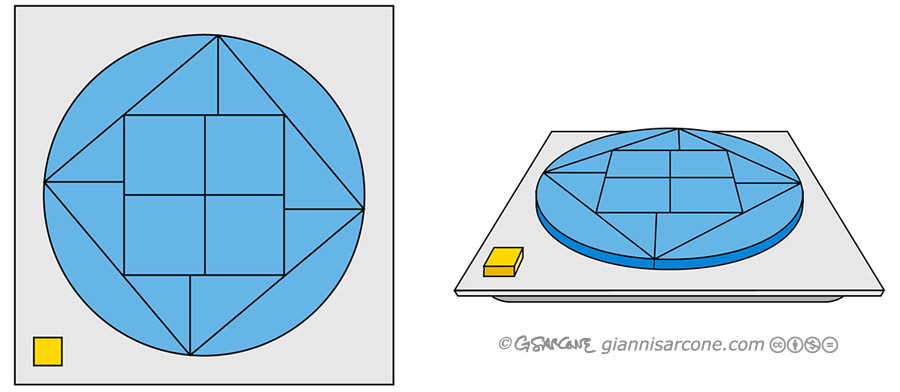
This “math-magical” puzzle is composed of a tray in which the pieces are assembled.
Object of the puzzle game
Fit the small extra piece into the puzzle without apparently altering its original dimensions. All the pieces must lie tight and flat! Impossible? See the solutions below.
The animated demonstration below is more eloquent than all theories. The puzzle shown in the video is a variant made in hard plastic, and cut using water-jet technology with an accuracy/precision of 0.01!
Here’s a wooden version of the puzzle I designed in the late 1990s. Each set of pieces is made in a different color, giving the puzzle a clean, elegant look while making its deceptive geometry even more striking.
I am looking for a game manufacturer able to produce and distribute this incredible puzzle. You can contact me through my website.
☞ Further reading: explore the complete Vanishing Piece Puzzle project on my Behance profile.
A math-magic article I wrote for the German magazine Zeit Wissen: with the 13 triangular and square pieces (fig. 1) it is possible to form two large squares shown in fig. 2. Though the second large square has an extra piece the dimensions of the squares seem to be the same! Can you explain why this is possible?
Here’s a wooden version of the puzzle I designed in the late 1990s. Each set of pieces is made in a different color, giving the puzzle a clean, elegant look while making its deceptive geometry even more striking.
I am looking for a game manufacturer able to produce and distribute this incredible puzzle. You can contact me through my website.
☞ Further reading: explore the complete Vanishing Piece Puzzle project on my Behance profile.
Convex / Concave, it all depends on your point of view! Although the plates are the same, in the second picture, the indents of the egg plate look more like convex domes rather than concave indents.
Obviously not… The closest thing to a “perpetual motion machine” is the Beverly clock whose mechanism is driven by variations in atmospheric pressure, and by daily temperature variations.
This is one of my earliest color optical illusions. There is no yellow or green in the diamond shapes, just vertical black lines! (If you don’t believe it, use a eyedropper tool to check it.) This intriguing visual effect is mainly due to “simultaneouscolor contrast induction“.
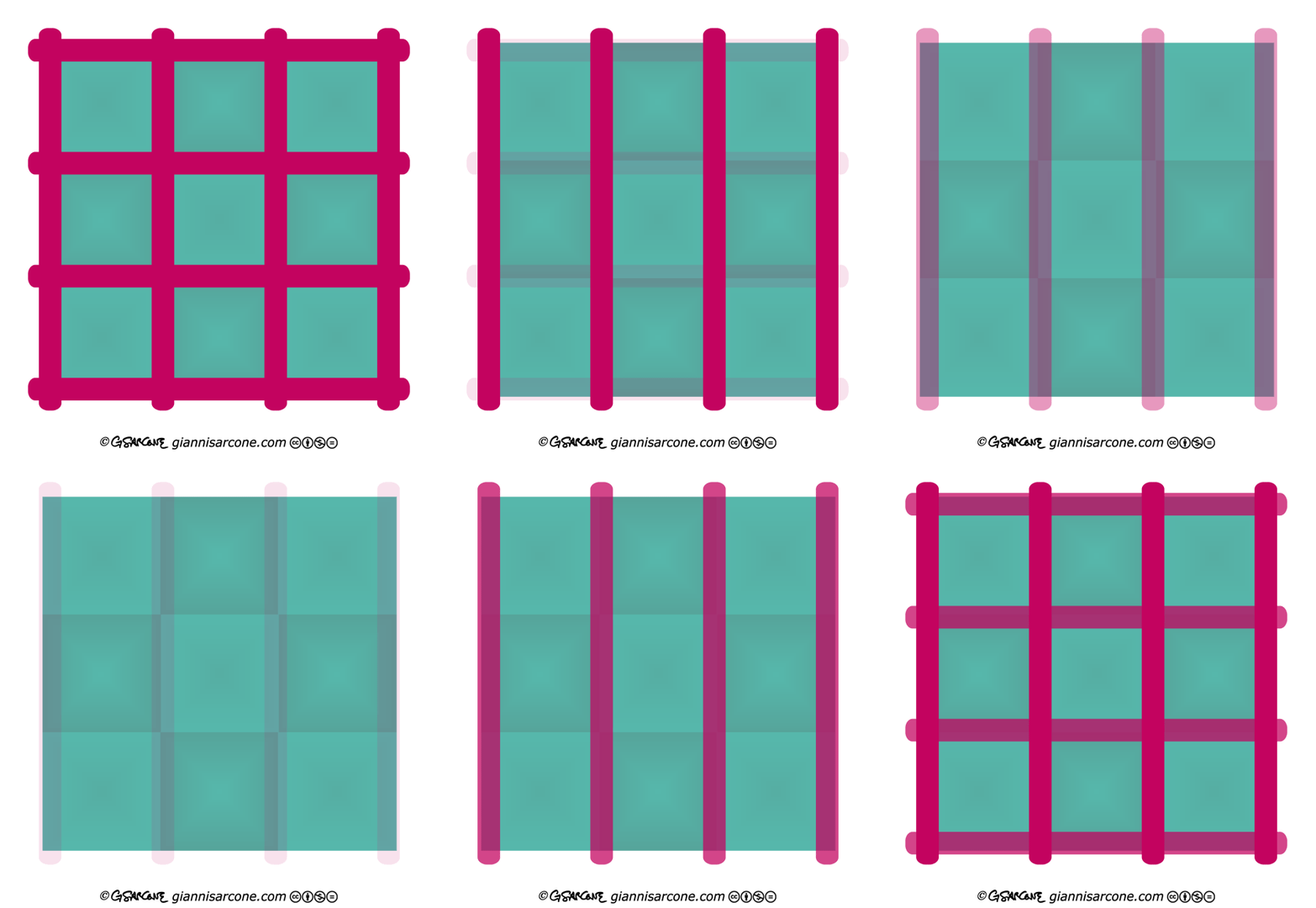
Our visual system can interpret colors and shades in surprising ways. This 3×3 Tic-Tac-Toe grid, for example, showcases how easily our perception of brightness can be fooled.
Do you notice anything unusual in the grid below?
Show / Hide the Trick
The looping animation below brings the illusion to life, revealing the trick in action. That large green square behind the grid isn’t actually uniform—it’s made up of alternating dark and light green squares.
Our visual system works like a “comparative computer”. In fact, we never see colors in isolation, as the appearance of any color is affected by the colors surrounding it. So, under certain conditions, colors that are identical may appear different, while colors that are different may look the same. In our visual system there is a mechanism that enhances the contrast of the outline of an object relative to its background: it is called “lateral inhibition”.
Thus, even small differences in brightness between adjacent zones, or objects, are deliberately increased by our visual system and the brain to better distinguish them. But something strange happens when the brightness boundaries of the color zones are concealed: the cues the brain needs to trigger the lateral inhibition no longer exist and consequently we become blind to variations in color brightness, as shown in the animated gif.
In the example below, in the left column, you can see two apples—one green, one red—appearing as a single solid color with a black cross over them. Now, if we remove the thick black lines, each apple clearly appears divided into four quarters of different shades—even though they are exactly the same in both columns, with and without the black cross.
Here’s a trickier version: with the black grid in place, the large green square appears uniform. Take the grid away, and it turns into a full-on checkerboard…
This occurs because in our visual system there is a mechanism that enhances the contrast of the outline of an object relative to its background: it is called ‘lateral inhibition’. Thus, even small differences in brightness between adjacent zones or objects are deliberately increased by the brain to better distinguish them. So, when the brightness boundaries of the color zones are concealed, the cues the brain needs to trigger the lateral inhibition mechanism no longer exist and consequently we become “blind” to variations in color brightness. The illustrations above have been taken from my book “Drawing Optical Illusions” who was translated in many languages. The book is still available from Amazon.
This eye-catching, colorful book is designed to inspire those artists interested in optical illusions and as an invaluable reference tool for people who to wish to create them. In clear, easy steps, this book shows people how to design a range of original and classic optical illusions and even how to create their own personalized illusions.
Explore My World of Art, Books, and Creative Concepts